हरि सर्वोत्तम । वायु जीवोत्तम | श्री गुरुभ्यो नमः
Introduction
In the revered fifteenth chapter of the Bhagavad Gita, the Lord presents the entire hierarchy of reality in a remarkably concise manner:
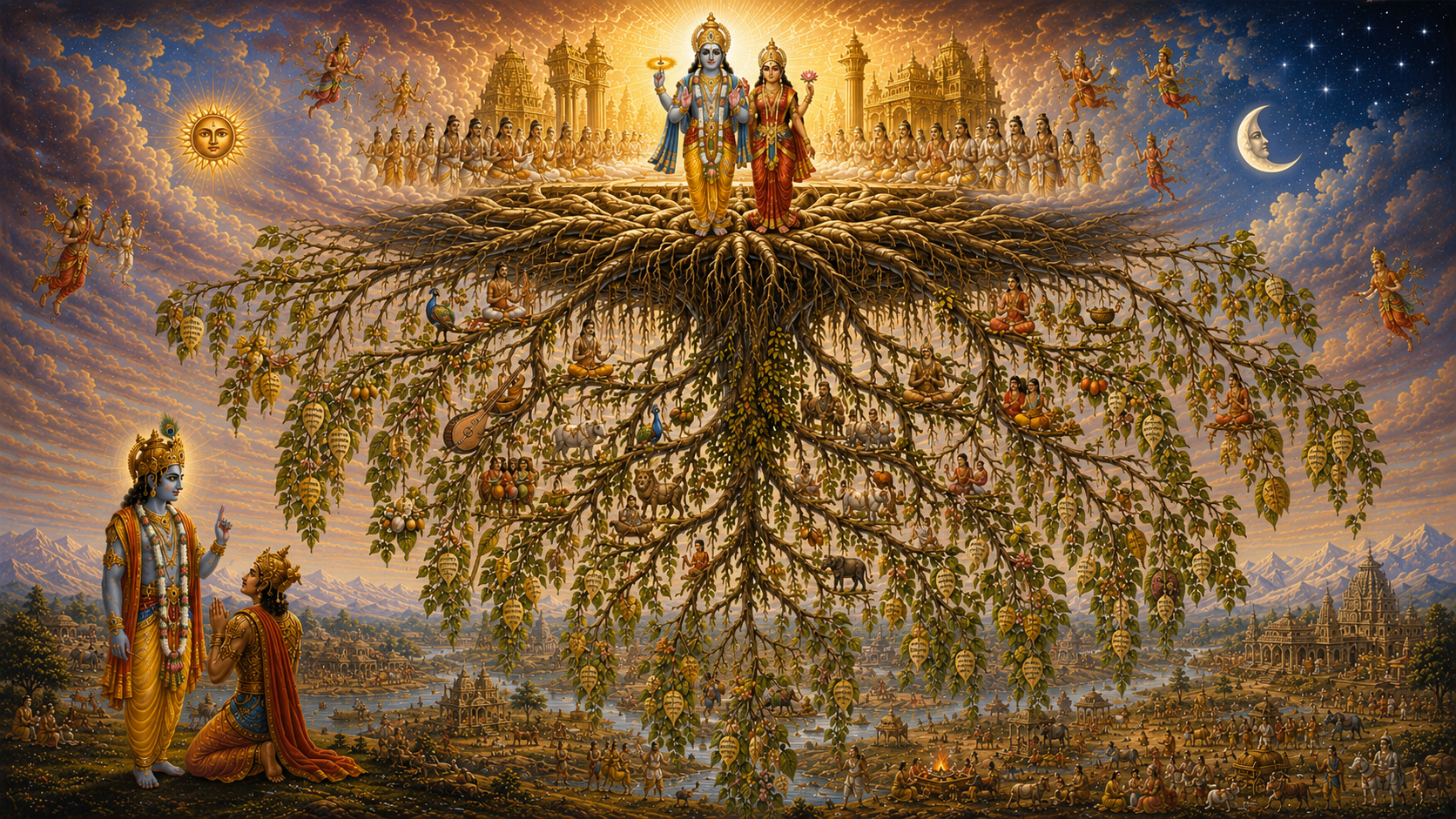
- The world is modeled by an ever-changing Ashvattha tree which is sustained by the Supreme Lord.
- All powers and greatness such as brilliance in Sun, Moon and Fire originate from Him.
- All living beings (Jeevas) are perishable (Kshara) realities dependent on Him as the inner controller of all senses, memory, knowledge and activity.
- The Imperishable (Akshara) Mahaalakshmi is distinct and in charge of the whole Universe as delegated to Her by the Lord.
- Lord alone transcends both Kshara and Akshara and therefore is called Purushottama, the Supreme Person.
- One who understands this correctly becomes a true knower of Shaastra, detaches from the sensory world, develops complete devotion to the Lord, and attains salvation.
This chapter is one of the clearest scriptural declarations of Hari-Sarvottamatva by none other than the Lord Himself. He also describes the eternal hierarchy of Hari, Lakshmi, Jeevas and Prakruti which forms the underpinning of Madhva Siddhaanta.
It is no wonder it is chanted regularly by devotees – as part of daily paaraayaNa, before taking teertha-prasaada meals (at least 15.14 अहं वैश्वानरो भूत्वा …), and especially during Adhika Maasa. This extra lunar month occurs once every 33 months (approx) to realign with the solar year. The Lord assigned his own Purushottama form to this month during which worldly activities are minimized and paarayaNa (esp. Purushottama Yoga, Stotra), japa, dhyaana, daana and other spiritually uplifting activities are prioritized.
अथ पञ्च-दशः अध्यायः
अथ पुरुषोत्तम-योगः (Meaning)
श्री-भगवान् उवाच
ऊर्ध्व-मूलम् अधः-शाखम् अश्वत्थं प्राहुः अव्ययम् ।
छन्दांसि यस्य पर्णानि यः तं वेद सः वेद-वित् ॥ १५.१ ॥
The Lord said:
It is said (प्राहुः) that this world is called the indestructible (अव्ययम्) Ashvattha tree (अश्वत्थम्) – so called because it does not remain tomorrow as it is today and is constantly changing – and has upward roots (ऊर्ध्व-मूलम्) which are the Supreme ones, Vishnu, the intelligent and nonintelligent Prakruti; and that its downward branches (अधः-शाखम्) are the inferior entities viz., the five Bhootas, Mahat, Ahankaara and Buddhi Tattvas; and that its leaves (पर्णानि) are the Vedas (छन्दांसि). He who knows (वेद) that tree (तम्), is the knower of the Vedas (वेद-वित्).
- Ashvattha = अ श्वः स्थ = “that which does not remain the same tomorrow,” indicating the ever-changing nature of Samsaara.
- The Vedas are compared to leaves because they nourish understanding of the tree and reveal its true nature.
अधः च ऊर्ध्वं प्रसृताः तस्य शाखाः गुण-प्रवृद्धाः विषय-प्रवालाः ।
अधः च मूलानि अनु-सन्ततानि कर्म-अनुबन्धीनि मनुष्य-लोके ॥ १५.२ ॥
The branches (शाखाः) of that tree, nourished (प्रवृद्धाः) by the Gunas (गुण), of which the objects of the senses (विषयाः) are the tender sprouts (प्रवालाः), are spread (प्रसृताः) downwards (अधः) connected with the bodies — and upwards (ऊर्ध्वम्) connected with the Prakruti, their original cause. The roots (मूलानि) of this tree spread completely (अनु-सन्ततानि) over the branches and yield fruits in accordance with Karma (कर्म-अनुबन्धीनि) in the world of human beings (मनुष्य-लोके).
- The “sprouts” represent sense objects because they entice the Jeeva into further involvement with Samsaara.
- Karma is not independent but operates under the Lord’s supervision binding the Jeeva to the tree of worldly existence.
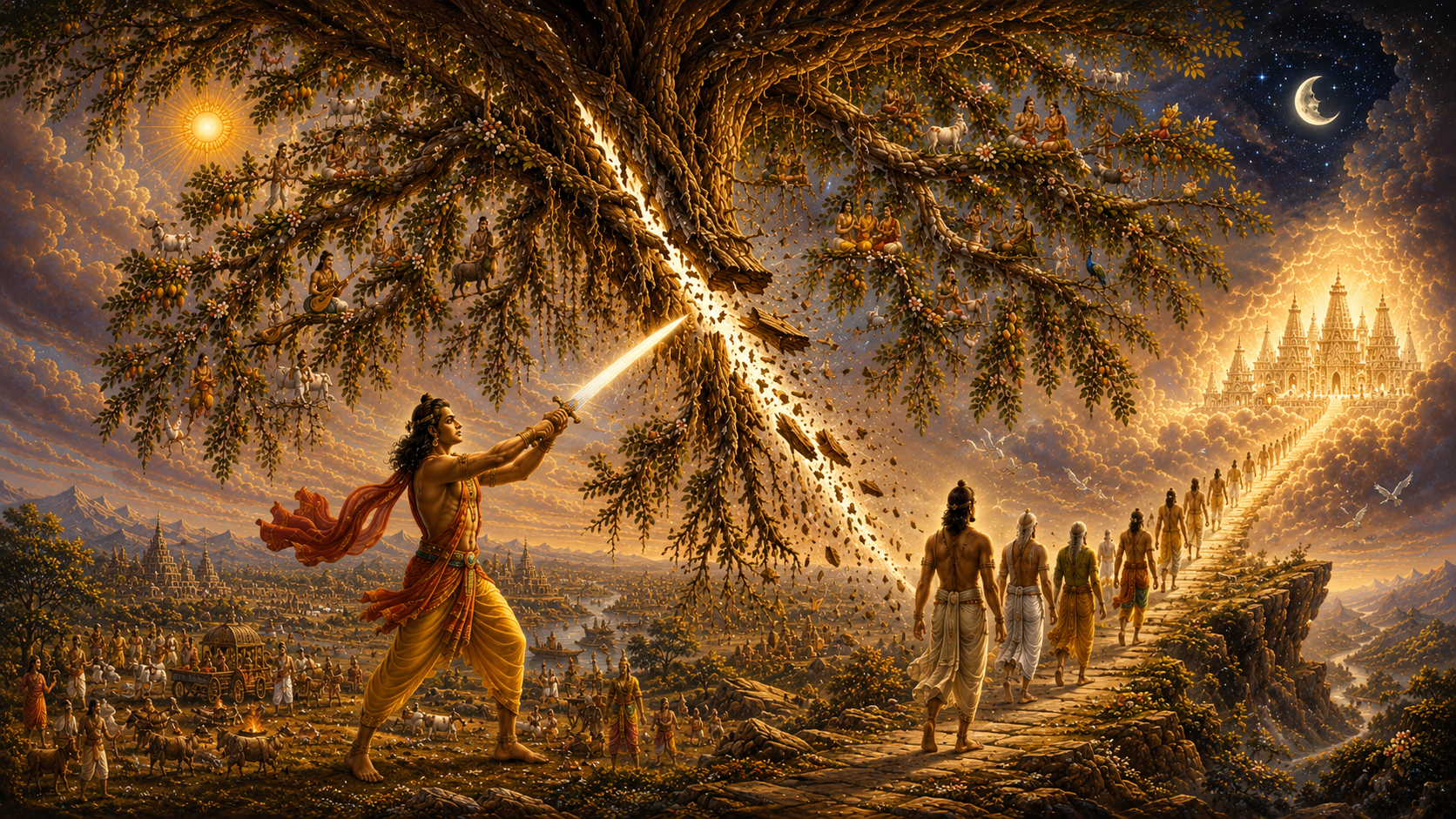
न रूपम् अस्य इह तथा उपलभ्यते न अन्तः न च आदिः न च सम्प्रतिष्ठा ।
अश्वत्थम् एनं सु-विरूढ-मूलं असङ्ग-शस्त्रेण दृढेन छित्त्वा ॥ १५.३ ॥
ततः पदं तत् परि-मार्गितव्यं यस्मिन् गताः न निवर्तन्ति भूयः ।
तम् एव च आद्यं पुरुषं प्रपद्ये यतः प्रवृत्तिः प्रसृता पुराणी ॥ १५.४ ॥
The nature (रूपम्) of this world-tree (अश्वत्थम्) is not perceived (न उपलभ्यते), as it is ever undergoing modifications; nor is that Lord perceived Who is the Beginning (आदिः) and End (अन्तः) of this Universe though He has well entered into the tree of the Universe. This Ashvattha tree (अश्वत्थम्), which is firmly established (सु-विरूढ-मूलम्), is to be cut (छित्त्वा) by the knife (शस्त्रेण) of knowledge born out of non-attachment (असङ्ग) — i.e. it should be well understood that God and Prakruti are different and that this changeable universe is ever subordinate to God.
Thereafter (ततः), that Brahman (तत् पदम्), after attaining Whom the souls do not return back (न निवर्तन्ति) to this world, should be sought after (परि-मार्गितव्यम्) by studying, thinking and contemplating so that one may be directly released. That original (आद्यं) Purusha (पुरुषम्), from whom (यतः) streamed forth (प्रसृता) the original current (पुराणी प्रवृत्तिः) of Samsara, should be resorted to (प्रपद्ये).
- Note the eternal distinction between Hari, Lakshmi, Jeevas and Prakruti, which is the cornerstone of Tattvavaada Philosophy.
- Asanga (असङ्ग) does not mean abandonment of duties, but freedom from false attachment to body, possessions and worldly status.
- The “cutting” is through correct knowledge (तत्त्व-ज्ञान), not physical renunciation or artificial abstinence.
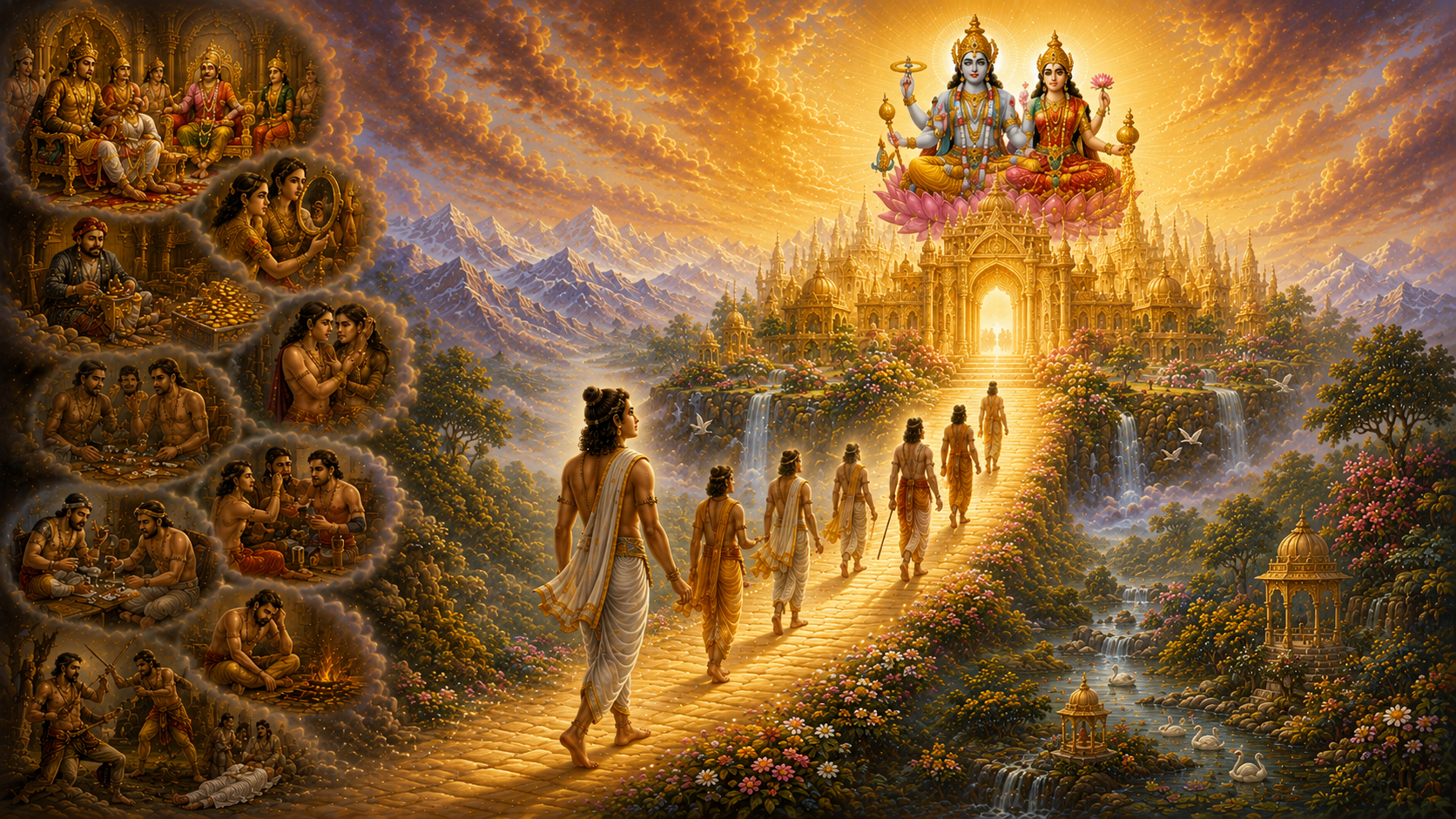
निर्-मान-मोहाः जित-सङ्ग-दोषाः अध्यात्म-नित्याः विनिवृत्त-कामाः ।
द्वन्द्वैः विमुक्ताः सुख-दुःख-संज्ञैः गच्छन्ति अमूढाः पदम् अव्ययं तत् ॥ १५.५ ॥
Those who are free from pride (निर्मानाः) and delusion (मोहाः), who have conquered (जित) the evil (दोष) of attachment (सङ्ग), who are constantly devoted (नित्याः) to the Supreme Lord (अध्यात्म), whose sensual desires (कामाः) have completely disappeared (विनिवृत्त), and who are free (विमुक्ताः) from the pairs of opposites (द्वन्द्वैः) such as gain and loss, success and defeat, pleasure and pain (सुख-दुःख-संज्ञैः), and who get over delusion caused by Rajas and Tamas, attain (गच्छन्ति) that imperishable (अव्ययम्) Supreme State (पदम्) of Moksha.
- Moksha is not merger into Brahman; it is eternal blissful service to the Supreme Lord according to one’s intrinsic capacity.
- Nir-maana (निर्मान) means absence of false self-importance, not lack of self-respect.
- Adhyaatma-nitya (अध्यात्म-नित्य) indicates knowing one’s own dependent nature and thus constantly contemplating on the Supreme Lord while doing one’s duties.
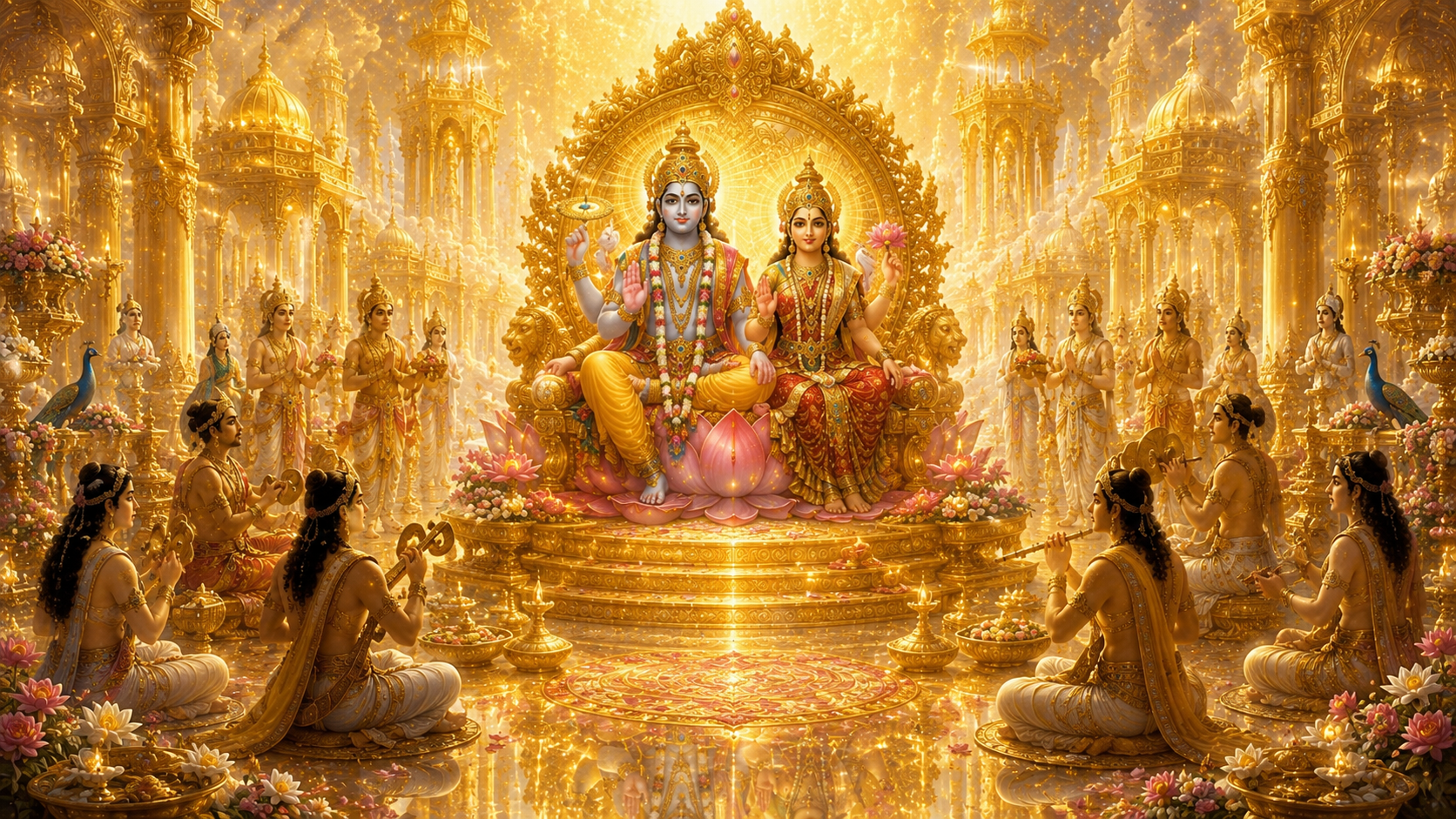
न तत् भासयते सूर्यः न शशाङ्कः न पावकः ।
यत् गत्वा न निवर्तन्ते तत् धाम परमं मम ॥ १५.६ ॥
The Sun (सूर्यः) does not illuminate (न भासयते) that Divine form (तत् धाम), nor the Moon (शशाङ्कः), nor fire (पावकः); having reached (गत्वा) that Supreme (परमम्) form (धाम) of Mine (मम), they do not return (न निवर्तन्ते) to Samsara.
- The Lord’s supreme abode is self-luminous and does not depend upon any external source of light.
- “Dhaama” here can indicate both the Lord’s divine abode and also His transcendental form.
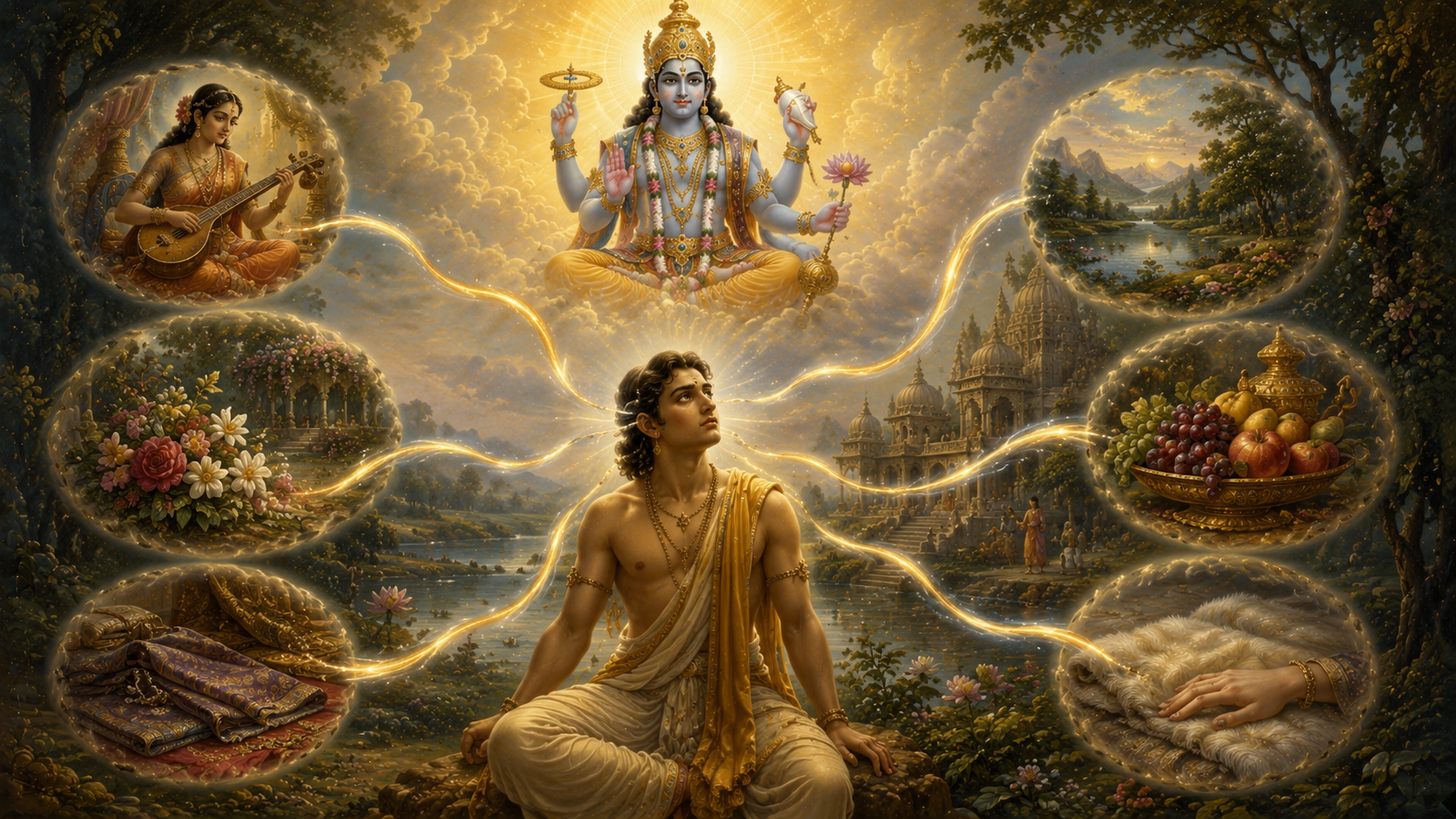
मम एव अंशः जीव-लोके जीव-भूतः सनातनः ।
मनः-षष्ठानि इन्द्रियाणि प्रकृति-स्थानि कर्षति ॥ १५.७ ॥
The entities (जीव-भूतः) that dwell in embodied existence (जीव-लोके) are eternal (सनातनः) and are separate dependent-entities (अंशः) of Mine (मम एव) — being similar to Me. That Jeeva draws (कर्षति) towards sense objects the senses (इन्द्रियाणि), which are six in number (षष्ठानि) including the mind (मनः), and which rest in Prakruti (प्रकृति-स्थानि).
- The similarity between Lord and Jeeva is limited and does not imply equality at any time. The Jeeva is eternally distinct from the Lord, and always dependent upon Him.
- “Amsha” indicates that the dependent Jeeva draws its powers from the independent Lord – not that the Jeeva is a physical part cut off from Lord.
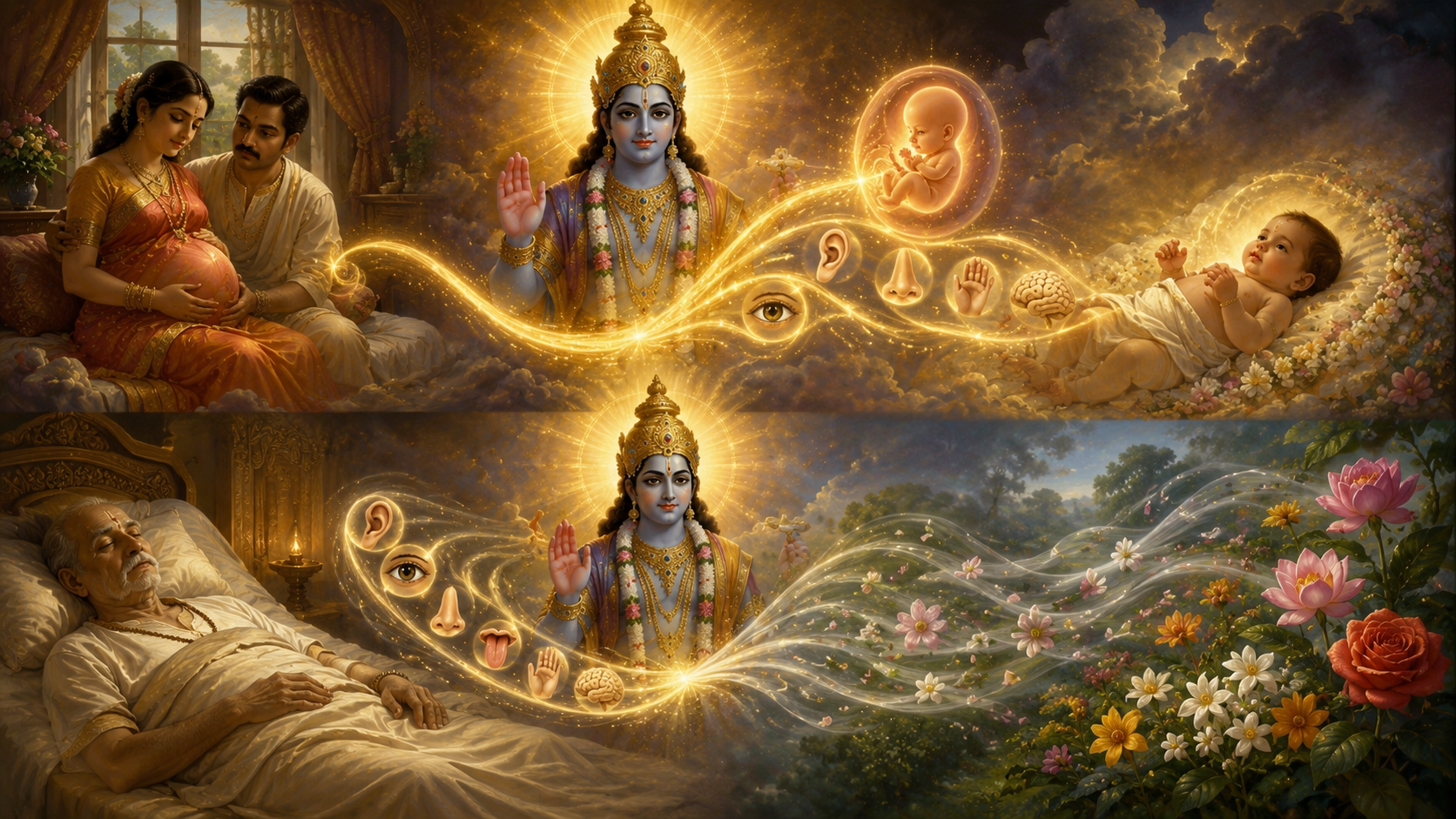
शरीरं यत् अवाप्नोति यत् च अपि उत्क्रामति ईश्वरः ।
गृहीत्वा एतानि संयाति वायुः गन्धान् इव आशयात् ॥ १५.८ ॥
The Lord (ईश्वरः) carries with Him the six senses (एतानि) along with the Jeeva both at the time of entry into the Jeeva’s body (शरीरं अवाप्नोति) and departure therefrom (उत्क्रामति), just as the wind (वायुः) carries (संयाति) fragrance (गन्धान्) from flowers, their abode (आशयात्).
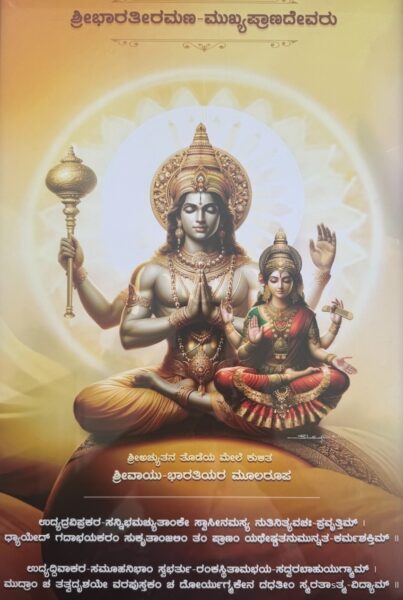
- The mention of Vaayu is not merely an analogy, but indicates that Lord Mukhyapraana is in charge of enablement and embodiment of the Jeeva’s life force.
- Similarly, the senses do not function independently; they remain under the Lord’s supervision controlled by respective assigned deities, under Mukhyapraana’s regulation as well.
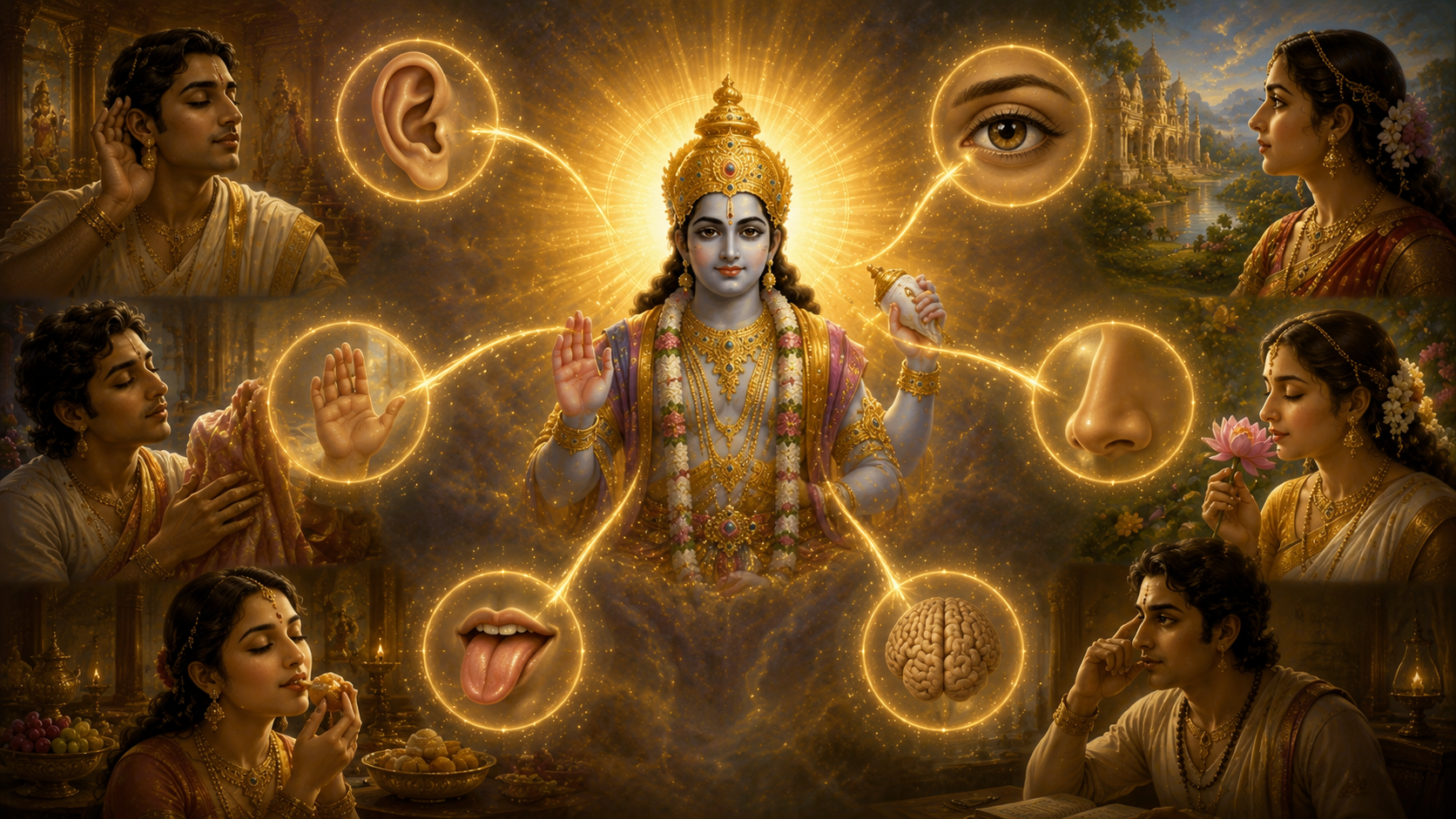
श्रोत्रं चक्षुः स्पर्शनं च रसनं घ्राणम् एव च ।
अधिष्ठाय मनः च अयं विषयान् उपसेवते ॥ १५.९ ॥
Standing as the guide (अधिष्ठाय) in the ear (श्रोत्रम्), eye (चक्षुः), touch (स्पर्शनम्), taste (रसनम्), smell (घ्राणम्), and mind (मनः), the Lord (अयम्) enjoys (उपसेवते) the objects of the senses (विषयान्).
- The Lord is the inner controller (अन्तर्यामि) of all senses – every act of perception is possible only because He empowers the sense organs.
- “Enjoys” only means the Lord presides over and enables all experiences for the Jeeva. He is of the innate nature of infinite bliss and has no need to experience any external joy.
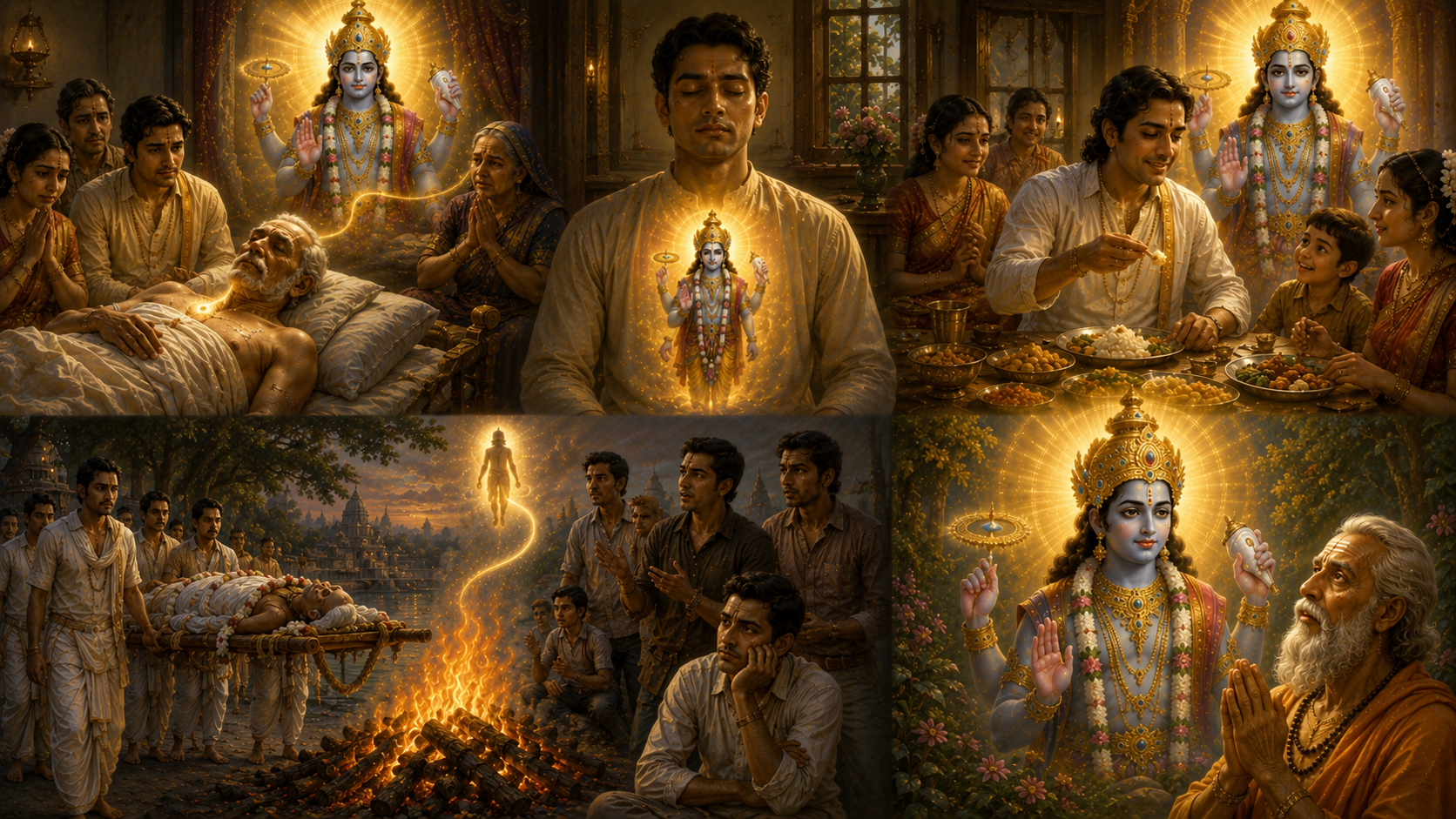
उत्क्रामन्तं स्थितं वा अपि भुञ्जानं वा गुण-अन्वितम् ।
विमूढाः न अनुपश्यन्ति पश्यन्ति ज्ञान-चक्षुषः ॥ १५.१० ॥
The deluded (विमूढाः) do not perceive (न अनुपश्यन्ति) Him when He departs (उत्क्रामन्तम्) from this body, or stays within it (स्थितम्), or enjoys (भुञ्जानम्) that which is excellent (गुण-अन्वितम्). Those, however, who possess the eye of wisdom (ज्ञान-चक्षुषः), perceive Him (पश्यन्ति).
- The ignorant see only bodily functions and material causes while the wise perceive the Lord’s presence behind every activity of life.
- ज्ञान चक्षुषः refers to those with scripturally grounded insight, not just intellectual knowledge.
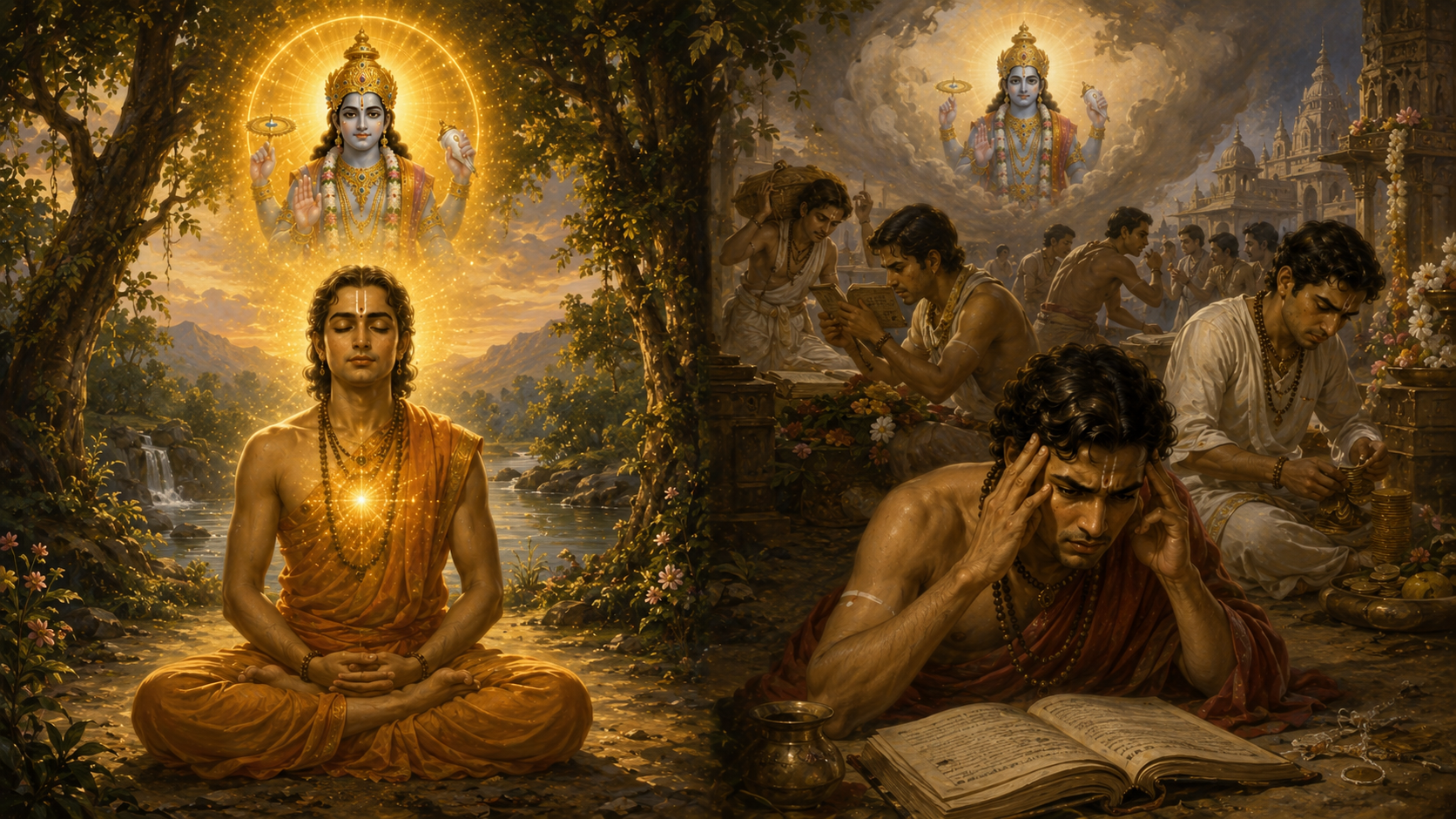
यतन्तः योगिनः च एनं पश्यन्ति आत्मनि अवस्थितम् ।
यतन्तः अपि अकृत-आत्मानः न एनं पश्यन्ति अचेतसः ॥ १५.११ ॥
Yogis (योगिनः) that strive (यतन्तः), perceive (पश्यन्ति) Him (एनम्) residing (अवस्थितम्) in their self (आत्मनि), but those ignorant persons (अचेतसः) whose minds are impure (अकृत-आत्मानः) do not see Him (न पश्यन्ति) though they strive (यतन्तः अपि).
- Effort and austerity alone are inadequate without correct understanding – which is why realization is ultimately dependent upon devotion and the Lord’s grace.
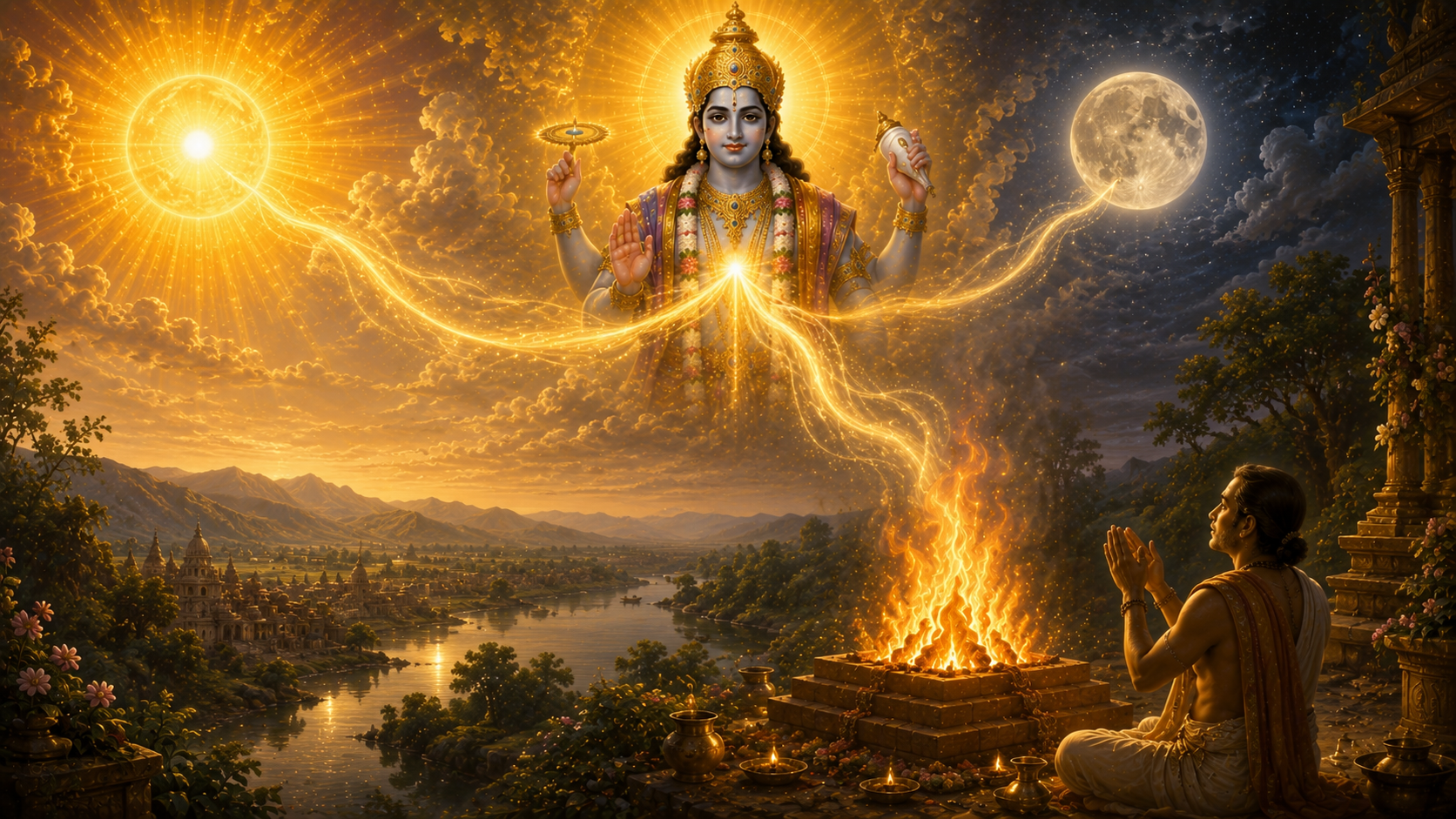
यत् आदित्य-गतं तेजः जगत् भासयते अखिलम् ।
यत् चन्द्रमसि यत् च अग्नौ तत् तेजः विद्धि मामकम् ॥ १५.१२ ॥
That lustre (तेजः) in the Sun (आदित्य-गतम्) which illuminates (भासयते) the whole world (अखिलं जगत्), that which is in the Moon (चन्द्रमसि), that which is in the Fire (अग्नौ), know (विद्धि) them all (तत् तेजः) to be Mine (मामकम्) — as being under My control and emanated from Me.
- Greatness seen anywhere originates from the Lord. So this verse does not teach identity of the Sun, Moon and Fire with the Lord – just that all such brilliance is derived from Him and exists entirely under His control.
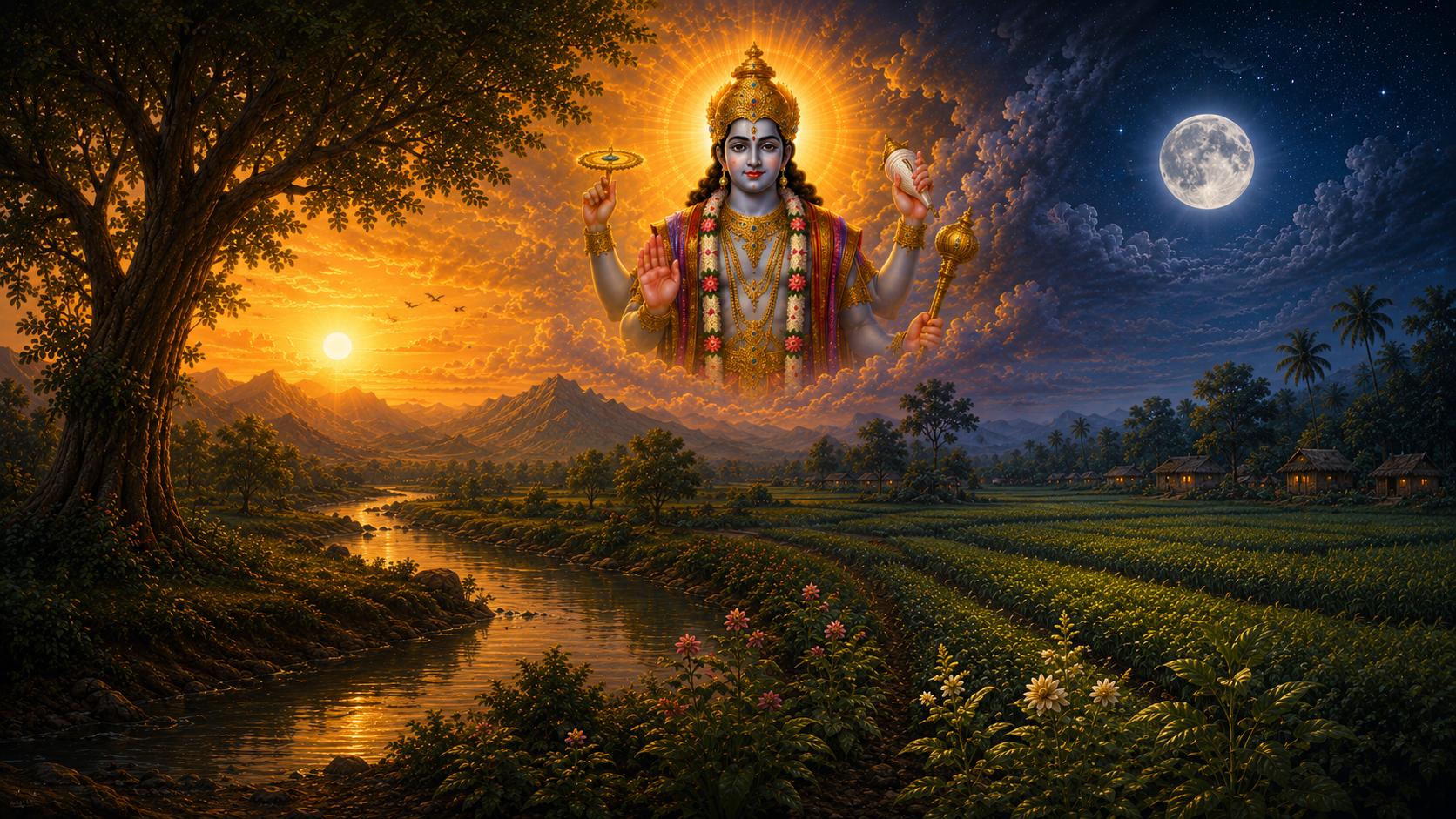
गाम् आविश्य च भूतानि धारयामि अहम् ओजसा ।
पुष्णामि च औषधीः सर्वाः सोमः भूत्वा रस-आत्मकः ॥ १५.१३ ॥
Entering into (आविश्य) the earth (गाम्), I (अहम्) support (धारयामि) all beings (भूतानि) by My Vital Energy (ओजसा); and being (भूत्वा) in Moon (सोमः), who is of the nature of ambrosia (रस-आत्मकः), I nourish (पुष्णामि) all plants (सर्वाः औषधीः).
- Growth of crops and vegetation – and consequently all life – depends upon the Lord’s presence and sustaining power operating within the Earth.
- “Soma” refers not merely to the physical moon here, but to the nourishing divine principle associated within.
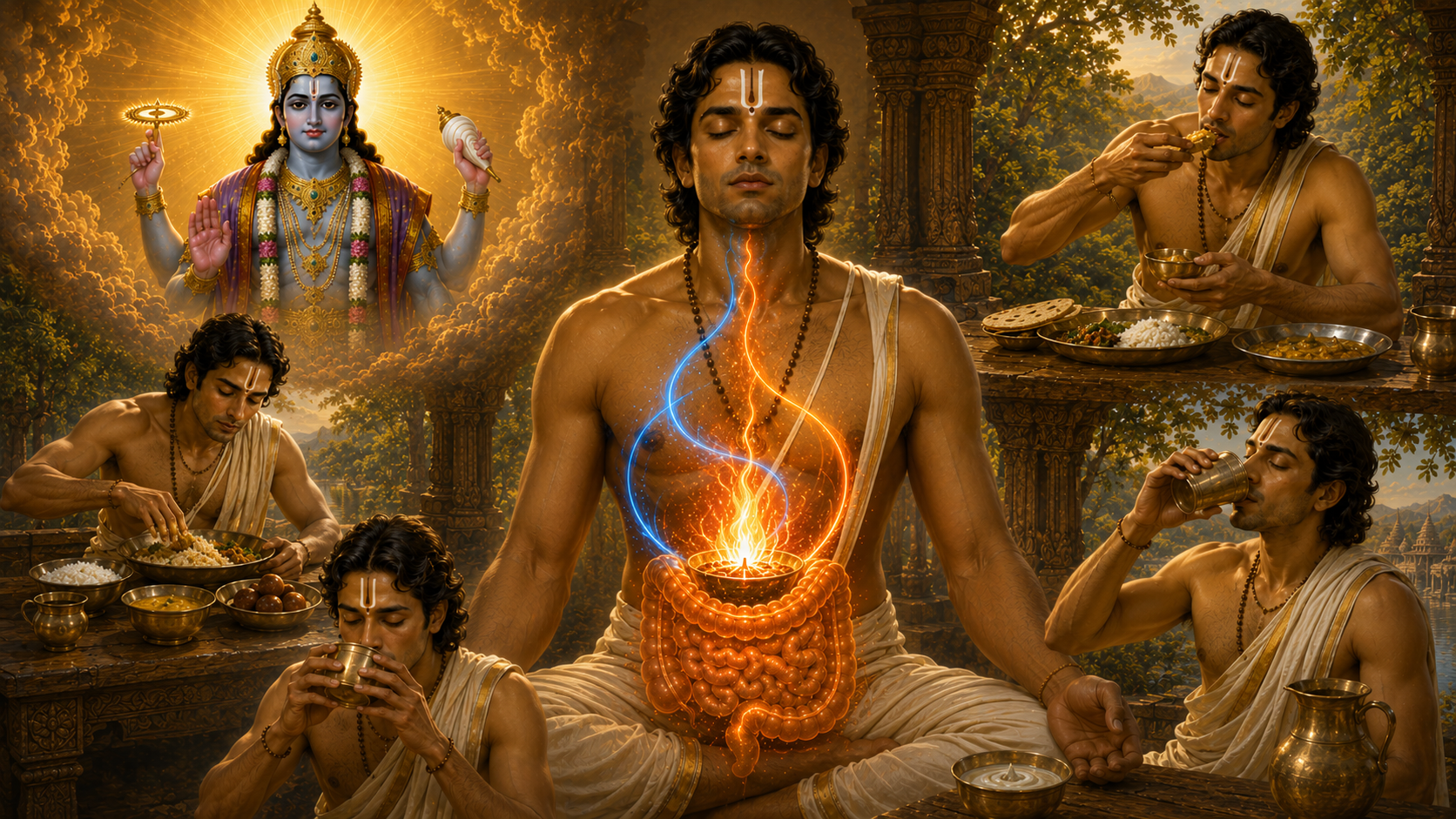
अहं वैश्वानरः भूत्वा प्राणिनां देहम् आश्रितः ।
प्राण-अपान-समायुक्तः पचामि अन्नं चतुर्विधम् ॥ १५.१४ ॥
Under the name of Vaishvaanara (वैश्वानरः) — Who is Agni in every one’s stomach — and residing in (आश्रितः) the bodies (देहम्) of living beings (प्राणिनाम्), united with (समायुक्तः) Praana and Apaana (प्राण-अपान), the life-breath forms of Mukhyapraana, I digest (पचामि) the four kinds of food (चतुर्विधम् अन्नम्).
- The four kinds of food are traditionally: chewable (भक्ष्य), eatable/swallowable (भोज्य), lickable (लेह्य), drinkable (पेय).
- Digestion is not merely a physiological process. It is the Lord’s presence as Vaishvaanara (along with Mukhyapraana) that converts food to life-sustaining energy.
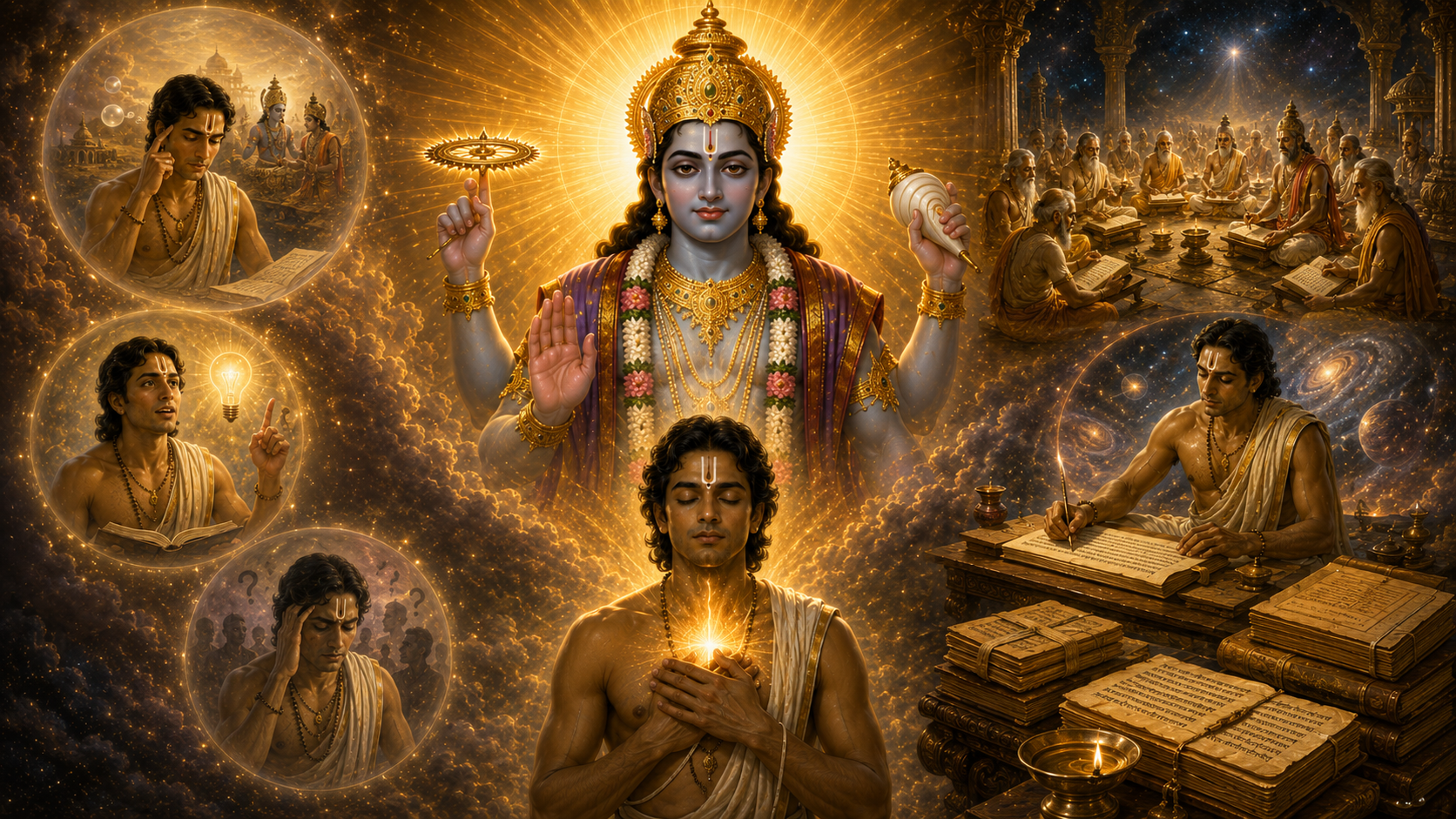
सर्वस्य च अहं हृदि सन्निविष्टः मत्तः स्मृतिः ज्ञानम् अपोहनं च ।
वेदैः च सर्वैः अहम् एव वेद्यः वेदान्त-कृत् वेद-वित् एव च अहम् ॥ १५.१५ ॥
I am lodged (सन्निविष्टः) in the hearts (हृदि) of all (सर्वस्य); from Me (मत्तः) proceed memory (स्मृतिः), knowledge (ज्ञानम्) and misapprehension (अपोहनम्). I am indeed (अहम् एव) He who is to be known (वेद्यः) by all (सर्वैः) the Vedas (वेदैः); I am the author (वेदान्त-कृत्) of Vedaanta (the Brahmasootras which give the correct interpretation of all Vedas), and I alone (अहम् एव) possess the knowledge (वेद-वित्) of what the Vedas proclaim.
- “वेदैश्च सर्वैरहमेव वेद्यः” is one of the clearest declarations of Hari-Sarvottamatva in the Gita: all Vedic study ultimately culminates in knowledge of
e Supreme Lord.
द्वौ इमौ पुरुषौ लोके क्षरः च अक्षरः एव च ।
क्षरः सर्वाणि भूतानि कूट-स्थः अक्षरः उच्यते ॥ १५.१६ ॥
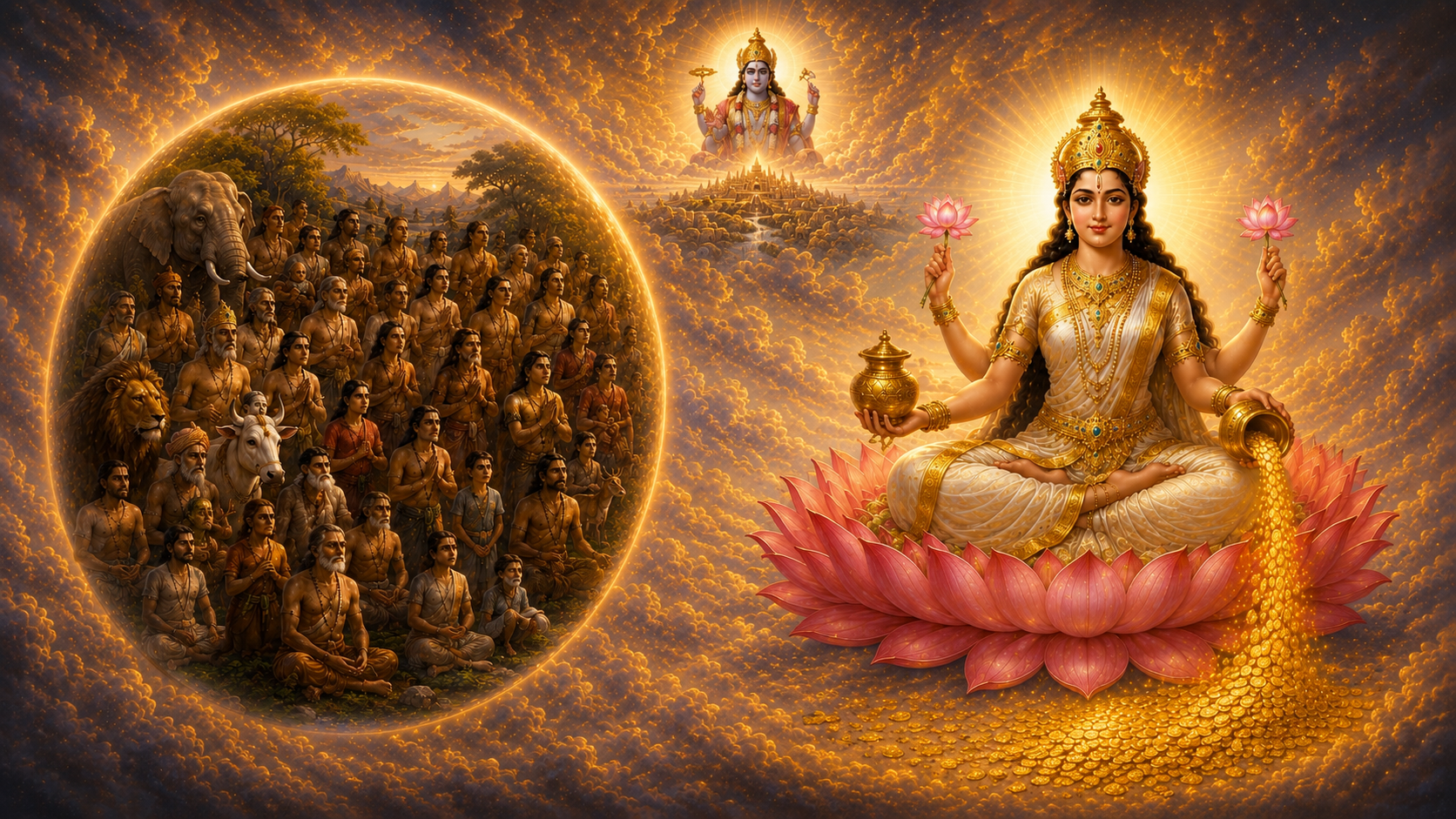
In this world (लोके), there are two kinds (द्वौ इमौ) of Purushas (पुरुषौ) — the Kshara (क्षरः), the perishable, comprising all beings (सर्वाणि भूतानि); and the Akshara (अक्षरः), the imperishable, who is unchanging (कूट-स्थः) like the sky.
- This verse distinguishes Mahaalakshmi and places her above all Jeevas from Brahma downwards, i.e. the Ksharas (क्षराः) whose physical bodies undergo change and perish.
- Akshara (अक्षरः) is Mahaalakshmi, who is free from decay and change, and is therefore called imperishable. Note the use of masculine gender to emphasize activity, power and lordship.
उत्तमः पुरुषः तु अन्यः परम-आत्मा इति उदाहृतः ।
यः लोक-त्रयम् आविश्य बिभर्ति अव्ययः ईश्वरः ॥ १५.१७ ॥
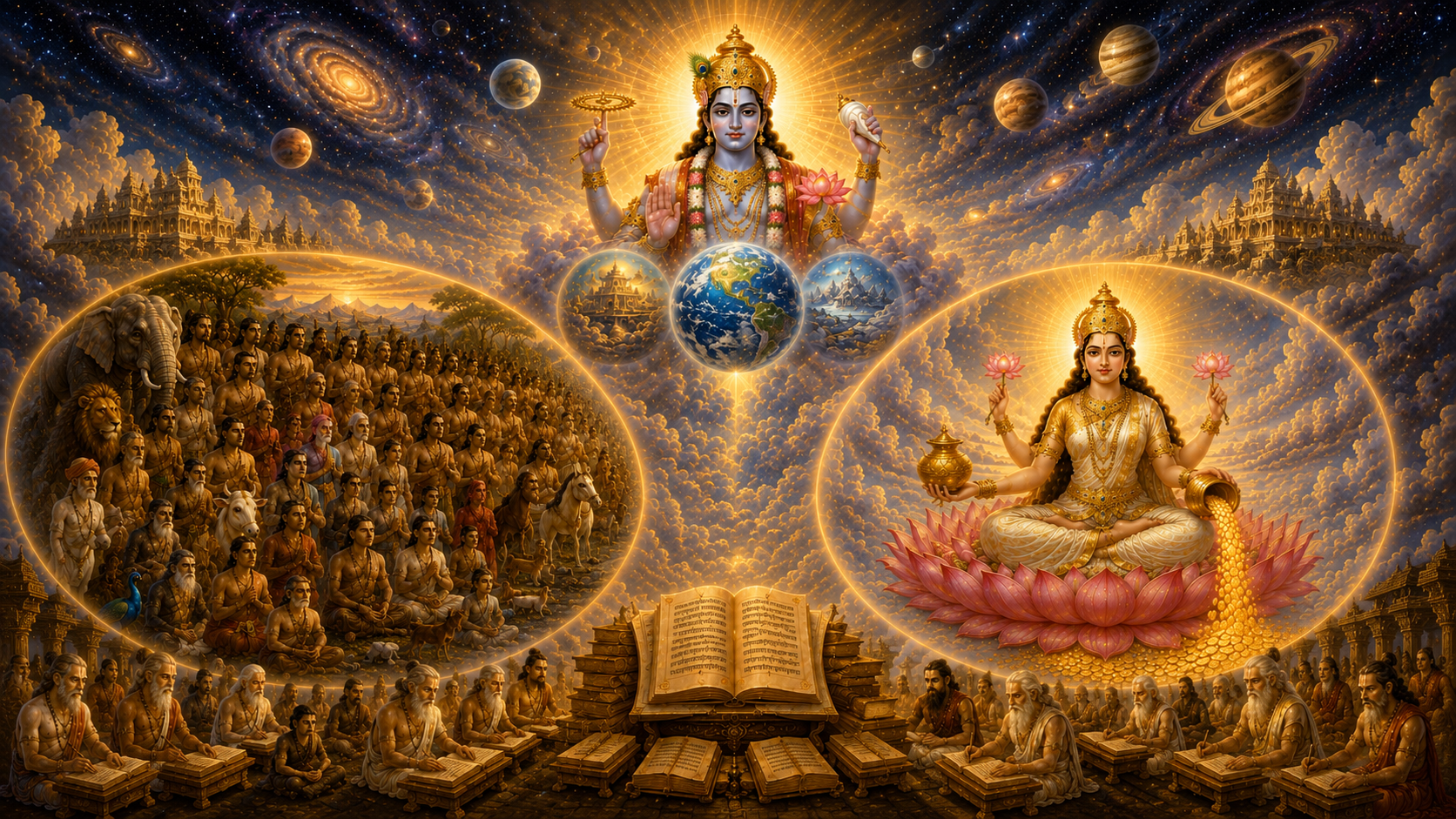
The most exalted person (उत्तमः पुरुषः) is different (अन्यः) from both Kshara and Akshara and is described (उदाहृतः) as Paramaatman (परम-आत्मा), the Supreme Lord. He (यः), entering (आविश्य) the three worlds (लोक-त्रयम्), sustains (बिभर्ति) them and is the Imperishable (अव्ययः) Ruler (ईश्वरः) of Supreme Powers that stagger imagination.
- “Anyah” (अन्यः) explicitly clarifies that there is no equality or oneness – the Supreme Lord is distinct from both Kshara (all Jeevas) and Akshara (Mahalakshmi).
यस्मात् क्षरम् अतीतः अहम् अक्षरात् अपि च उत्तमः ।
अतः अस्मि लोके वेदे च प्रथितः पुरुषोत्तमः ॥ १५.१८ ॥
For the reason that (यस्मात्) I (अहम्) surpass (अतीतः) the Kshara (क्षरम्), the perishable, and that I am far superior (उत्तमः) even to (अपि) Akshara (अक्षरात्), the imperishable Mahaalakshmi, therefore (अतः) I am known (प्रथितः) as Purushottama (पुरुषोत्तमः), both in the world (लोके) of works written by the seers and in the Vedas (वेदे).
- “Purushottama” literally means “the Supreme among all persons.”
- The Lord is superior not only to all Jeevas but even to Mahaalakshmi – who remains eternally the highest among all dependent beings.
यः माम् एवम् असम्मूढः जानाति पुरुषोत्तमम् ।
सः सर्व-वित् भजति माम् सर्व-भावेन भारत ॥ १५.१९ ॥
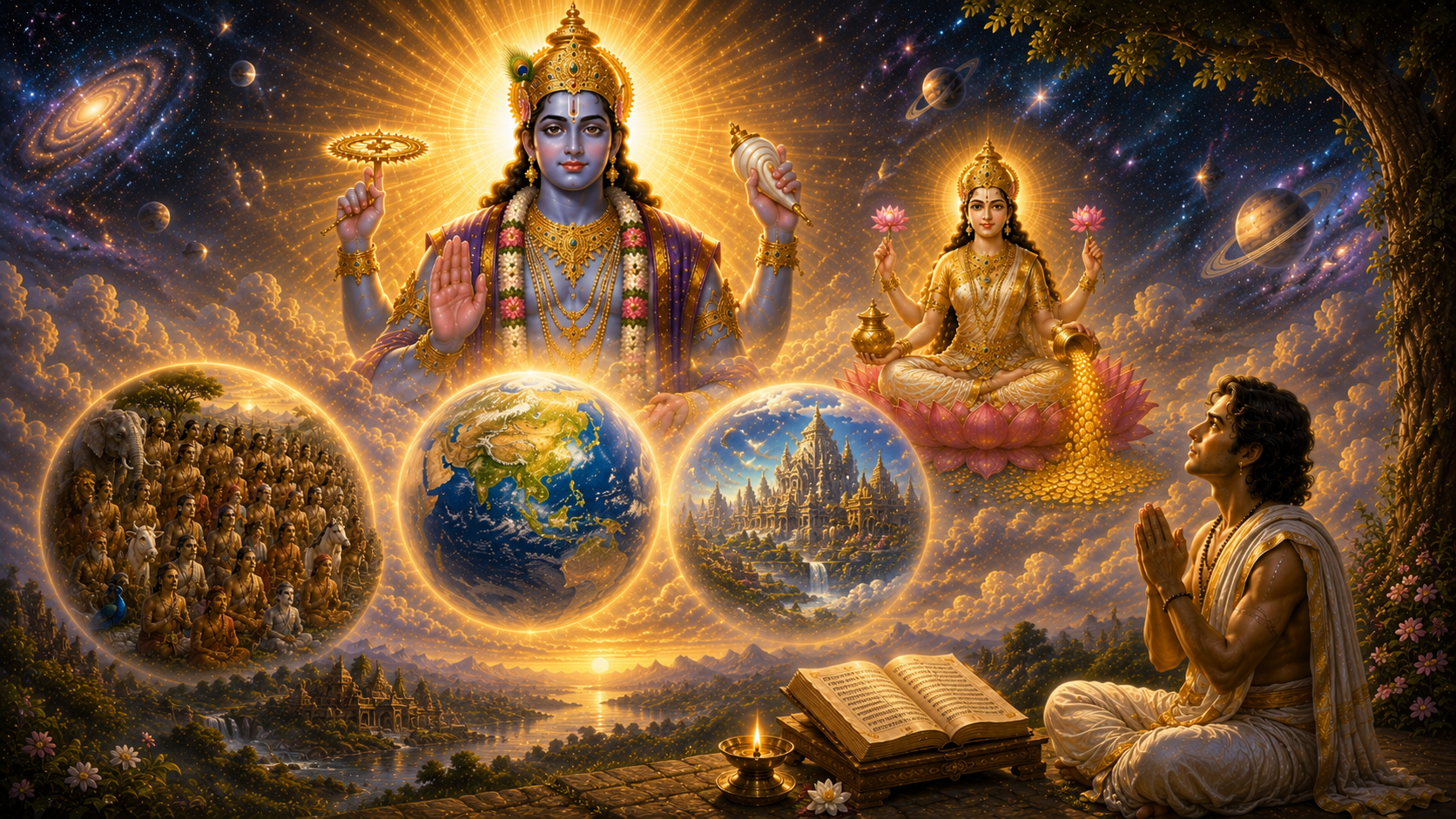
O Bhaarata (भारत), he who, being free from delusion (असम्मूढः), knows (जानाति) Me (माम्) thus (एवम्) to be Purushottama (पुरुषोत्तमम्), the Supreme Lord, he (सः) is the knower of the meaning of all Shaastras (सर्व-वित्) and worships (भजति) Me with full-fledged devotion (सर्व-भावेन).
- This verse emphasizes the importance of Bhakti combined with Tattva-jnaana, i.e. devotion and correct knowledge are inseparable.
- सर्व-वित् does not mean all-knowing but one who has correct purport of shaastra-s especially a devoted understanding of the Lord’s supremacy.
इति गुह्य-तमं शास्त्रम् इदम् उक्तं मया अनघ ।
एतत् बुद्ध्वा बुद्धिमान् स्यात् कृत-कृत्यः च भारत ॥ १५.२० ॥
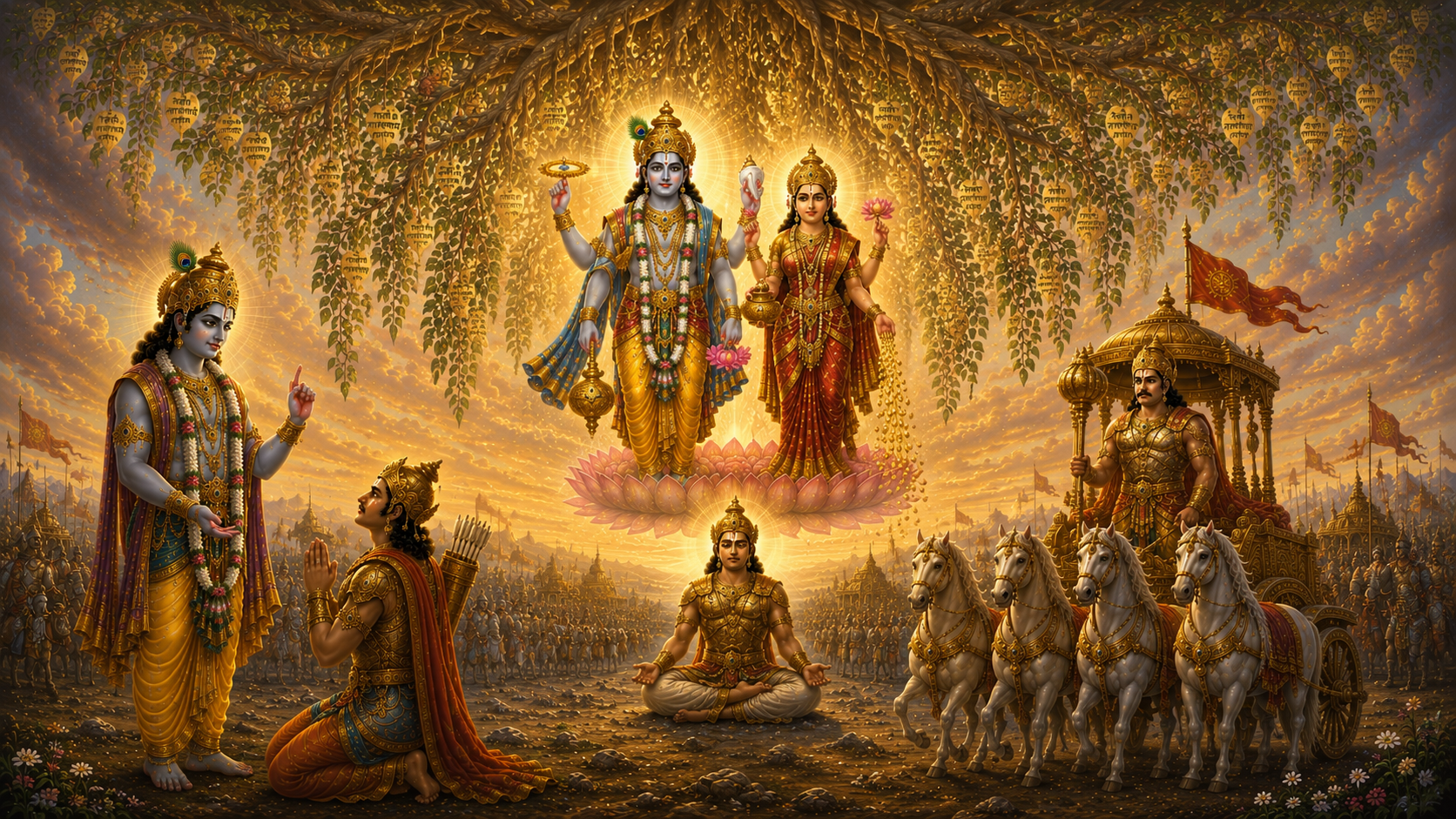
O sinless one (अनघ), thus (इति) this most profound secret (गुह्य-तमम्) knowledge (शास्त्रम्) has been imparted (उक्तम्) to you by Me (मया). O Bhaarata (भारत), having known (बुद्ध्वा) this (एतत्), a man becomes wise (बुद्धिमान् स्यात्), realizes the Lord and becomes one whose task is accomplished (कृत-कृत्यः), attaining salvation.
- The most profound secret is the true relationship between the Universe, Jeevas, Lakshmi and Hari.
- Knowing this leads to the highest accomplishment – which is not worldly success but attainment of Moksha.
- Moksha is not merger into Brahman; it is eternal blissful service to the Supreme Lord according to one’s intrinsic capacity.
ॐ तत् सत् इति श्रीमद्-भगवद्-गीतासु उपनिषत्सु ।
ब्रह्म-विद्यायां योग-शास्त्रे श्री-कृष्ण-अर्जुन-संवादे ।
पुरुषोत्तम-योगः नाम पञ्च-दशः अध्यायः ॥
Thus ends the Fifteenth Chapter of the Upanishads of the Bhagavad Geeta entitled “Purushottama Yoga” (पुरुषोत्तम-योगः), the Yoga of the Supreme Person, occurring in the dialogue (संवादे) between Shri Krishna (श्री-कृष्ण) and Arjuna (अर्जुन), in the scripture of Yoga (योग-शास्त्रे) dealing with the knowledge of Brahman (ब्रह्म-विद्यायाम्).
अथ पुरुषोत्तम-योगः (Chanting)
श्री-भगवान् उवाच
ऊर्ध्व-मूलम् अधः-शाखम् अश्वत्थं प्राहुर्-अव्ययम् ।
छन्दांसि यस्य पर्णानि यश्-तं वेद स वेद-वित् ॥ १५.१ ॥
अधश्-च्-ओर्ध्वं प्रसृतास्-तस्य शाखाः गुण-प्रवृद्धाः विषय-प्रवालाः ।
अधश्-च मूलान्य्-अनु-सन्ततानि कर्म-अनुबन्धीनि मनुष्य-लोके ॥ १५.२ ॥
न रूपम्-अस्येह तथोपलभ्यते नान्तो न चादिर्-न च सम्प्रतिष्ठा ।
अश्वत्थम्-एनं सु-विरूढ-मूलम् असङ्ग-शस्त्रेण दृढेन छित्त्वा ॥ १५.३ ॥
ततः पदं तत्-परि-मार्गितव्यं यस्मिन्-गता न निवर्तन्ति भूयः ।
तम्-एव च्-आद्यं पुरुषं प्रपद्ये यतः प्रवृत्तिः प्रसृता पुराणी ॥ १५.४ ॥
निर्मान-मोहा जित-सङ्ग-दोषा अध्यात्म-नित्या विनिवृत्त-कामाः ।
द्वन्द्वैर्-विमुक्ताः सुख-दुःख-संज्ञैर् गच्छन्त्य्-अमूढाः पदम्-अव्ययं तत् ॥ १५.५ ॥
न तद्-भासयते सूर्यो न शशाङ्को न पावकः ।
यद्-गत्वा न निवर्तन्ते तद्-धाम परमं मम ॥ १५.६ ॥
ममैवांशो जीव-लोके जीव-भूतः सनातनः ।
मनः-षष्ठानि-इन्द्रियाणि प्रकृति-स्थानि कर्षति ॥ १५.७ ॥
शरीरं यद्-अवाप्नोति यच्-चाप्य्-उत्क्रामतीश्वरः ।
गृहीत्वैतानि संयाति वायुर्-गन्धानिवाशयात् ॥ १५.८ ॥
श्रोत्रं चक्षुः स्पर्शनं च रसनं घ्राणम्-एव च ।
अधिष्ठाय मनश्-चायं विषयान्-उपसेवते ॥ १५.९ ॥
उत्क्रामन्तं स्थितं वापि भुञ्जानं वा गुणान्वितम् ।
विमूढा नानुपश्यन्ति पश्यन्ति ज्ञान-चक्षुषः ॥ १५.१० ॥
यतन्तो योगिनश्-चैनं पश्यन्त्य्-आत्मन्य्-अवस्थितम् ।
यतन्तोऽप्य्-अकृतात्मानो नैनं पश्यन्त्य्-अचेतसः ॥ १५.११ ॥
यद्-आदित्य-गतं तेजो जगद्-भासयतेऽखिलम् ।
यच्-चन्द्रमसि यच्-चाग्नौ तत्-तेजो विद्धि मामकम् ॥ १५.१२ ॥
गाम्-आविश्य च भूतानि धारयाम्य्-अहम्-ओजसा ।
पुष्णामि च-औषधीः सर्वाः सोमो भूत्वा रस-आत्मकः ॥ १५.१३ ॥
अहं वैश्वानरो भूत्वा प्राणिनां देहम्-आश्रितः ।
प्राण-अपान-समायुक्तः पचाम्य्-अन्नं चतुर्विधम् ॥ १५.१४ ॥
सर्वस्य चाहं हृदि सन्निविष्टो मत्तः स्मृतिर्-ज्ञानम्-अपोहनं च ।
वेदैश्-च सर्वैर्-अहम्-एव वेद्यो वेदान्त-कृद्-वेद-विद्-एव चाहम् ॥ १५.१५ ॥
द्वाव्-इमौ पुरुषौ लोके क्षरश्-चाक्षर एव च ।
क्षरः सर्वाणि भूतानि कूट-स्थोऽक्षर उच्यते ॥ १५.१६ ॥
उत्तमः पुरुषस्-त्वन्यः परमात्मेत्य्-उदाहृतः ।
यो लोक-त्रयम्-आविश्य बिभर्त्य्-अव्यय ईश्वरः ॥ १५.१७ ॥
यस्मात्-क्षरम्-अतीतोऽहम्-अक्षराद्-अपि चोत्तमः ।
अतोऽस्मि लोके वेदे च प्रथितः पुरुषोत्तमः ॥ १५.१८ ॥
यो माम्-एवम्-असम्मूढो जानाति पुरुषोत्तमम् ।
स सर्व-विद्-भजति मां सर्व-भावेन भारत ॥ १५.१९ ॥
इति गुह्यतमं शास्त्रम्-इदम्-उक्तं मयानघ ।
एतद्-बुद्ध्वा बुद्धिमान्-स्यात्-कृत-कृत्यश्-च भारत ॥ १५.२० ॥
ॐ तत्-सदिति श्रीमद्-भगवद्-गीतासूपनिषत्सु ।
ब्रह्म-विद्यायां योग-शास्त्रे श्री-कृष्णार्जुन-संवादे ।
पुरुषोत्तम-योगो नाम पञ्च-दशोऽध्यायः ॥॥
References
- Srimad Bhagavad Gita pocket book published by Suguna Samsath (Received with blessings from HH Shri Shri Sugunendra Tirtha Swamiji of Puttige Matha in Austin, TX, Nov 1997)
- https://sahuri.org/bhagavadgita/bhagavad-gita-15-purushottama-yoga/
/Raghunath Rao/ “Do your Best … and leave the Rest … “
(All mistakes mine – all credit to Gurus and Acharyas )
|| sarvaṁ śrī kṛṣṇārpanamastu ||