हरि सर्वोत्तम । वायु जीवोत्तम | श्री गुरुभ्यो नमः
Quick Links (incl. Audio):
- All Daily Stotras
- Purushottama Yoga -Bhagavad Gita Chapter 15
- Krishna Stotra
- Purushottama Stotra
- 33 Roopas (Apoopa daana)
Introduction
Adhika Maasa, also called Purushottama Maasa, is the extra lunar month that appears about once every 33 months to keep the lunar and solar calendars aligned. This is a very sacred month with no solar zodiac crossing (सङ्क्रमण) and is especially dedicated to Lord Purushottama Narayana (मास नियामक). This is the very form that the Supreme Lord Himself describes in instruction to Arjuna (Purushottama Yoga – Bhagavad Gita Chapter 15).
Because the month belongs to Him, it is considered one of the best periods for spiritual effort, especially Hari Smarane (remembrance of the Lord), study of Shaastra-s, Japa (meditation), Paarayana (recitation), Daana (charity), Homa-s, prayers, Bhajane (devotional songs), Niyama (self-discipline) and Vrata-s.
The sankalpa should not be for worldly gain, but on spiritual growth and devotion to Lord Purushottama (पुरुषोत्तम-प्रेरणया पुरुषोत्तम-प्रीत्यर्थम्). Paarayana of Bhagavad Gita, Vishnu Sahasranama, Hari Vayu Stuti, Dvadasha Stotra, Bhagavata are highly recommended. In the Maadhva tradition, Purushottama Yoga – Bhagavad Gita Chapter 15is particularly cherished because it clearly teaches the supremacy of Lord Vishnu over all realities.
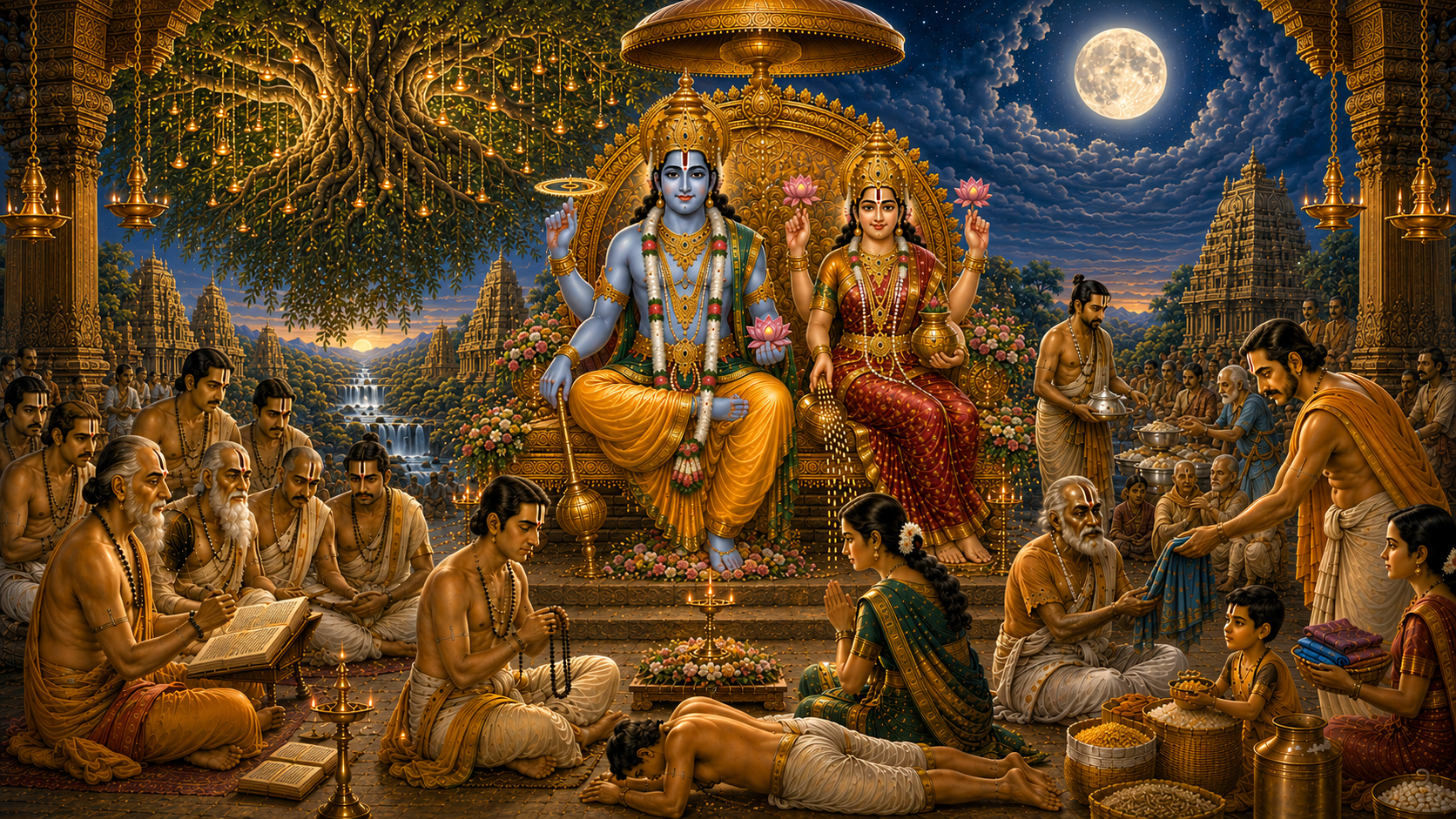
Charity performed during Adhika Maasa is of great merit, particularly Anna Daana (feeding others), Vastra Daana (giving clothing), Support of temples & Vedic learning, and giving assistance to the needy. Such acts, when performed with devotion to Hari and without pride, become means of spiritual purification.
Adhika Maasa reminds us that worldly achievements are temporary and devotion to the Supreme Lord is everlasting. This is why it is also called Mala Maasa since worldly activities are minimized, including shubha-kaarya-s that can be postponed. Instead, devotees use this sacred month to dedicate extra time to learning, worshipping, serving and remembering Lord Purushottama Narayana.
अधिकमास-नित्यपठनीय-स्तोत्राणि
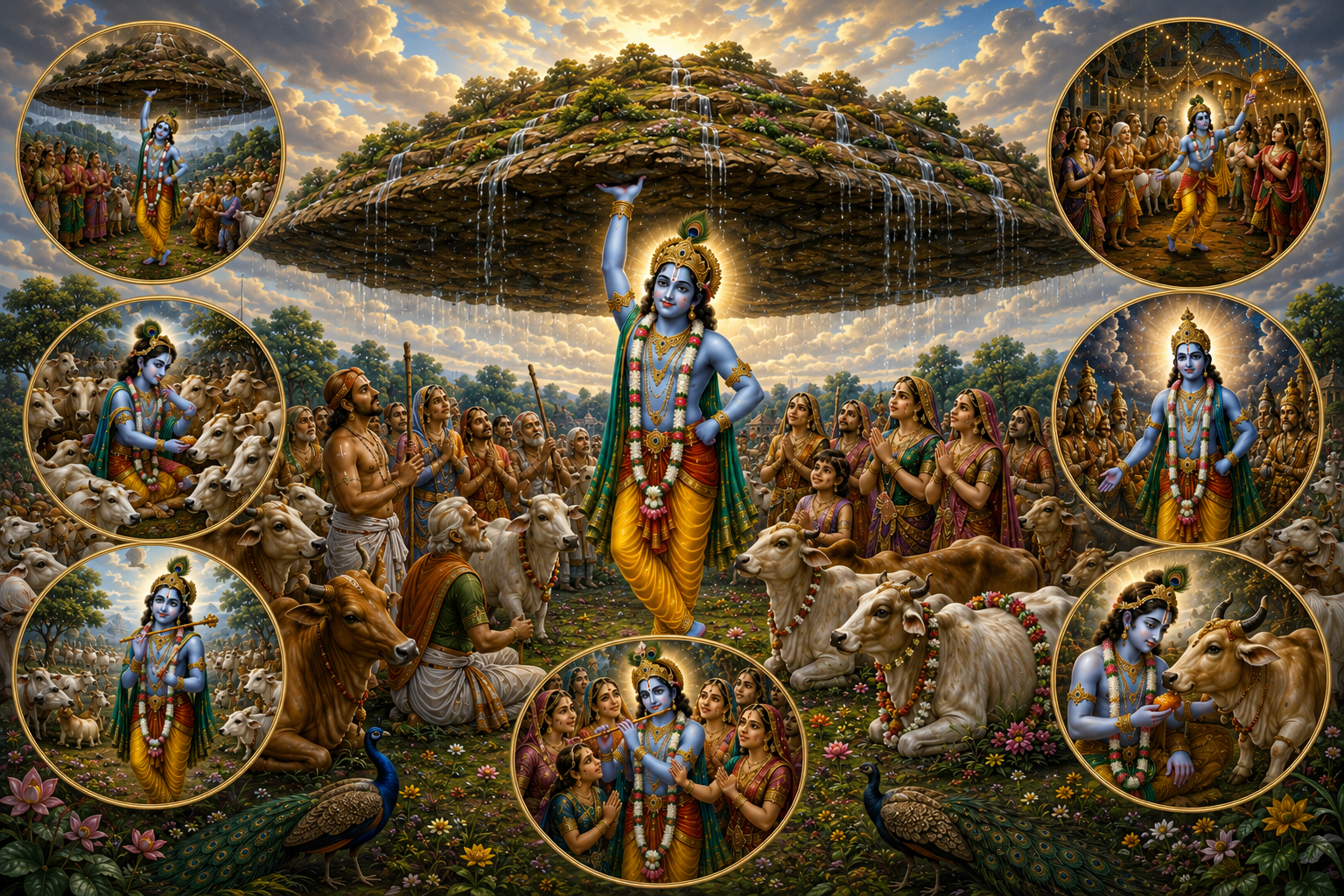
गोवर्धन-धरं वन्दे गोपालं गोप-रूपिणम् ।
गोकुल-उत्सवम् ईशानं गोविन्दं गोपिका-प्रियम् ॥
I bow to (वन्दे) Lord Krishna, Who
lifted (धरं) Govardhana mountain (गोवर्धन),
protects cows and all beings (गो-पालं),
took the form (रूपिणम्) of a cowherd (गोप),
is the festive delight (उत्सवम्) of Gokula (गोकुल),
is the Supreme Controller (ईशानम्),
protects the earth, Veda-s and cows (गो-विन्दम्),
is dearly beloved (प्रियम्) to the Gopikas (गोपिका).
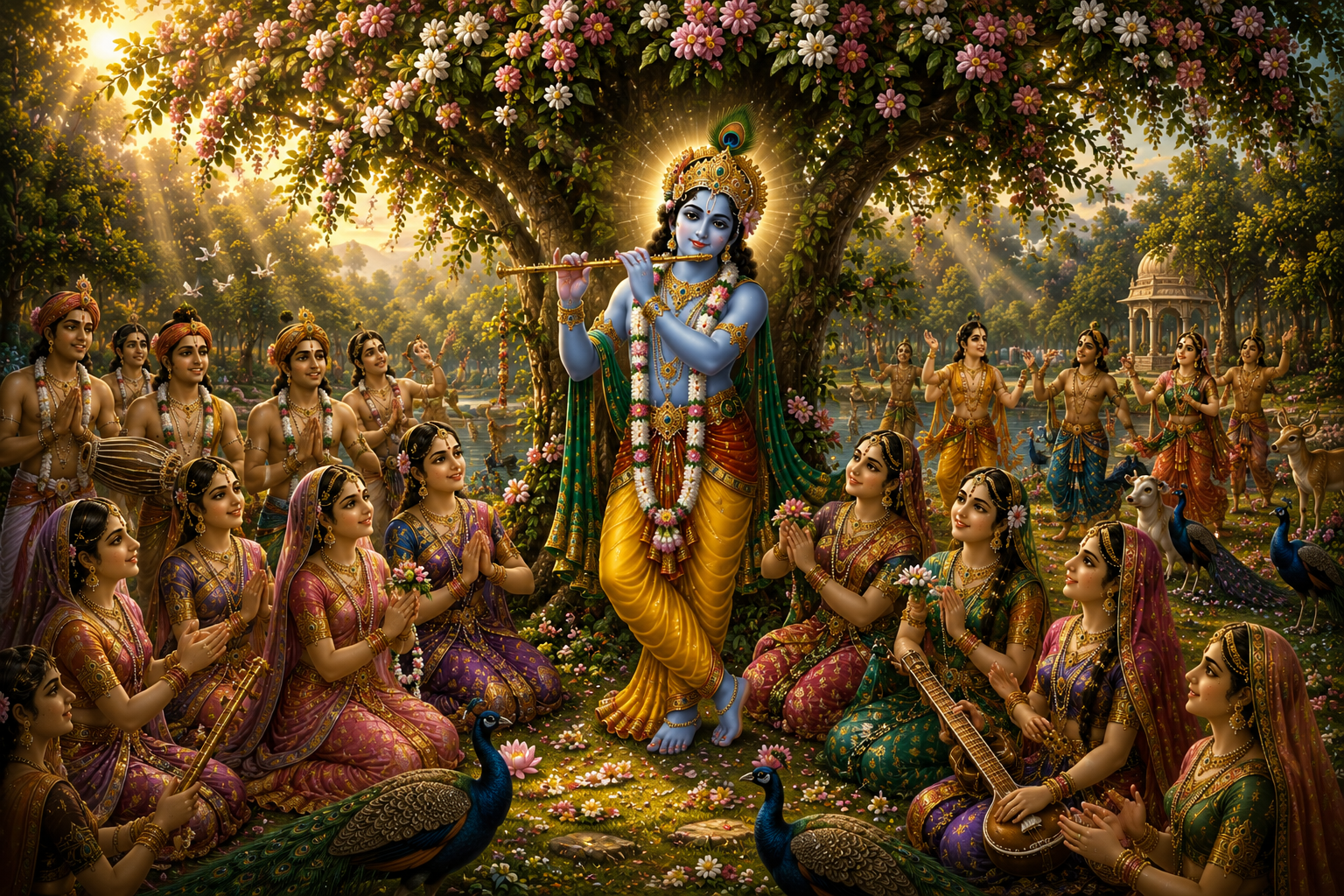
वन्दे वन्दारु-मन्दारं वृन्दावन-विनोदिनम् ।
वृन्दावन-कला-नाथं पुरुषोत्तमम् अद्भुतम् ॥
I bow to (वन्दे) the wondrous Supreme Lord (पुरुषोत्तमम् अद्भुतम्), Who
is like the celestial desire-fulfilling Mandaara tree (मन्दारम्) for those who bow before Him (वन्दारु),
is the delight (विनोदिनम्) of Vrundavana (वृन्दावन),
is the Lord (नाथम्) of all the divine arts, excellences and pastimes (कला) of Vrindavana (वृन्दावन).
Click to open Purushottama Yoga -Bhagavad Gita Chapter 15
ब्रह्मकृत श्रीकृष्णस्तोत्रम् (ब्रह्मवैवर्तपुराणम्)
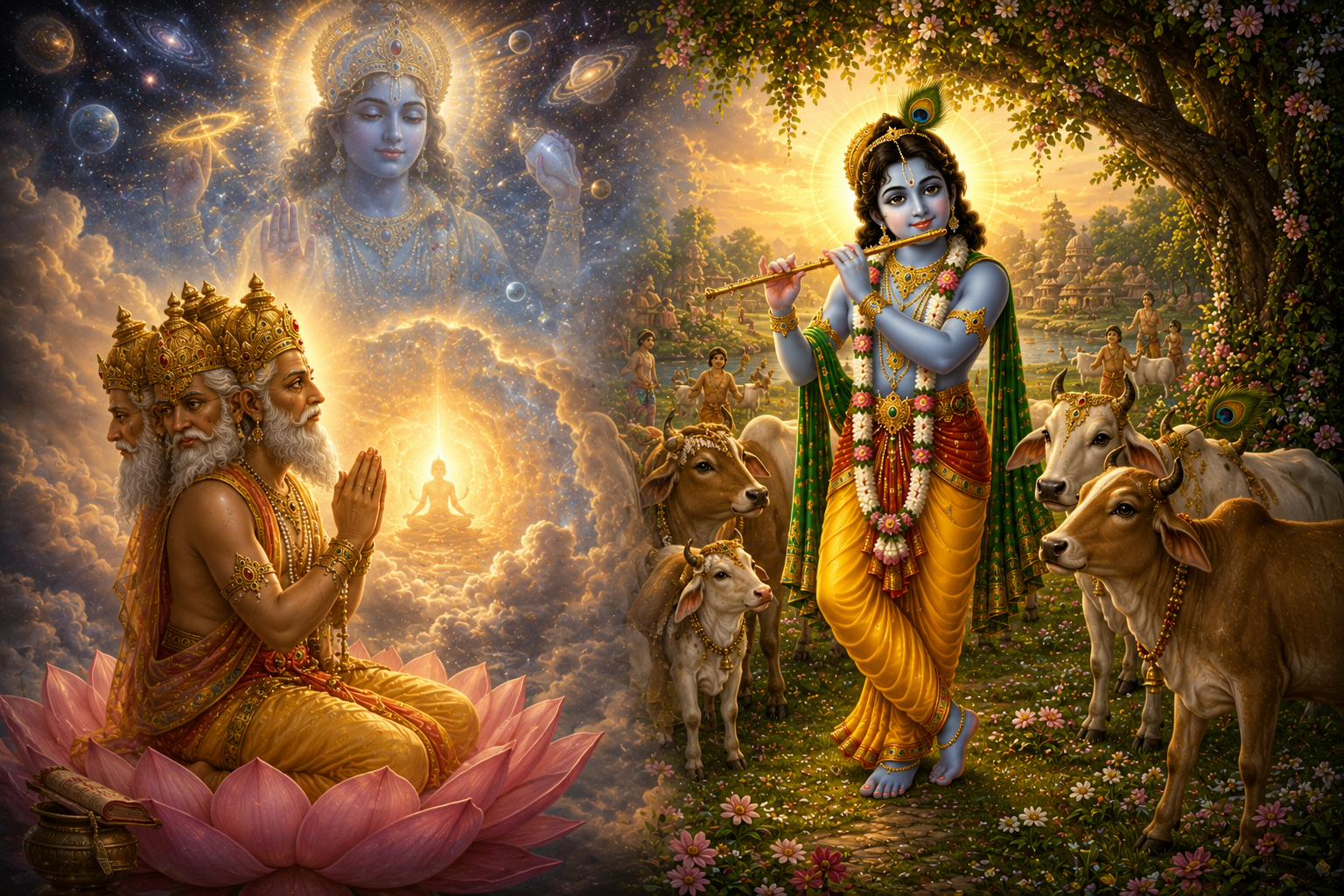
ब्रह्म उवाच
कृष्णं वन्दे गुण-अतीतं गोविन्दम् एकम् अक्षरम् ।
अव्यक्तम् अव्ययं व्यक्तं गोप-वेष-विधायिनम् ॥ ३-३५ ॥
I bow to (वन्दे) Lord Krishna (कृष्णम्), Who
is beyond (अतीतं) all material qualities of sattva-rajas-tamas (गुण),
is the protector of the earth, Veda-s and cows (गोविन्दम्),
alone (एकम्) is imperishable (अक्षरम्),
is unmanifest (अव्यक्तम्) to ordinary perception,
is without change or decay (अव्ययम्),
manifests (व्यक्तम्) for His devotees,
assumes (विधायिनम्) the attire (वेष) of a cowherd (गोप).
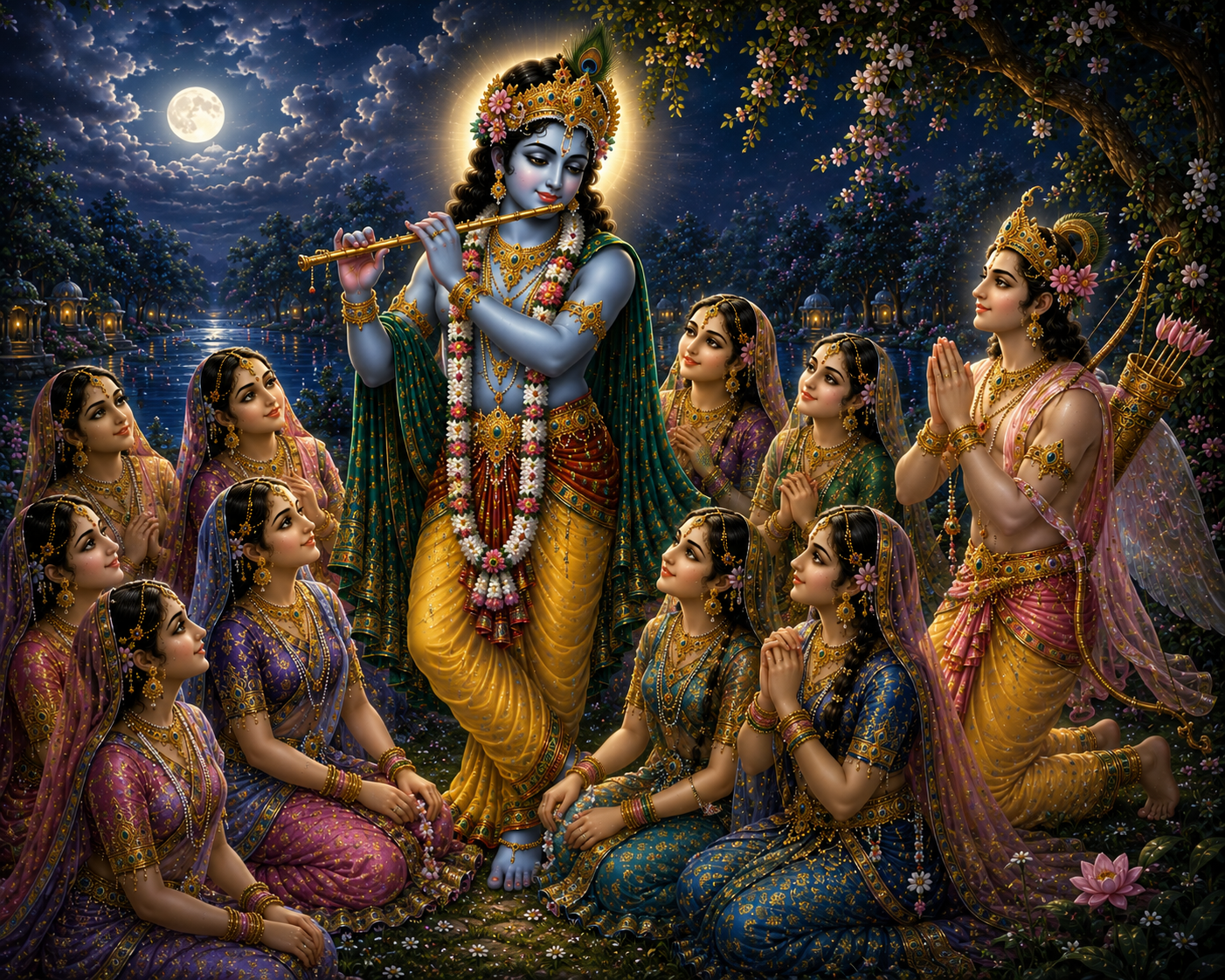
किशोर-वयसं शान्तं गोपी-कान्तं मनोहरम् ।
नवीन-नीरद-श्यामं कोटि-कन्दर्प-सुन्दरम् ॥ ३-३६ ॥
I bow to Him, Who
eternally possesses youthful beauty (किशोर-वयसम्),
is perfectly serene (शान्तम्),
is the beloved (कान्तम्) of the Gopikas (गोपी),
captivates the mind (मनोहरम्),
has dark complexion dark (श्यामम्) like a newly-formed (नवीन) water-giving cloud (नीरद),
has beauty surpassing (सुन्दरम्) many millions (कोटि) of Gods of Love (कन्दर्प).
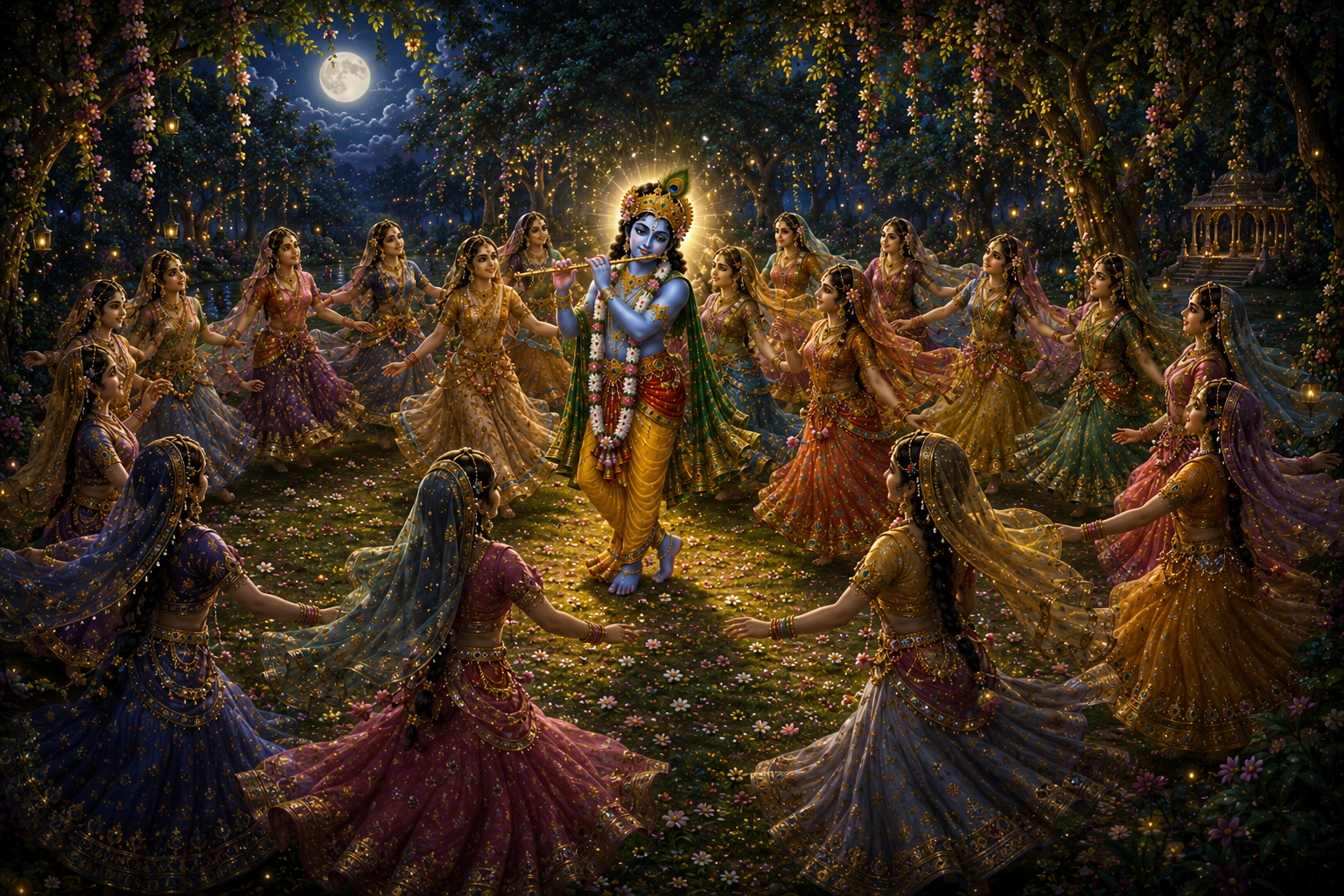
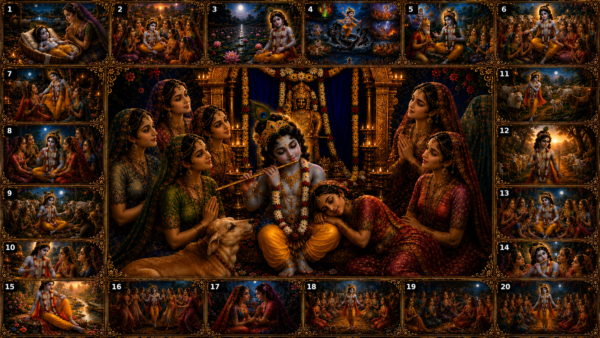
वृन्दावन-वन-अभ्यन्ते रास-मण्डल-संस्थितम् ।
रास-ईश्वरं रास-वासं रास-उल्लास-समुत्सुकम् ॥ ३-३७ ॥
I bow to Him, Who
stands established (संस्थितम्) within (अभ्यन्ते) the forests (वन) of Vrundavana (वृन्दावन),
is present in the circle (मण्डल) of the Raasa dance (रास),
is the Lord (ईश्वरम्) of the Raasa (रास),
presides (वासम्) in the Raasa (रास),
is eager (समुत्सुकम्) to bestow the joy (उल्लास) of divine devotion through the Raasa (रास).
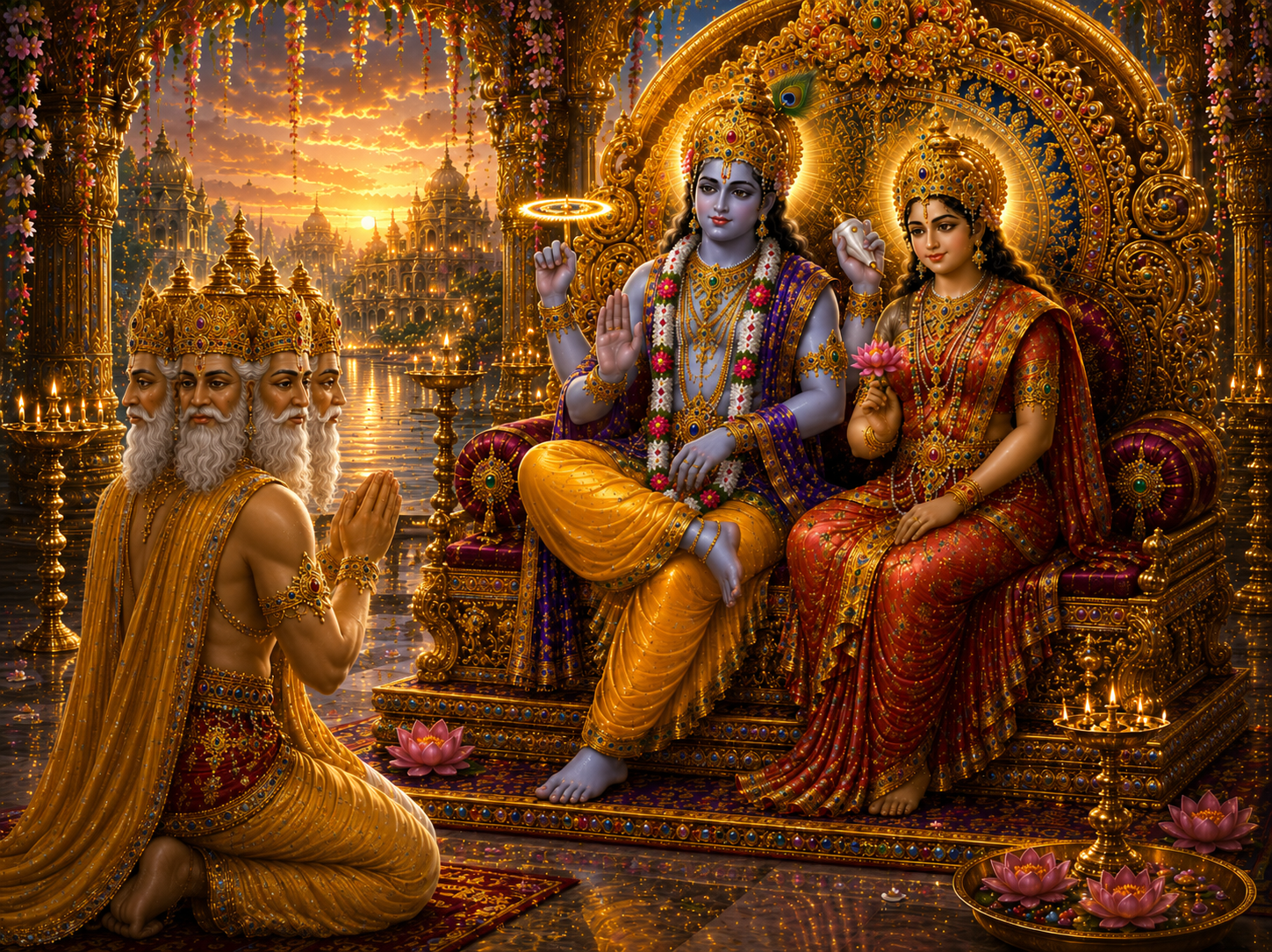
इत्येवम् उक्त्वा तं नत्वा रत्न-सिंहासने वरम् ।
नारायण-ईशौ संभाष्य स उवास तदाज्ञया ॥ ३-३८ ॥
Having spoken (उक्त्वा) thusly (इति एवम्), and having bowed (नत्वा) to Him (तम्) seated upon the excellent (वरम्) jeweled throne (रत्न-सिंहासने), Brahma conversed (संभाष्य) with Lord Narayana and Lakshmi (नारायण-ईशौ), and then remained (उवास) there according to Their command (तत्-आज्ञया).
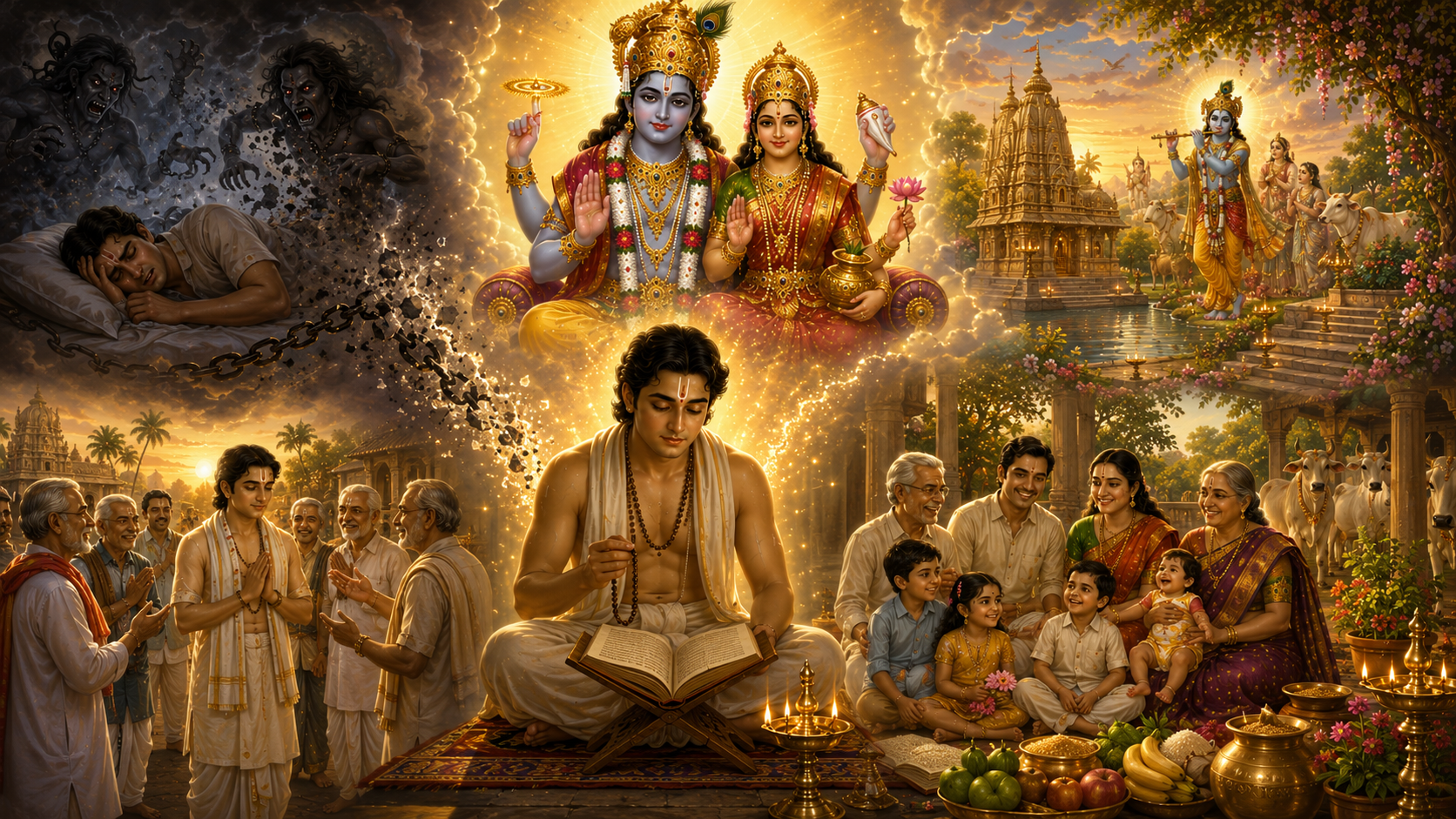
इति ब्रह्म-कृतं स्तोत्रं प्रातरुत्थाय यः पठेत् ।
पापानि तस्य नश्यन्ति दुःस्वप्नः सुस्वप्नो भवेत् ॥ ३-३९ ॥
Whoever (यः) rises in the morning (प्रातरुत्थाय) and recites (पठेत्) this hymn (स्तोत्रम्) composed by Brahma (ब्रह्म-कृतम्), their sins (पापानि) are destroyed (नश्यन्ति), and evil dreams (दुःस्वप्नः) become auspicious dreams (सुस्वप्नः भवेत्).
भक्तिर्भवति गोविन्दे श्री-पुत्र-पौत्र-वर्धिनी ।
अकीर्तिः क्षयम् आप्नोति सत्-कीर्तिः वर्धते चिरम् ॥ ३-४० ॥
Devotion (भक्तिः) toward Govinda (गोविन्दे) arises (भवति) leading to prosperity (श्री), children (पुत्र), grandchildren (पौत्र), and lineage (वर्धिनी) increase.
Ill-fame (अकीर्तिः) meets (आप्नोति) destruction (क्षयम्), while good fame (सत्-कीर्तिः) grows (वर्धते) for a long time (चिरम्).
यमकृत पुरुषोत्तमस्तोत्रम् (ब्रह्मपुराण)
यम उवाच
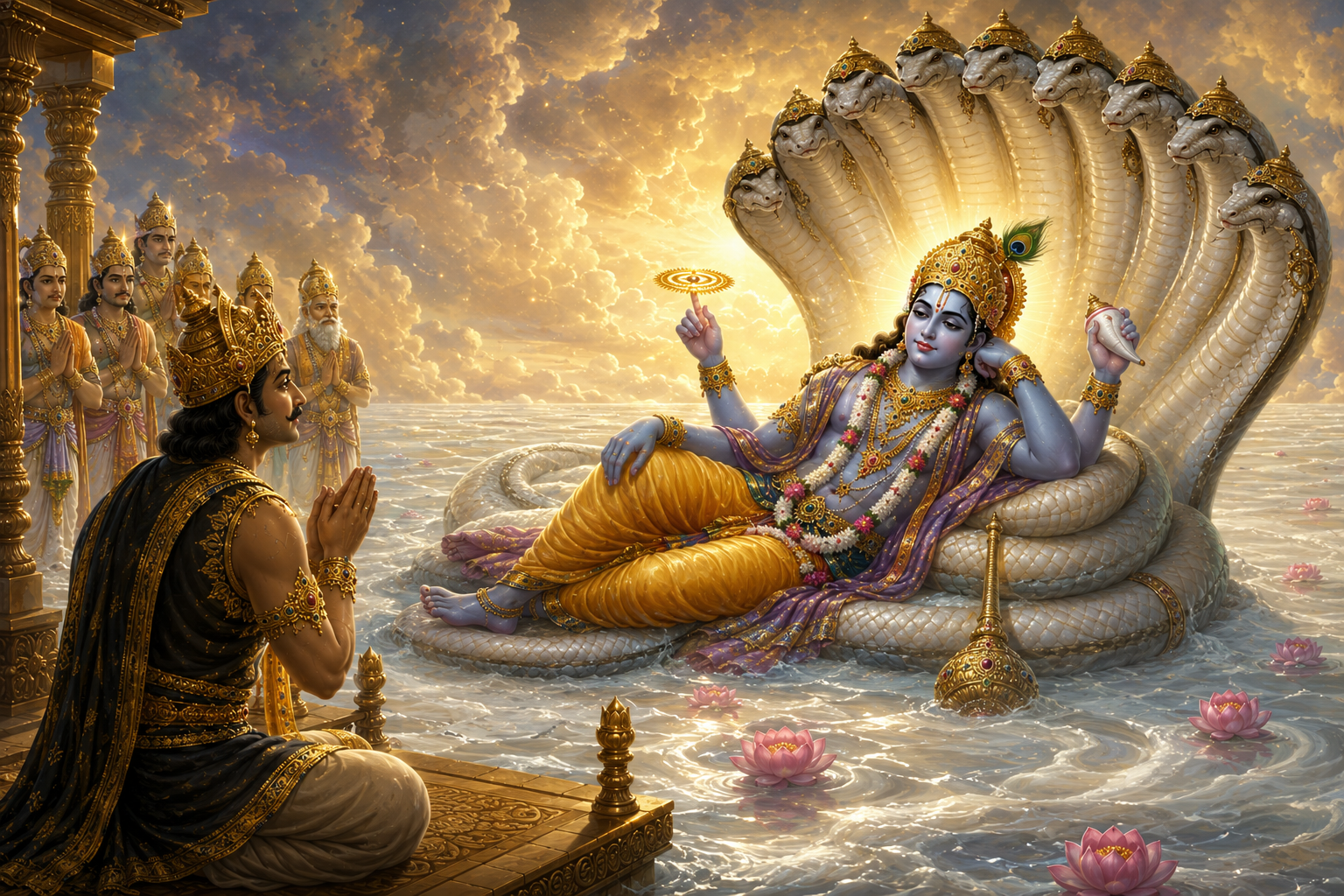
नमस्ते भगवन् देव लोक-नाथ जगत्-पते ।
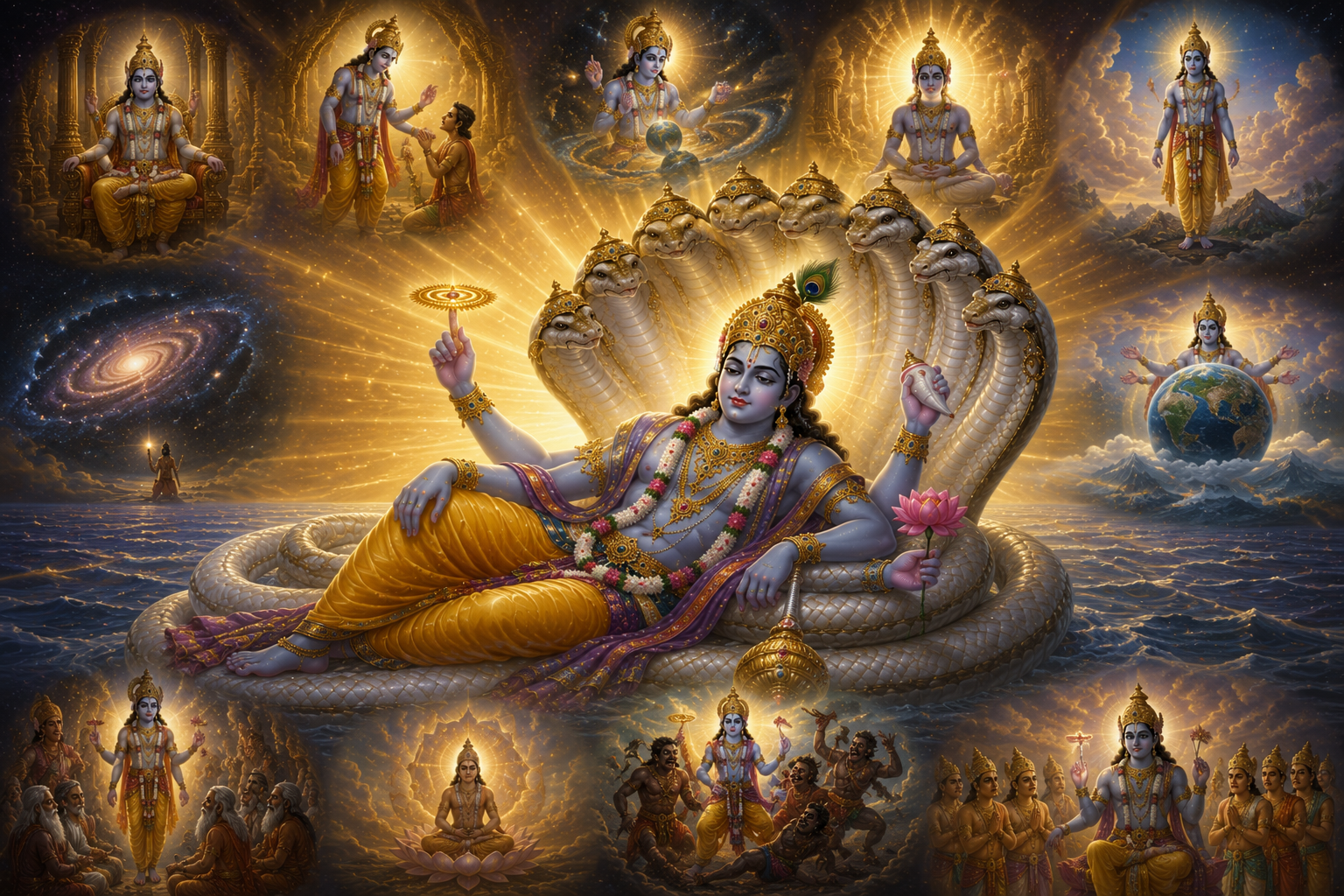
क्षीर-उद-वासिनं देवं शेष-भोग-अनुशायिनम् ॥ ४५-६० ॥
My salutations to (नमस्ते) The Lord (भगवन्), The Divine One (देव) Who
is the Master (नाथ) of all worlds (लोक)
is the Lord (पते) of the universe (जगत्),
resides (वासिनम्) in the Ocean (उद) of Milk (क्षीर),
is the Supreme Lord (देवम्),
reclines (अनुशायिनम्) upon the couch (भोग) of Adi Sesha (शेष).
वरं वरेण्यं वरदं कर्तारम् अकृतं प्रभुम् ।
विश्व-ईश्वरम् अजं विष्णुं सर्वज्ञम् अपराजितम् ॥ ४५-६१ ॥
I bow to Lord Vishnu (विष्णुम्), Who
is the Supreme Excellence (वरम्),
alone is worthy of being chosen and worshipped (वरेण्यम्),
grants boons (वरदम्),
is the Creator (कर्तारम्),
Himself is uncreated (अकृतम्),
is the Supreme Master (प्रभुम्),
is the Lord (ईश्वरम्) of the universe (विश्व),
who is unborn (अजम्),
who is all-knowing (सर्वज्ञम्),
and who is never defeated (अपराजितम्).
- अकृतम् does not merely mean “not made”; it means absolutely independent and not produced by any cause because Hari is both कर्ता (Creator) and अकृत (uncaused).
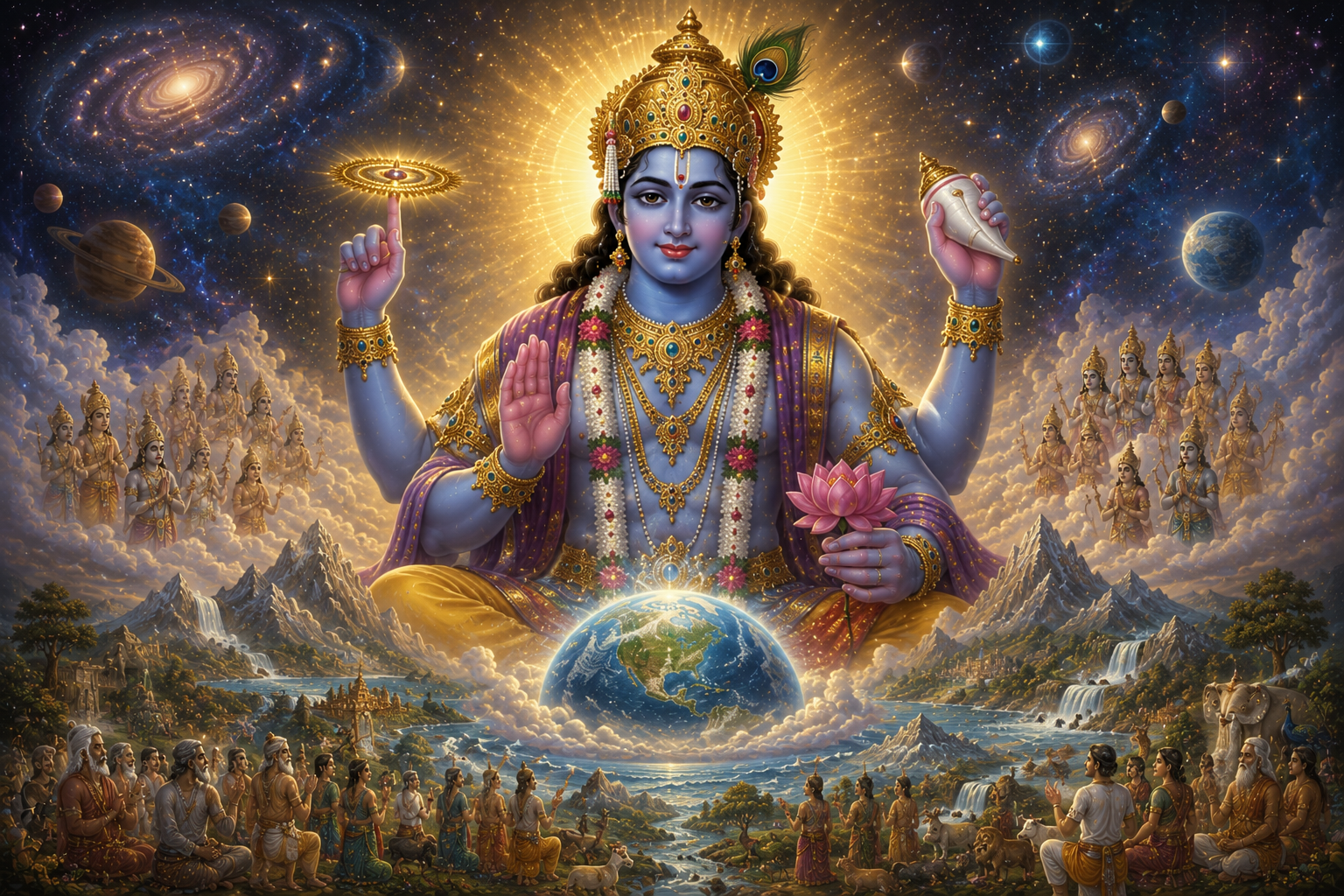
नील-उत्पल-दल-श्यामं पुण्डरीक-निभ-ईक्षणम् ।
सर्वज्ञं निर्गुणं शान्तं जगत्-धातारम् अव्ययम् ॥ ४५-६२ ॥
I bow to Him, Who
has complexion (श्यामम्) like the petals (दल) of a blue lotus (नील-उत्पल),
has eyes (ईक्षणम्) like (निभ) lotuses (पुण्डरीक),
is all-knowing (सर्वज्ञम्),
is beyond material qualities (निर्गुणम्),
is perfectly serene (शान्तम्),
sustains (धातारम्) the universe (जगत्),
never undergoes decay (अव्ययम्).
- निर्गुण means free from Sattva-Rajas-Tamas material qualities, not devoid of auspicious qualities. because Hari possesses infinite auspicious attributes (अनन्त-कल्याण-गुणाः).
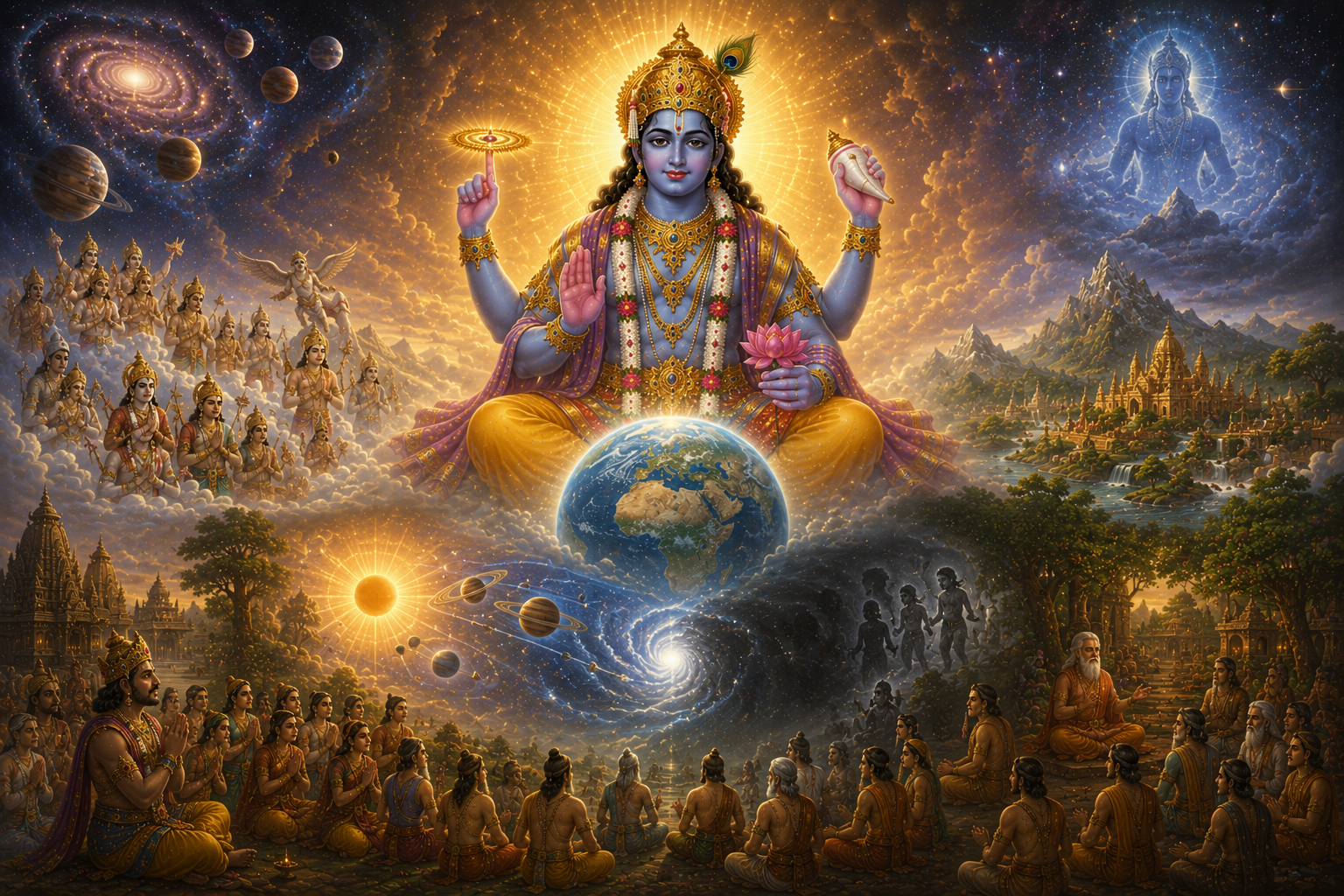
सर्व-लोक-विधातारं सर्व-लोक-सुख-आवहम् ।
पुराणं पुरुषं वेद्यं व्यक्त-अव्यक्तं सनातनम् ॥ ४५-६३ ॥
I bow to Him, Who
ordains and governs (विधातारम्) all worlds (सर्व-लोक),
brings (आवहम्) happiness (सुख) to all worlds,
is the Ancient Eternal Being (पुराणं पुरुषम्),
is The One to be known (वेद्यम्),
is both manifest (व्यक्त) and unmanifest (अव्यक्त),
is eternal (सनातनम्).
- व्यक्त-अव्यक्तम् means the Lord is visible to true devotees but not to ordinary perception.
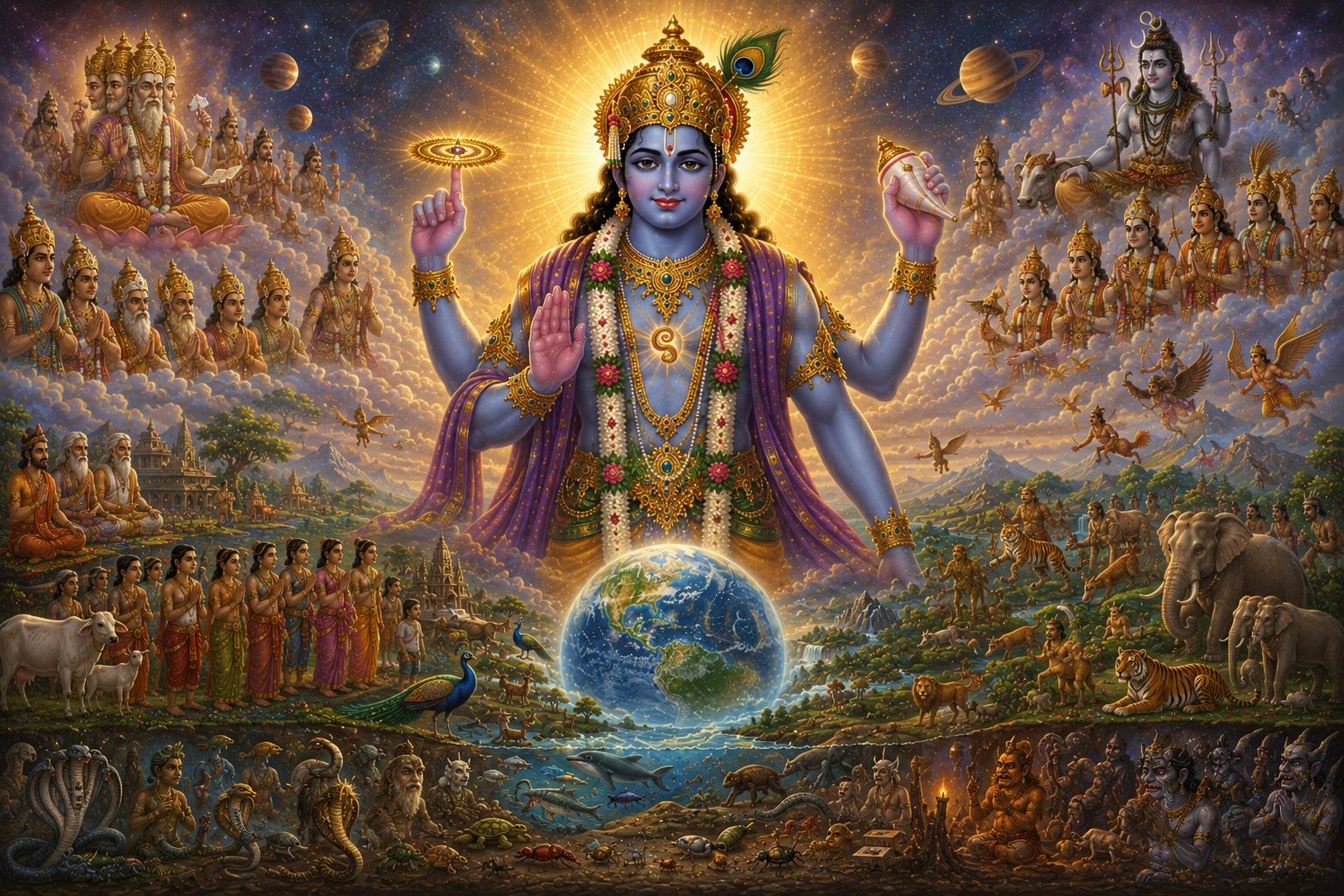
पर-अवराणां स्रष्टारं लोक-नाथं जगद्-गुरुम् ।
श्रीवत्स-उरस्क-संयुक्तं वन-माला-विभूषितम् ॥ ४५-६४ ॥
I bow to Him, Who
is the creator (स्रष्टारम्) of all higher (पर) and lower (अवर) beings,
is the Master (नाथम्) of all worlds (लोक),
is the Teacher (गुरुम्) of the universe (जगत्),
has the mark of Shri (श्रीवत्स) on His chest (उरस्क),
is adorned (विभूषितम्) with the divine garland (वन-माला).
- पर-अवर includes all of Kshara, i.e. gradations of beings from Brahma downward.
- Shrivatsa mark represents Akshara, i.e. Mahaalakshmi, on the Lord’s chest.
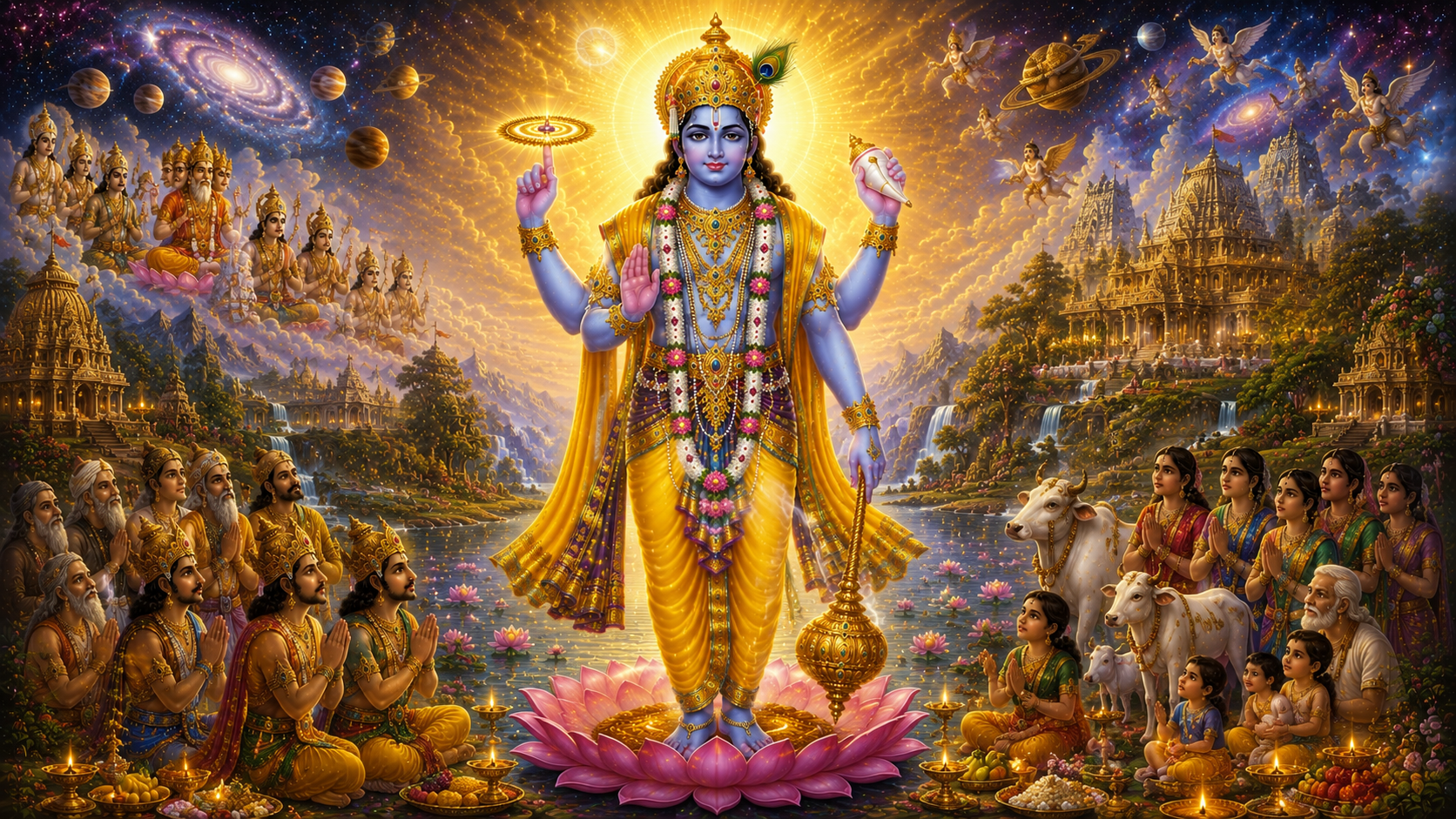
पीत-वस्त्रं चतुर्बाहुं शङ्ख-चक्र-गदा-धरम् ।
हार-केयूर-संयुक्तं मुकुट-अङ्गद-धारिणम् ॥ ४५-६५ ॥
I bow to Him, Who
wears yellow garments (पीत-वस्त्रम्),
possesses four arms (चतुर्बाहुम्),
holds (धरम्) the conch (शङ्ख), discus (चक्र) and mace (गदा),
is adorned (संयुक्तम्) with necklaces (हार) and armlets (केयूर),
who wears (धारिणम्) a crown (मुकुट) and arm ornaments (अङ्गद).
- There is no difference between Lord’s divine weapons and accessories and Himself – They are all fully conscious, eternal and fully empowered as the Lord Himself.
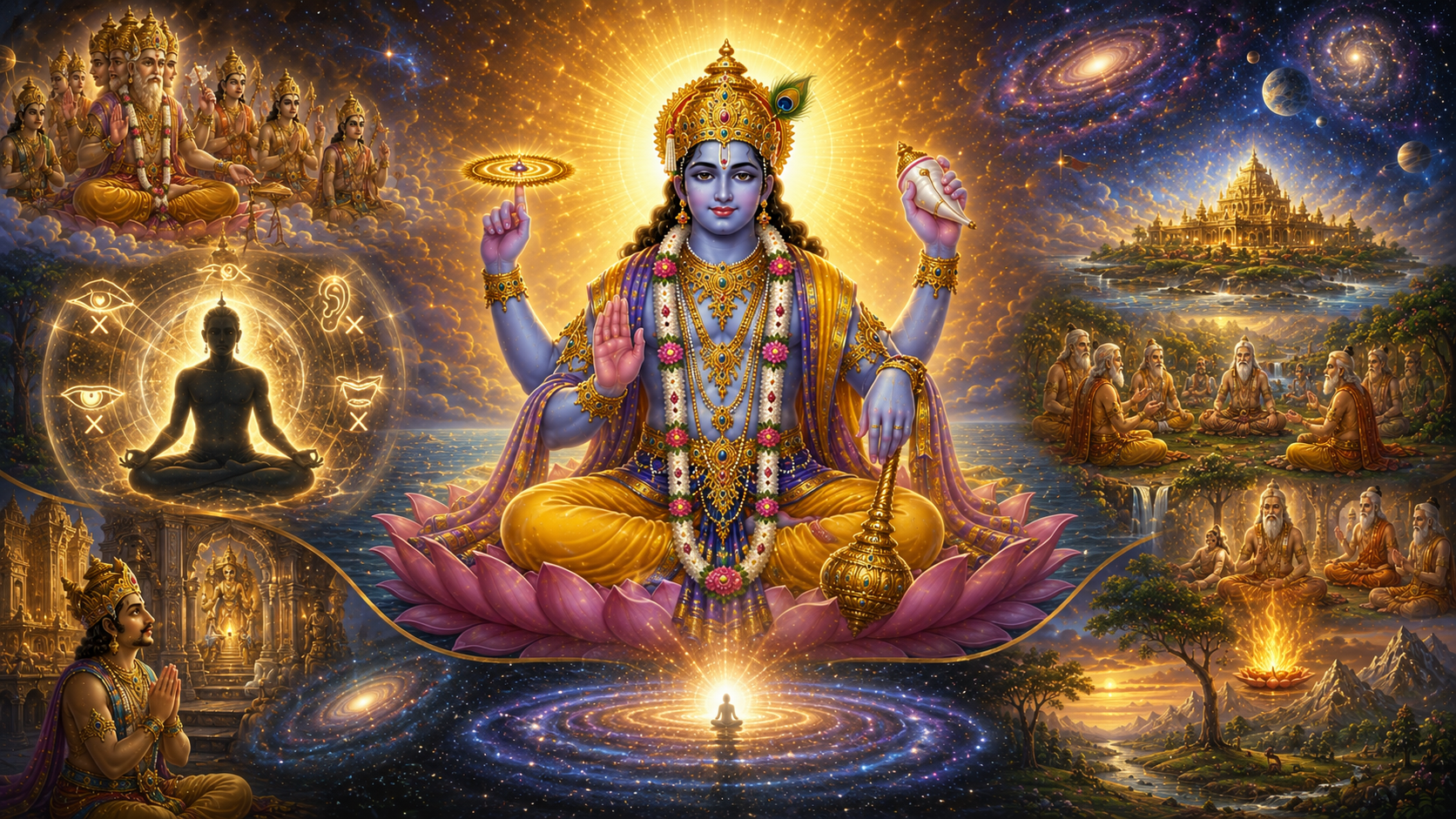
सर्व-लक्षण-सम्पूर्णं सर्व-इन्द्रिय-विवर्जितम् ।
कूट-स्थम् अचलं सूक्ष्मं ज्योति-रूपं सनातनम् ॥ ४५-६६ ॥
I bow to Him, Who
completely possesses (सम्पूर्णम्) every (सर्व) auspicious mark (लक्षण),
is free from (विवर्जितम्) all material senses (सर्व-इन्द्रिय),
remains eternally unchanged (कूट-स्थम्),
is unchanging in His perfection (अचलम्),
is subtle beyond comprehension (सूक्ष्मम्),
is of the nature of divine effulgence (ज्योति-रूपम्),
is eternal (सनातनम्).
- सर्वेन्द्रियविवर्जितम् does not mean Lord has no senses but indicates He is not limited by human-like material senses
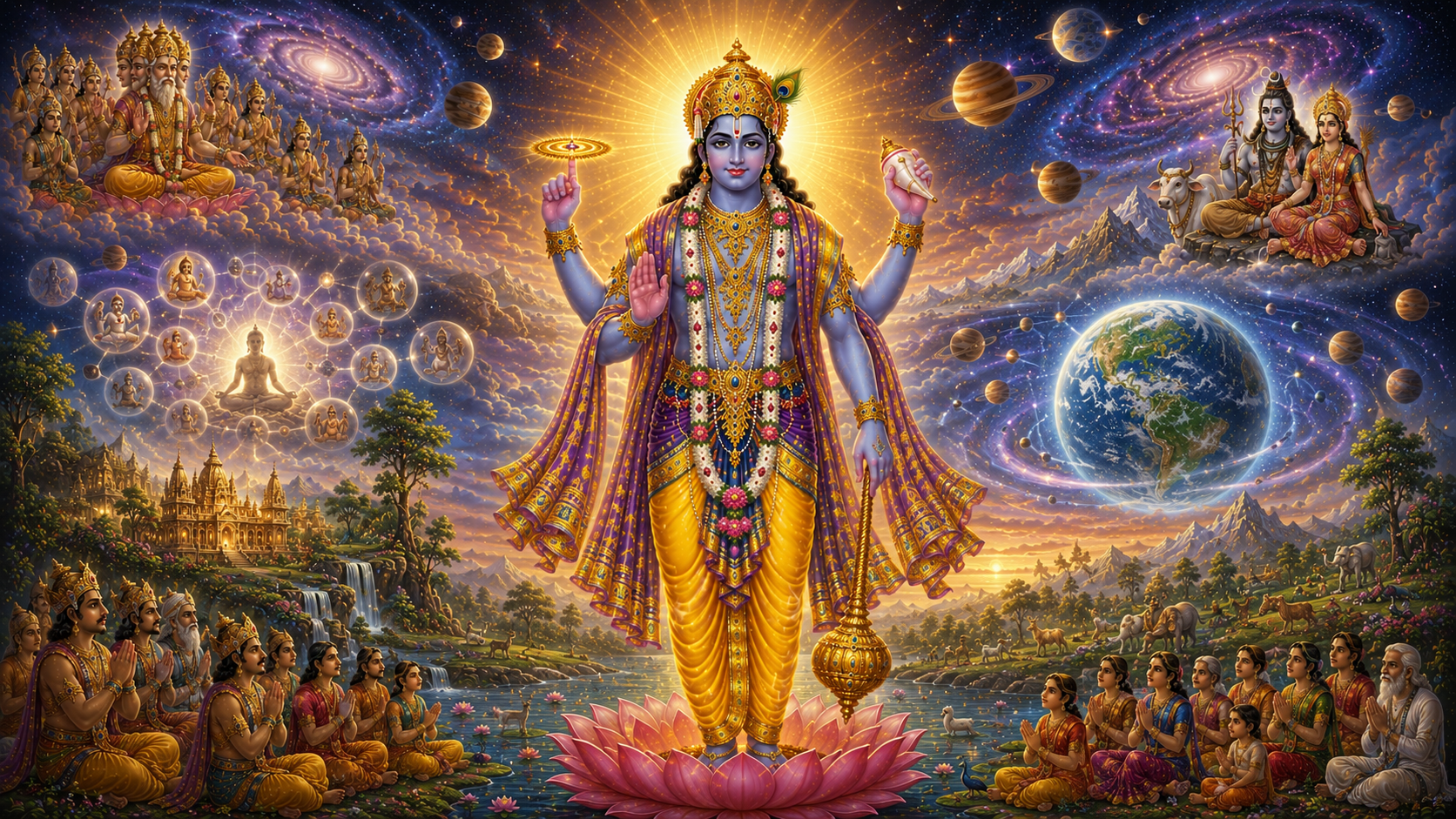
भाव-अभाव-विनिर्मुक्तं व्यापिनं प्रकृतेः परम् ।
नमस्यामि जगन्नाथम् ईश्वरं सुखदं प्रभुम् ॥ ४५-६७ ॥
I bow (नमस्यामि) to the Lord (प्रभुम्), Who
is free (विनिर्मुक्तम्) from existence and non-existence as understood in the material sense (भाव-अभाव),
pervades everything (व्यापिनम्),
is beyond (परम्) Prakriti (प्रकृतेः),
is the Lord (नाथम्) of the universe (जगत्),
is the Supreme Controller (ईश्वरम्),
bestows happiness (सुखदम्).
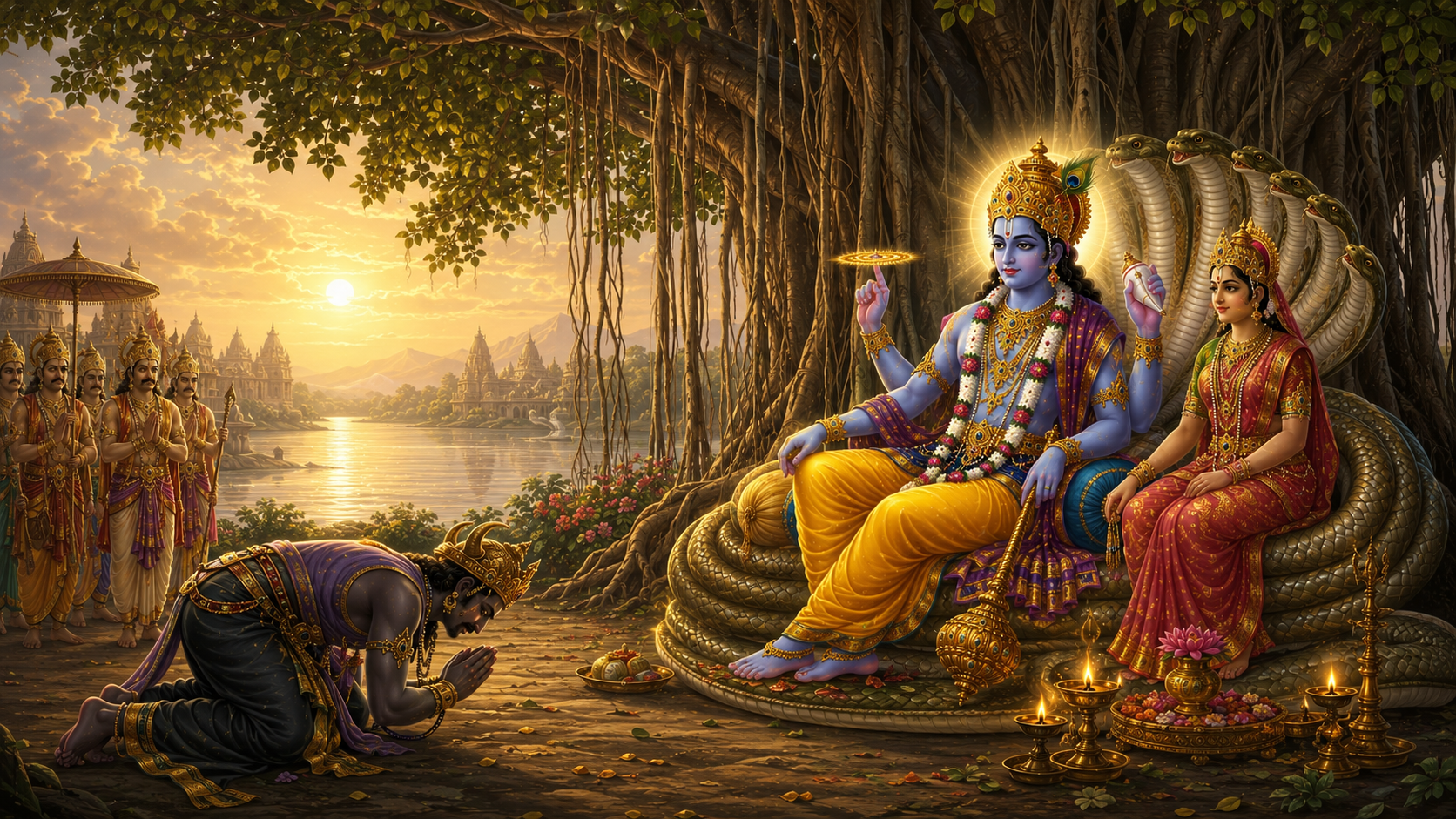
इत्येवं धर्म-राजस्तु पुरा न्यग्रोध-सन्निधौ ।
स्तुत्वा नाना-विधैः स्तोत्रैः प्रणामम् अकरोत् तदा ॥ ४५-६८ ॥
Thus (इति एवम्), long ago (पुरा), Yama (धर्म-राजः), having praised (स्तुत्वा) the Lord with many kinds (नाना-विधैः) of hymns (स्तोत्रैः) in the presence (सन्निधौ) of a banyan tree (न्यग्रोध), then (तदा) offered humble prostrations (प्रणामम् अकरोत्).
अपूपदानकाल-चिन्तनीय-भगवद्रूपाः
Here are the different forms to be remembered when performing the Daana of 33 Apoopa sweets:
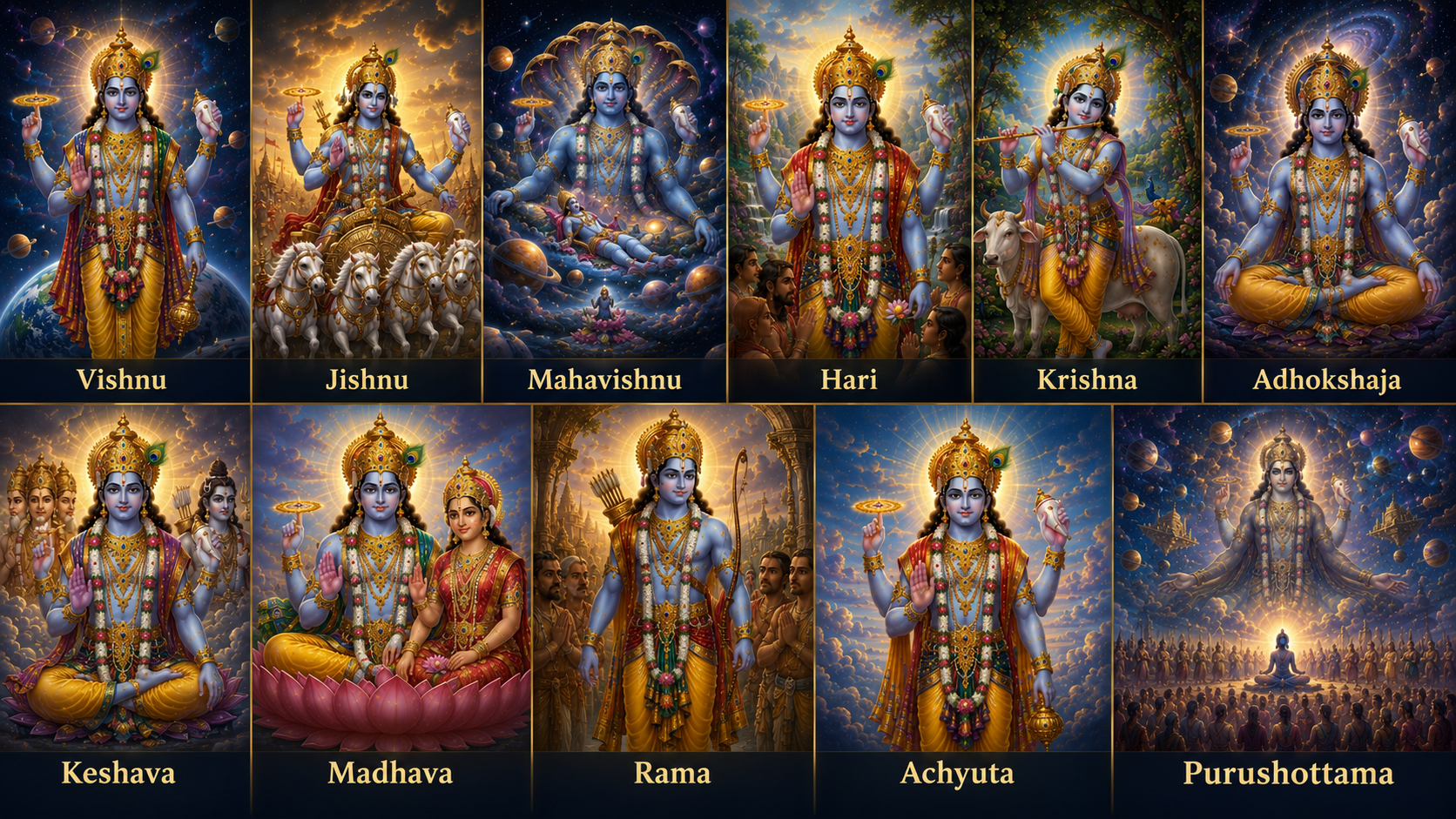
विष्णुं जिष्णुं महा-विष्णुं हरिं कृष्णम् अधोक्षजम् ।
केशवं माधवं रामम् अच्युतं पुरुषोत्तमम् ॥
One should meditate upon (चिन्तनीय) the following forms of the Lord:
Vishnu (विष्णुम्) – the All-pervading One,
Jishnu (जिष्णुम्) – the Ever-Victorious One,
Mahavishnu (महा-विष्णुम्) – the Great All-pervading Lord,
Hari (हरिम्) – the Remover (हरि) of sins, suffering and bondage,
Krishna (कृष्णम्) – the All-attractive Lord,
Adhokshaja (अधोक्षजम्) – He who is beyond (अधः) the grasp of the senses (अक्ष),
Keshava (केशवम्) – Lord of Brahma and Rudra, and the One with beautiful locks,
Madhava (माधवम्) – the Lord (धव) of Lakshmi and all Knowledge (मा),
Rama (रामम्) – the One who delights devotees,
Achyuta (अच्युतम्) – the Infallible One who never changes from,
and Purushottama (पुरुषोत्तमम्) – the Supreme Person beyond all beings.
- Each form of the Lord is complete, perfect, and fully identical in supremacy. The different forms exist only to reveal to devotees each distinct divine aspect and power of the same Supreme Lord.
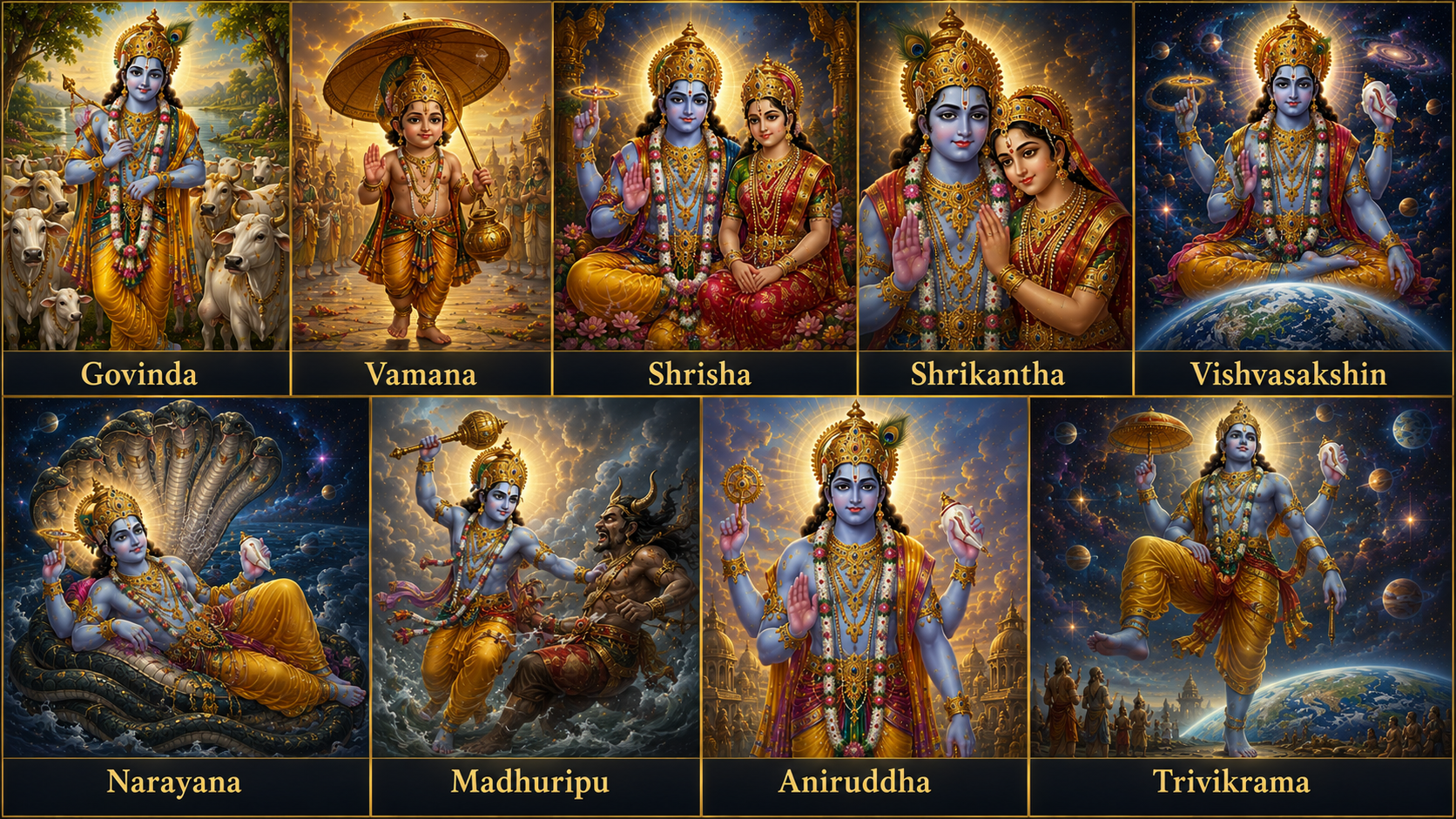
गोविन्दं वामनं श्रीशं श्रीकण्ठं विश्वसाक्षिणम् ।
नारायणं मधुरिपुम् अनिरुद्धं त्रिविक्रमम् ॥
One should meditate upon:
Govinda (गोविन्दम्) – Protector of cows, earth, Vedas and senses,
Vamana (वामनम्) – the Divine Dwarf incarnation,
Shrisha (श्रीशम्) – the Lord of Lakshmi (श्री),
Shrikantha (श्रीकण्ठम्) – He who bears Shri (Lakshmi) eternally,
Vishvasakshin (विश्व-साक्षिणम्) – the Witness of the entire universe,
Narayana (नारायणम्) – the Refuge (आयन) of all beings (नार),
Madhuripu (मधु-रिपुम्) – the destroyer (रिपु) of the demon Madhu,
Aniruddha (अनिरुद्धम्) – the Unobstructed and Unconquerable One,
and Trivikrama (त्रिविक्रमम्) – He who measured the three worlds.
- विश्वसाक्षिन् teaches that nothing is hidden from the Lord who witnesses every action, thought and intention.
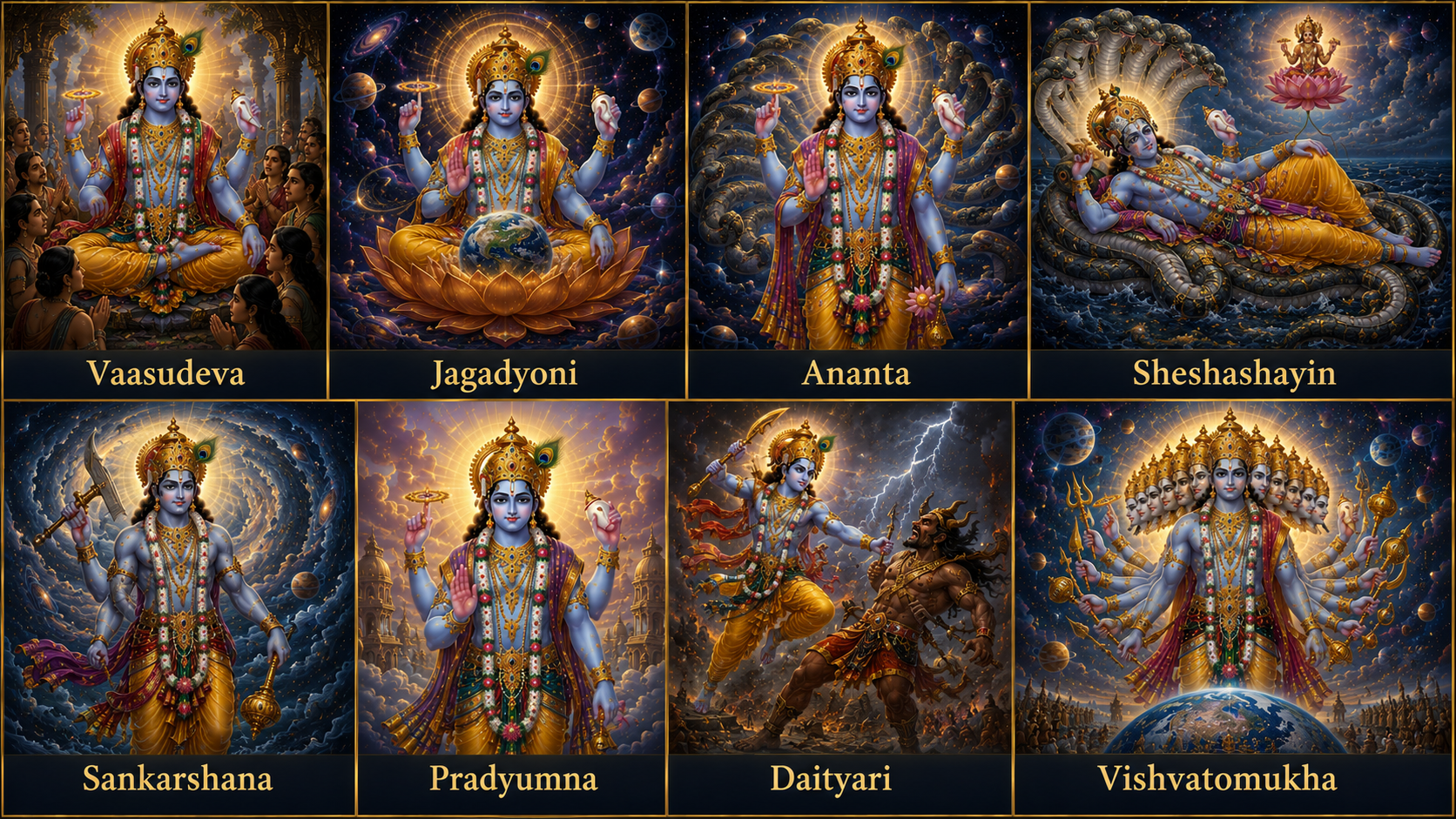
वासुदेवं जगद्-योनिम् अनन्तं शेष-शायिनम् ।
सङ्कर्षणं च प्रद्युम्नं दैत्यारिं विश्वतो-मुखम् ॥
One should meditate upon:
Vaasudeva (वासुदेवम्) – the indwelling Lord of all beings,
Jagadyoni (जगत्-योनिम्) – the Source and Origin of the universe,
Ananta (अनन्तम्) – the Infinite One,
Sheshashayin (शेष-शायिनम्) – He who reclines upon Adi Sesha,
Sankarshana (सङ्कर्षणम्) – He who draws all beings unto Himself during dissolution,
Pradyumna (प्रद्युम्नम्) – the Lord of supreme brilliance and intelligence,
Daityari (दैत्य-अरिम्) – the enemy and destroyer of demons,
and Vishvatomukha (विश्वतो-मुखम्) – whose faces and vision extend everywhere.
- The names Vasudeva, Sankarshana, Pradyumna, and Aniruddha are the famous Chatur-vyooha eternal manifestations described in Pancharatra.
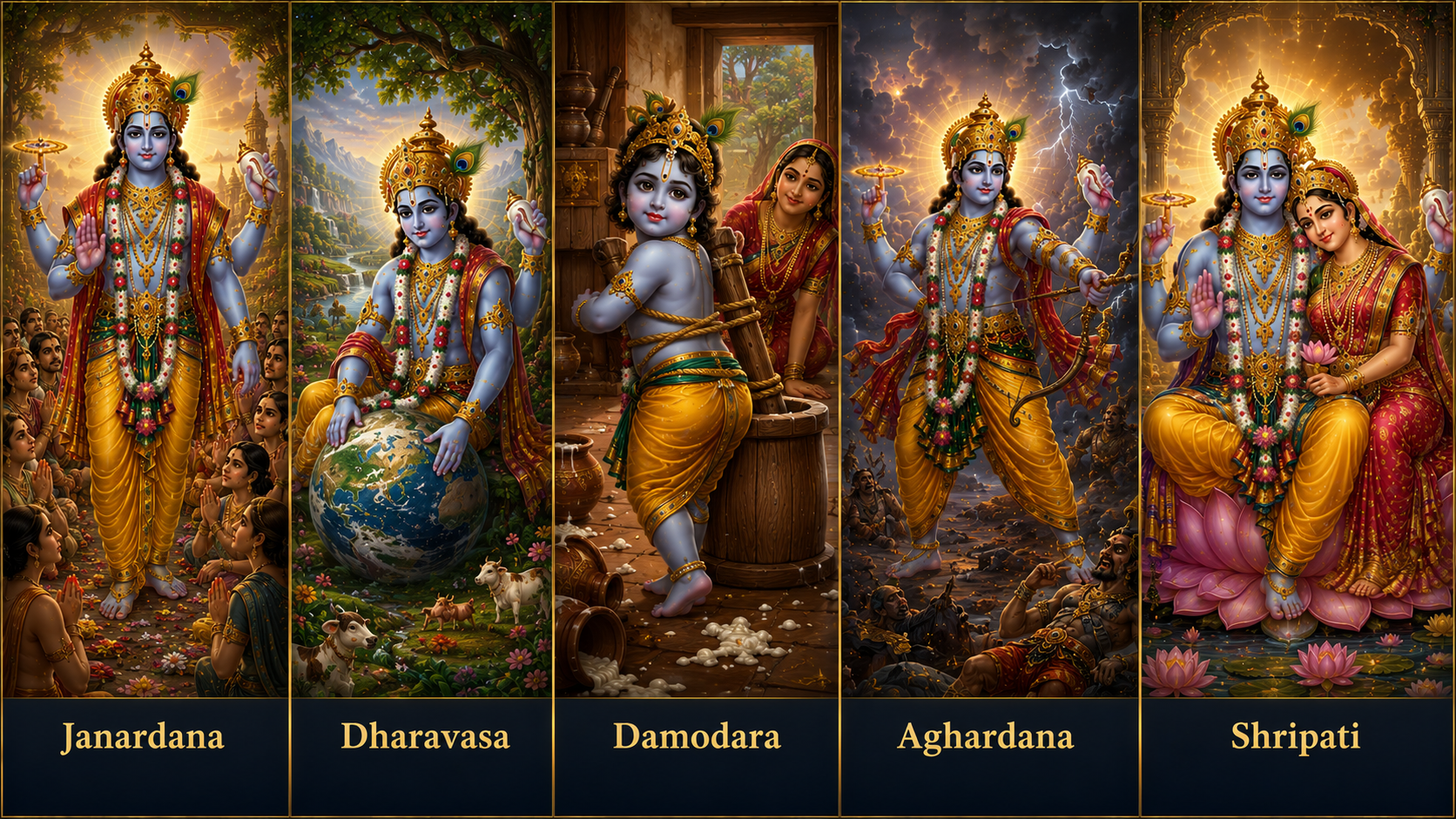
जनार्दनं धरा-वासं दामोदरम् अघार्दनम् ।
श्रीपतिं च त्रयस्त्रिंशद् उद्दिश्य प्रति-नामभिः ॥
One should meditate upon:
Janardana (जनार्दनम्) – He who corrects, protects and guides people,
Dharavaasa (धरा-वासम्) – He who dwells upon and supports the earth,
Damodara (दामोदरम्) – He whose waist (उदर) was bound (दाम) by Yashoda,
Aghardana (अघ-अर्दनम्) – the destroyer (अर्दन) of sins and troubles (अघ),
and Shripati (श्री-पतिम्) – the eternal Lord of Lakshmi (श्री),
thus remembering these thirty-three names (त्रयस्त्रिंशत् प्रति-नामभिः).
- दामोदर conveys that the Lord allows Himself to be bound only by devotion, never by force.
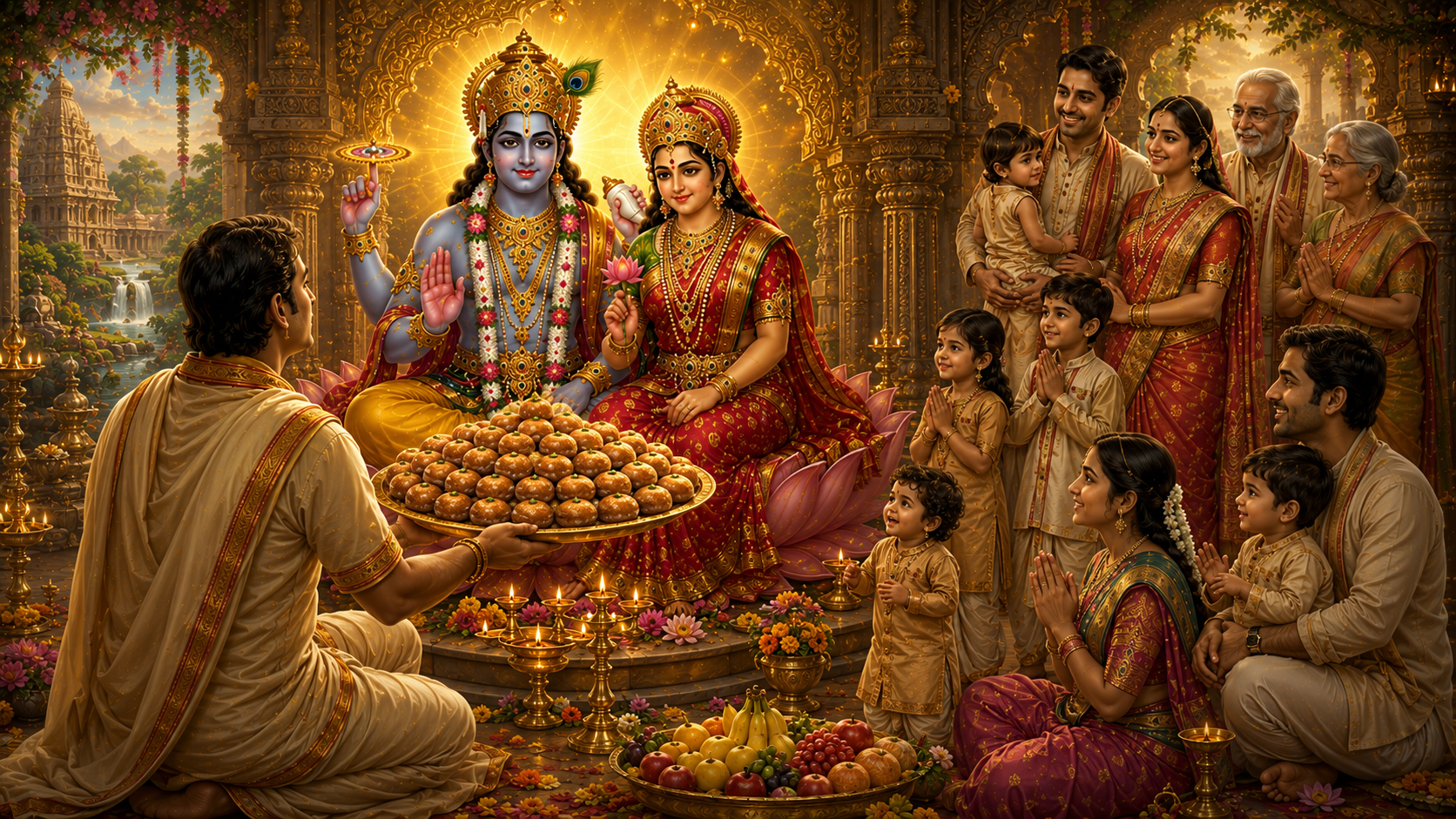
मन्त्रैः एतैः च यः दद्यात् त्रयस्त्रिंशद् अपूपकम् ।
प्राप्नोति विपुलां लक्ष्मीं पुत्र-पौत्र-आदि-सन्ततिम् ॥
Whoever (यः), using these mantras (मन्त्रैः एतैः), offers (दद्यात्) thirty-three Apoopa sweet-cakes (त्रयस्त्रिंशद् अपूपकम्), obtains (प्राप्नोति) abundant prosperity (विपुलां लक्ष्मीम्), children (पुत्र), grandchildren (पौत्र), and flourishing lineage (आदि-सन्ततिम्).
- The primary objective should be the grace of Lakshmi and Narayana. The rest of the material prosperity mentioned is made available to follow Dharma, not for worldly accumulation.
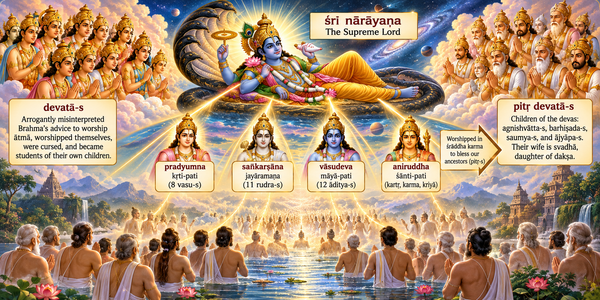
पुरुषोत्तममास-त्रयस्त्रिंशत्-देवता-भगवद्रूपाः
तत्-तत्-रूप-अन्तर्गत भारती-रमण-मुख्य-प्राण-अन्तर्गत भगवद्-रूपेभ्यो नमस्कारः
Salutations (नमस्कारः) to these thirty-three forms of Bhagavan (भगवद्-रूपेभ्यः), present within the respective deities, and ultimately presided over by Lord Hari through Bharati-Ramana Mukhyaprana.
- Note that each of the Vasu, Rudra, Aditya, Prajapati and Vashatkara deities has a corresponding in-dwelling form of the Lord who remains Supreme and independent. The deities function as dependent servants presiding over allotted functions using powers delegated to them by the Lord.
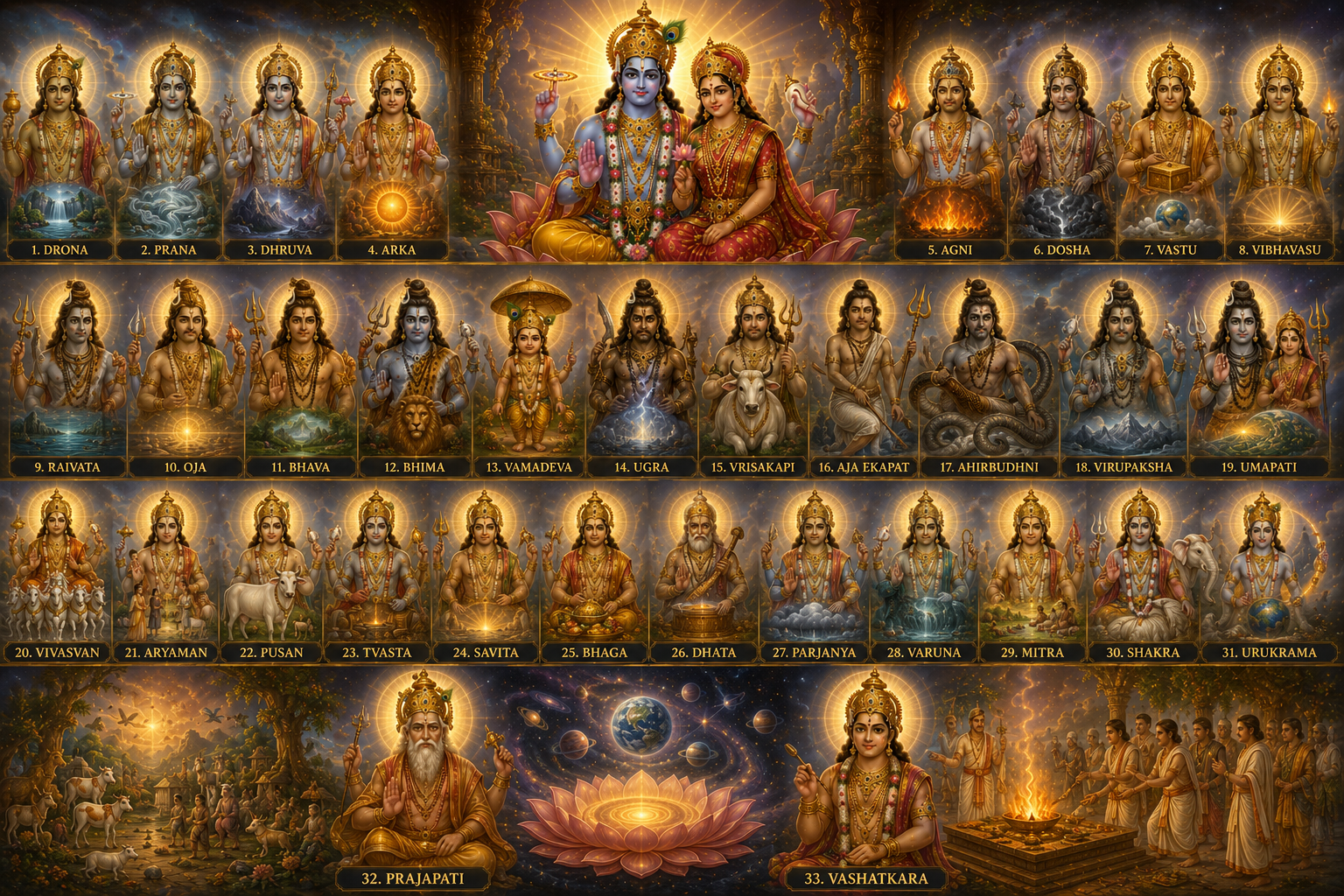
| १–८ Eight Vasu-s : अष्टवसवः द्रोण — विष्णु प्राण — जिष्णु ध्रुव — महाविष्णु अर्क — हरि अग्नि — कृष्ण दोष — अधोक्षज वस्तु — केशव विभावसु — माधव | ९–१९ Eleven Rudra-s : एकादश रुद्राः रैवत — राम ओज — अच्युत भव — पुरुषोत्तम भीम — गोविन्द वामदेव — वामन उग्र — श्रीश वृषाकपि — श्रीकण्ठ अजैकपात् — विश्वसाक्षी अहीर्बुध्नि — नारायण विरूपाक्ष — मधुरिपु उमापति — अनिरुद्ध | २०–३१ Twelve Aditya-s : द्वादश आदित्याः विवस्वान् — त्रिविक्रम आर्यमन् — वासुदेव पूषन् — जगद्योनि त्वष्टा — अनन्त सविता — शेषशायिन् भग — सङ्कर्षण धाता — प्रद्युम्न पर्जन्य — दैत्यारि वरुण — विश्वतोमुख मित्र — जनार्दन शक्र — धरावास उरुक्रम — दामोदर |
| ३२ Prajaapati : प्रजापति प्रजापति — अघार्दन | ३३ Vashatkaara : वषट्कार वषट्कार — श्रीपति |
References for more Adhika Maasa information:
- https://archive.org/details/adhika-masa-prabhanjanacharya
- https://meerasubbarao.wordpress.com/2026/05/13/aadhika-masa-significance-of-33-a-brief-note/
- https://shivallibrahmins.com/articles/adhika-masa/
- https://madhwafestivals.com/2018/04/23/adhika-maasa/
- https://madhwaprameyamahodadhi.blogspot.com/2023/07/adhika-masa.html
/Raghunath Rao/ “Do your Best … and leave the Rest … “
(All mistakes mine – all credit to Gurus and Acharyas)
|| sarvaṁ śrī kṛṣṇārpanamastu ||