हरि सर्वोत्तम । वायु जीवोत्तम | श्री गुरुभ्यो नमः
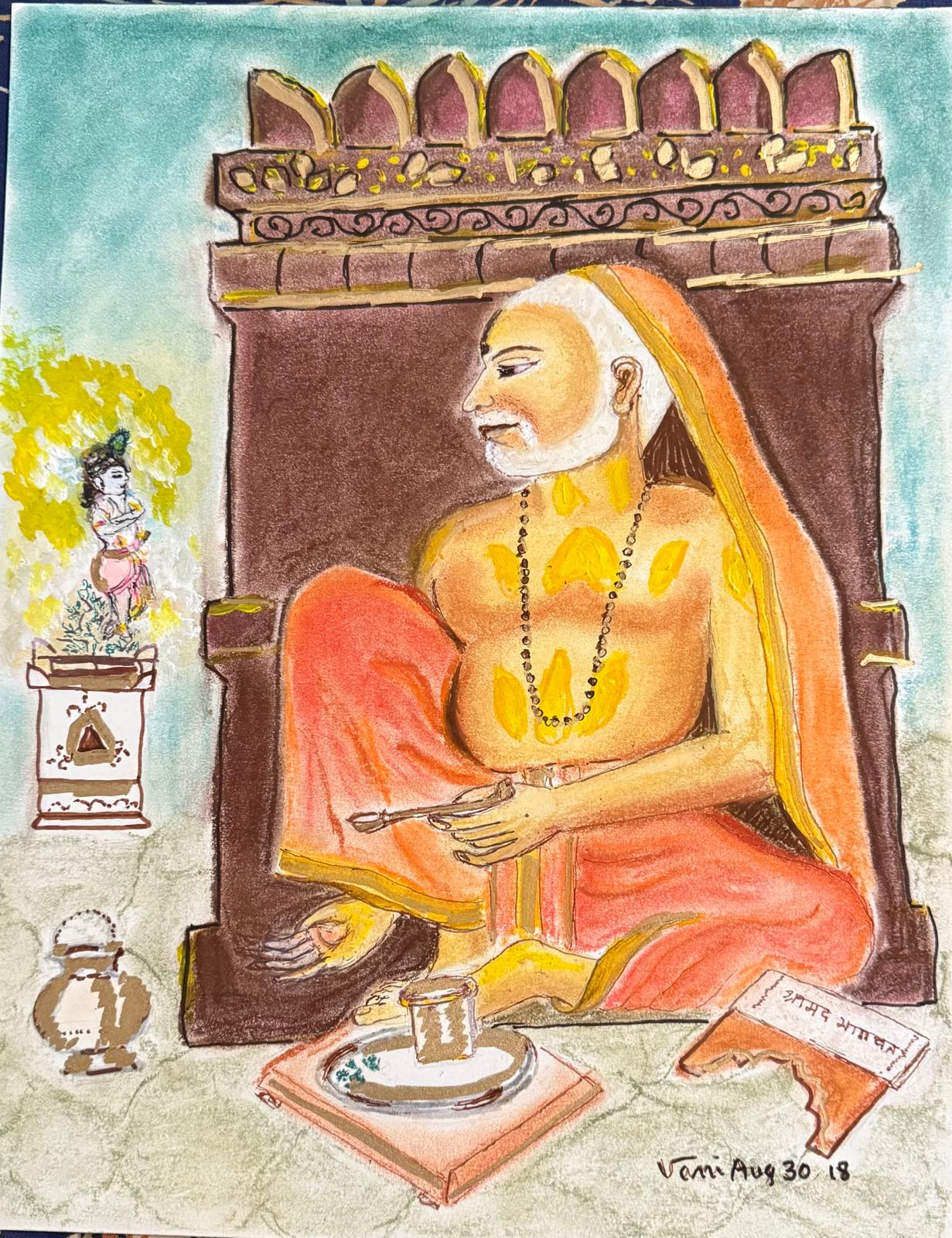
This is a translation and transcription of the beautifully ornate and deeply profound दण्डक followed by मङ्गळाष्टक on Raayaru, both of which are composed by his dear and devoted disciple Shri Appanacharya. Traditionally recited at the end of Rathotsava in Mantralaya, the grand prose description uses long metrical lines, dense compounds with rapid flowing rhythm, and intricate Sanskrit prosody in praise of Guru Saarvabhauma.
The दण्डक transliteration is based on the captivating rendition below by Late Shri Raghavendracharya, who performed pooja at Shri Raaghavendra Swamy’s Moola Brindavana.

(Link to CHANTING and ORIGINAL version)
श्री राघवेन्द्र दण्डकम् (Translation with Commentary)
सुर-कुल-कलित-आनति-श्री-रमाकान्त-पदाब्ज-लोलम्ब-लीला-लसत्-चित्त-योगीश्वर-श्रेष्ठ-गेयीयमान,
अति-भाव-उरु-कीर्ति-प्रभा-भासुर-आजाण्ड-वास्तव्य-भूलोक-मध्य-उल्लसत्-दिव्य-तुङ्गभद्रा-नदी-तीर-वास,
रमालोल-दास, गुणानाम्-निवास, जगत्-पाल-दास, सुविद्या-विलास, बुध-अन्तर्निवेश, लसत्-पण्डितेश,
लसत्-श्री-निवास ॥ १ ॥
He who is praised (गेयीयमान) as the foremost (श्रेष्ठ) among masters of Yoga (योगीश्वर),
whose mind (चित्त) sports delightfully (लीला-लसत्) like a bee (लोलम्ब) at the lotus feet (पदाब्ज) of the beloved Lord of
Ramaa (रमाकान्त),
to whom the pantheon of Devas (सुर-कुल) bow (आनति);
the master (प्रभो) whose exceedingly profound (अति-भाव) and great (उरु) glory (कीर्ति) shines brilliantly (प्रभा-भासुर);
who dwells (वास्तव्य) in the earthly world (भूलोक),
in the midst of the universe (आजाण्ड), upon the resplendent (उल्लसत्) divine (दिव्य) bank (तीर) of the Tungabhadraa River (तुङ्गभद्रा-नदी);
the servant (दास) of the Lord who delights Ramaa (रमालोल);
the abode (निवास) of virtues (गुणानाम्);
the servant (दास) of the protector (पाल) of the world (जगत्);
the splendour (विलास) of exalted knowledge (सुविद्या);
the indwelling presence (अन्तर्निवेश) in the wise (बुध);
the radiant (लसत् ) lord of scholars (पण्डितेश);
the shining (लसत्) abode of knowledge and spiritual wealth (श्री-निवास).
• The opening passage establishes the exalted position of Shri Raaghavendra due only to his unwavering devotion to Lord Hari.
ज्वलत्-रत्न-विभ्राजमान-उल्लसन्-मौलि-लेख-ऋषि-गन्धर्व-यक्ष-उरग-अधीश-कोटीर-सङ्घृष्ट-नारायण-अङ्घ्रि-द्वय-अम्भोज-भृङ्गायमान-अन्तरङ्ग-श्रिय, राजमान, अति-साम्राज्य-भृत, मध्व-मौनीन्द्र-सत्-शास्त्र-पाथोधि-चन्द्र ॥ २ ॥
His inner being (अन्तरङ्ग) is like a bee (भृङ्गायमान) at the lotus (अम्भोज) twin feet (अङ्घ्रि-द्वय) of Naaraayana (नारायण);
which (feet) are touched (सङ्घृष्ट) by the rows of crowns (कोटीर) of Devas (लेख), sages (ऋषि), Gandharvas (गन्धर्व), Yakshas (यक्ष) and serpent kings (उरग-अधीश);
which (crowns) shine (विभ्राजमान) with blazing jewels (ज्वलत्-रत्न);
He is resplendent (राजमान) and bears supreme sovereignty (अति-साम्राज्य-भृत).
He is the moon (चन्द्र) of the ocean (पाथोधि) of the true Shaastras (सत्-शास्त्र) of Madhva, the great sage (मध्व-मौनीन्द्र).
• As per Madhva shaastra, Naaraayana’s feet are placed above all other beings, devotion to which is the reason for Shri Raaghavendra’s brilliance.
श्रिया-लक्षित-इन्द्र, वचः-स्रस्त-तन्द्र, नमः-अस्तु-क्षम-इन्द्र, रस-आसद्-बुध-इन्द्र,
वर-श्री-जयीन्द्र-उरु-हस्त-अब्ज-सम्भूत, विख्यात-विद्वत्-सुधीन्द्र-अब्धि-चन्द्र, गुरो राघवेन्द्र ॥ ३ ॥
O lord (इन्द्र) blessed by Shri (श्रिया-लक्षित), one whose speech (वचः) is free (स्रस्त) from lethargy (तन्द्र);
O lord of forbearance (क्षम-इन्द्र);
O foremost among the wise (बुध-इन्द्र),
who delights in the nectar of wisdom (रस-आसद्);
born (सम्भूत) from the lotus-hand (हस्त-अब्ज) of
the excellent Shri Vijayeendra (वर-श्री-जयीन्द्र);
you are the moon (चन्द्र) to the ocean (अब्धि) of the renowned scholar (विख्यात-विद्वत्) Sudheendra (सुधीन्द्र);
O Guru Raaghavendra (गुरो राघवेन्द्र), my salutations (नमः-अस्तु) to you.
• Shri Raaghavendra’s lineage in the Madhva Guru Paramparaa is shown mentioning Shri Vijayeendra Teertha and Shri Sudheendra Teertha.
मन्त्रालय-स्थान-भद्रा-समाश्लिष्ट-तुङ्गा-तटे देव-यात्राम् नभो-वासि,
कृष्ण-द्वितीयायाम् गुरोः-वासरे सं-समाकल्प्य, वृन्दावन-अन्तः
समुत्थाय, नित्योत्सवैः,पक्ष-मास-आदि-भक्तोत्सवैः, समुपलक्षित ॥ ४ ॥
At the holy place of Mantraalaya (मन्त्रालय-स्थान),
embraced (समाश्लिष्ट) by Bhadraa (भद्रा), on the bank (तटे) of the Tungaa (तुङ्गा);
having fully ordained (सं-समाकल्प्य) the divine journey (देव-यात्राम्) in the month of Shraavana (नभो-वासि),
on 2nd day of the dark half (कृष्ण-द्वितीयायाम्), on Thursday, the weekday of the Guru (गुरोः-वासरे);
having entered (समुत्थाय) within the Brindaavana (वृन्दावन-अन्तः),
he is honored (समुपलक्षित) through continuous festivities (नित्योत्सवैः) and devotional services (भक्तोत्सवैः)
observed fortnightly, monthly and other occasions (पक्ष-मास-आदि).
• नभस् is the Vedic name for Shraavana but नभो-वासि also means dweller of the heavens which describes the destination of Raayara’s entering the Brindaavana.
कुष्ठ-अन्ध्य-बाधिर्य-मूकत्व-पङ्गुत्व-कुब्जत्व-वक्रत्व-नैष्पुत्र्य,
वन्ध्यत्व-वैरुद्ध्य-मात्सर्य-मत्तत्व-लुब्धत्व-क्रुद्धत्व,
मुख्य-अखिल-प्रौढ-दोष-उपदोष-आख्य-सद्-वृक्ष-कुञ्ज-अटवी-दाह,
दावाग्नि-कल्प-पादारविन्द-प्रभो, स्वामि-राज-प्रभो, राघवेन्द्र-प्रभो, रामचन्द्र-प्रभो ॥ ५ ॥
O Lord (प्रभो) whose lotus feet (पादारविन्द) are like a forest fire (दावाग्नि) that truly (सद्) burns ( दाह) the grove-forest (कुञ्ज-अटवी) of the trees (वृक्ष) that represent (आख्य) major (मुख्य) and deeply rooted (प्रौढ) defects (दोष) and subsidiary defects (उपदोष) of all kinds (अखिल),
such as leprosy (कुष्ठ), blindness (अन्ध्य), deafness (बाधिर्य), muteness (मूकत्व), lameness (पङ्गुत्व), deformity (कुब्जत्व), crookedness (वक्रत्व), childlessness (नैष्पुत्र्य), barrenness (वन्ध्यत्व), hostility (वैरुद्ध्य), jealousy (मात्सर्य), intoxication (मत्तत्व), greed (लुब्धत्व), and rage (क्रुद्धत्व);
O Lord and sovereign master (स्वामि-राज-प्रभो), O Lord Raaghavendra (राघवेन्द्र-प्रभो), O Lord Raama (रामचन्द्र-प्रभो).
• The verse describes both physical afflictions and serious inner defects both of which are within Shri Raaghavendra’s grace and power to remove.
एहि माम्, याहि माम्, पाहि माम्, रक्ष माम्
सर्वदा, सर्व-देशेषु, सर्व-प्रकारेण, सर्व-इष्ट-सिद्धि-अर्थम्,
अत्यन्त-माद्रेण चित्तेन संस्-सेवमानम्, सदा बाल-बाल-उपमानम्,
तव श्री-पद-अम्भोज-दास-अनुदासम्, जीयात्-भवान्, अस्तु मे श्रीः,
सदा नमः-ते नमः-ते वचः-ते यशः-ते शिरः-ते करः-ते नमः-ते नमः ॥ ६ ॥
Approach me (एहि माम्), reach me (याहि माम्), protect me (पाहि माम्), guard me (रक्ष माम्),
always (सर्वदा), in all places (सर्व-देशेषु), and in every manner (सर्व-प्रकारेण),
for the fulfilment (सिद्धि-अर्थम्) of all that is desired (सर्व-इष्ट);
I serve you (सेवमानम्) with a mind (चित्तेन) filled with utmost (अत्यन्त)
reverence (माद्रेण), like a little child (बाल-बाल-उपमानम्);
I am the servant (दास) of the servants (अनुदास) of your auspicious (श्री) lotus feet (पद-अम्भोज);
May you ever be victorious (जीयात्-भवान्). May auspiciousness (श्रीः) be mine (मे अस्तु).
Always (सदा), salutations (नमः-ते), salutations (नमः-ते) to you;
to your speech (वचः-ते), your fame (यशः-ते), your head (शिरः-ते), your hands (करः-ते), salutations (नमः-ते), salutations (नमः).
• दास-अनुदासम् expresses the ideal of being the servant of the servants of the Guru’s lotus feet, who is himself a servant of Lord’s lotus feet.
सकल-भुवन-भूषायमान-शारद-इन्दु-मण्डल-देदीप्यमान-मुख-मण्डल-मण्डित-हेम-गात्रम्,
कुन्द-कुड्मल-कोमल-दन्त-पङ्क्ति-विराजितम्, चम्पक-सुमन-नासिका-विलसितम्,
खञ्जरीट-वत्-आचरित-नेत्र-द्वन्द्व-उपशोभितम् ॥ ७ ॥
His golden body (हेम-गात्रम्), adorned (मण्डित) with a face (मुख-मण्डल) shining brilliantly (देदीप्यमान) like the autumn moon (शारद-इन्दु-मण्डल) that embellishes (भूषायमान) all the worlds (सकल-भुवन);
His teeth (दन्त-पङ्क्ति) are beautiful (विराजितम्) and tender (कोमल) like Jasmine buds (कुन्द-कुड्मल);
His nose (नासिका) shines (विलसितम्) like a Champaka flower (चम्पक-सुमन);
His pair of eyes (नेत्र-द्वन्द्व) is beautifully radiant (उपशोभितम्), moving (आचरित) like the graceful black-white wagtail bird (खञ्जरीट-वत्).
• This section begins an extended meditation on Shri Raaghavendra’s form with similes emphasizing auspicious beauty and spiritual radiance.
सन्तत-वेदान्त-श्रवण-मण्डित-श्रोत्र-द्वन्द्व-विराजितम्,
आदर्श-वत्-परिशोभित-गण्ड-युग्म-भासितम्,
कम्बु-कन्धर-उल्लसत्-तुलसी-दाम-भूषितम्,
कर-कमल-विराजमान-दण्ड-कमण्डलुभ्याम्-अलङ्कृतम्,
द्वारावती-कलित-रम्य-महा-ऊर्ध्व-पुण्ड्र-लक्षण-लक्षित-वैष्णव-दीक्षा-दक्षम्,
अरुण-किरण-अनुकारि-काषाय-वस्त्र-परिशोभित-दिव्य-देहम्,
पादुकोपरि-विन्यस्त-परम-पावन-पद-पङ्कजम्, सर्व-तन्त्र-स्वतन्त्रम्,
श्री-श्री-राघवेन्द्र-गुरुम्, भजेऽहम् भजेऽहम् भजेऽहम् भजे ॥ ८ ॥
His ears (श्रोत्र-द्वन्द्व) are adorned (मण्डित) by continual (सन्तत) listening (श्रवण) to Vedanta (वेदान्त);
his two cheeks (गण्ड-युग्म) shine (भासितम्) beautifully (परिशोभित) like a mirror (आदर्श-वत्).
his conch-like neck (कम्बु-कन्धर) is adorned (भूषितम्) with a shining (उल्लसत्) Tulasee garland (तुलसी-दाम);
his lotus-like hands (कर-कमल), majestically (विराजमान) adorned (अलङ्कृतम्) by the monk’s staff (दण्ड) and holy water-pot (कमण्डलु);
he is skilled (दक्षम्) in Vaishnava initiation (वैष्णव-दीक्षा), marked (लक्षित) with the beautiful great upward forehead mark (रम्य-महा-ऊर्ध्व-पुण्ड्र), made with Gopichandana from Dvaarakaa (द्वारावती-कलित), as its sacred characteristic (लक्षण).
his divine body (दिव्य-देहम्) is adorned (परिशोभित) with saffron garments (काषाय-वस्त्र) resembling (अनुकारि) the rays (किरण) of the rising sun (अरुण);
his supremely sacred (परम-पावन) lotus feet (पद-पङ्कजम्) are placed (विन्यस्त) upon the sandals (पादुकोपरि).
He is independently knowledgeable (स्वतन्त्रम्) in all Shaastra-s (सर्व-तन्त्र).
I worship (भजेऽहम्) the highly auspicious (श्री-श्री) Guru Raaghavendra (राघवेन्द्र-गुरुम्).
I worship him again and again (भजेऽहम् भजेऽहम् भजे).
• The verse visualizes Shri Raaghavendra as a traditional Vaishnava Yati.
जय जय जय, परिव्राड्-राज-राजाधिराज-गुरु-सार्वभौम, श्री-श्री-राघवेन्द्र-प्रभो ॥ ९ ॥
Victory (जय), victory (जय), victory (जय) to the supreme Guru (गुरु-सार्वभौम),
the king (राज) of ascetics (परिव्राड्) and sovereign among kings (राजाधिराज) thereof;
O Lord (प्रभो), highly auspicious (श्री-श्री) Guru Raaghavendra (श्री-श्री-राघवेन्द्र).
• This victory chant and succession of royal titles expresses the supreme eminence of Shri Raaghavendra among Yatis.
पुरा खलु विधायापि शुश्रूषाम्-अनलम्-बुद्धिना किल,
तत्र भवता भवता श्रीमता व्यास-अवतारेऽपि शिषेविषुणा,
वेङ्कट-आज्ञया वेङ्कट-आख्यया अवतीर्य,
तत्र प्रवचन-अर्चना-आदि-उपचर्यया-अपि तोषयित्वा श्रीकृष्णम् ॥ १० ॥
Formerly indeed (पुरा खलु), having also rendered (विधायापि) devoted service (शुश्रूषाम्) with immeasurable
(अनलम्) intelligence (बुद्धिना), there too (तत्र), by you (भवता), the illustrious one (श्रीमता),
desirous of serving (शिषेविषुणा) even in the incarnation of Vyaasa (व्यास-अवतारेऽपि),
having descended (अवतीर्य) by the command of Venkatesha (वेङ्कट-आज्ञया) under the name Venkata (वेङ्कट-आख्यया),
there too (तत्र) having pleased (तोषयित्वा) Shri Krishna (श्रीकृष्णम्) through discourse (प्रवचन), worship (अर्चना), and other respectful services (आदि-उपचर्यया-अपि).
• The verse emphasizes that the Guru’s exceptional intelligence is directed toward devoted service to the Lord by means of discourse, worship and service – not merely toward intellectual accomplishment.
पुत्र-मित्र-क्षेत्र-कळत्र-आदिकम्, तत्र संसृति-पाश-पतित-तरणे च अन्तराय-रूपम् मन्यमानेन,
अधिकृत्य गार्हस्थ्यम् अङ्गीकृत्य प्रभोः-आज्ञाम्, तञ्जापुरे
रुधिर-उद्गारि-समायाम्, तपस्ये-मासे, शुक्ल-द्वितीयायाम्,
गुरोः-वासरे स्वीकृत्य वराश्रमम्, अलङ्कृत्य कुम्भकोणम्,
निराकृत्य यादवेन्द्रम्, तिरस्कृत्य दुर्वादीन्द्रान् ॥ ११ ॥
Considering sons (पुत्र), friends (मित्र), property (क्षेत्र), spouse (कळत्र), and other such attachments (आदिकम्) to
be obstacles (अन्तराय-रूपम्) to crossing (तरणे) the bonds (पाश) of worldly existence (संसृति);
having regarded them as such (मन्यमानेन), having undertaken (अधिकृत्य) the householder’s position (गार्हस्थ्यम्)
and accepted it (अङ्गीकृत्य) by the command (आज्ञाम्) of the Lord (प्रभोः);
at Tanjaavur (तञ्जापुरे), in the lunar year of Rudhirodgaari (रुधिर-उद्गारि-समायाम्), in the month of Phaalguna (तपस्ये-मासे), on the second day of the bright fortnight (शुक्ल-द्वितीयायाम्), on Thursday, the weekday of the Guru (गुरोः-वासरे),
having accepted (स्वीकृत्य) the supreme order of ascetism (वराश्रमम्), having adorned (अलङ्कृत्य) Kumbhakonam (कुम्भकोणम्), having taken over (निराकृत्य) from Yaadavendra (यादवेन्द्रम्), and having vanquished (तिरस्कृत्य) the hostile disputants (दुर्वादीन्द्रान्)…
• Yaadavendra Teertha had received sannyaasa from Sudheendra Teertha before Guru Raaghavendra but was on pilgrimage at this time. However, even when offered the pontiff position and worship of Moola Raama upon return, he declined the position and continued his pilgrimage, leaving the establishment under Raayaru.
सु-भक्त-उद्धरण-अर्थम् प्राच्याम् काष्ठायाम्-आशङ्ख-मुखम्,
अवाच्याम्-आराम-सेतु, प्रतीच्याम्-आरजत-पीठ-पुरम्,
उदीच्याम्-आ-पौण्डरीकम्,भूषित-दिगन्तरेण, ततः किल मन्त्रालयम्-इयासुना,
मनाक् स्व-महिमा-मौल्येन स्वायत्तीकृतम्, म्लेच्छ-राजेन तत्-स्वायत्तीकृत-मन्त्रालये ॥ १२ ॥
… for the uplift (उद्धरण-अर्थम्) of true devotees (सु-भक्त),
in the eastern direction (प्राच्याम् काष्ठायाम्) towards the Bay of Bengal (आशङ्ख-मुखम्);
in the southern direction (अवाच्याम्) towards Raameshwaram (आराम-सेतु);
in the western direction (प्रतीच्याम्) towards Udupi (आरजत-पीठ-पुरम्);
in the northern direction (उदीच्याम्) towards Pandharpur (आ-पौण्डरीकम्);
adorning [traversing] the different directions (दिगन्तरेण);
and then, intending to go (इयासुना) to Mantraalaya (मन्त्रालयम्),
by just a little (मनाक्) of his own glorious greatness (स्व-महिमा-मौल्येन) made it his own (स्वायत्तीकृतम्) bringing under his authority (तत्-स्वायत्तीकृतम्) by the foreign king (म्लेच्छ-राजेन) at Mantraalaya (मन्त्रालये).
• Apart from Raayaru’s dig-vijaya, the miraculous way in which Raayaru got Mantraalaya from Nawab of Adoni (Siddi Masud Khan) is referred to here also.
निर्विरोधेन-अपि विरोधि-कृत्-वत्सरे, शुभ-आसा-अपि नभो-मासे,
अद्वितीयेन-अपि कृष्ण-द्वितीयायाम्, सत्-वृन्दावने,
सत्-वृन्दावन-अर्थम् उष्यते, सकर्मन्दिरात् ॥ १३ ॥
In the year (वत्सरे) called Virodhikrit (विरोधि-कृत्), even though there was no
conflict (निर्विरोधेन-अपि),
in the auspicious month of Shraavana (नभो-मासे); on the unique (अद्वितीयेन-अपि) second day of the dark half (कृष्ण-द्वितीयायाम्),
he takes residence (उष्यते) in the holy Brindaavana (सत्-वृन्दावने) with his spiritual merits (स-कर्मन्दिरात्) to make the Brindaavana sacred for his devotees.
• This passage emphasizes that Shri Raaghavendra’s Brindaavana is a sacred continuation of his presence and service to Lord in order to shower deserving devotees with the extra puNya he has accumulated over his four avataara-s (Shankukarna->Prahlaada->Baahlika->Vyaasaraaja->Raaghavendra).
कमल-आलपन-जम्बाल-जपतङ्गायित-श्रीमूल-
दिग्विजय-जयराम-अङ्घ्रि-पाथोज-निषट्पदायितः,
यजन-तोषित-मन्थान-दामकर-कृष्णः, सल्लोक-लोचन-चकैरव-अब्जायितः,
श्रीमत्-सुधा-परिमळ-वासित-दिङ्-मण्डलः, वितरण-जित-कर्णः,
सुधी-जित-सुवाक्-पतिः-त्वम् ॥ १४ ॥
You are like an engrossed honeybee (निषट्पदायितः) at the lotus feet (अङ्घ्रि-पाथोज) of Moola Raama, Digvijaya Raama, and Jaya Raama (श्रीमूल-दिग्विजय-जयराम);
which lotuses bloom (कमल-आलपन) from the mire of worldly life (जम्बाल) by the rays of the Sun-like power of your meditation (जपतङ्गायित);
you have pleased (तोषित) through your sacrifices and worship (यजन) the Lord Krishna (कृष्णः) of Udupi holding the churning rod (मन्थान) and rope (दामकर);
you are the lotus-blooming moon (अब्जायितः) to the Chakora-like (चकैरव) eyes (लोचन) of virtuous people (सल्लोक);
your divine (श्रीमद्) nectar-like commentaries (सुधा) enrich (वासित) all directions (दिङ्-मण्डल) with the perfume of Madhva shaastra (परिमळ) ;
you have surpassed (जित) Karna (कर्णः) in generosity to seekers (वितरण);
you are the master of eloquent speech (सुवाक्-पतिः) with superior wisdom (सुधी).
• श्रीमूल-दिग्विजय-जयराम invokes the three sacred Raama forms that are worshipped in Shri Raaghavendra Matha.
• Just as Chakora birds long for moon beams and are nourished by them, virtuous people are attracted to Raayaru for his speech, commentaries and wisdom.
• श्रीमत्-सुधा-परिमळ poetically alludes to Raaghavendra’s Sudhaa Parimala the essential commentary that is critical to understanding Jayateertha’s Nyaayasudhaa and thereby Madhva Shaastra.
अनन्य-गतिकम् संसृति-पतितम् त्वत्-पाद-अम्बुज-सेवक-दासम् मत्वा व्यासम्
दोष-आवासम्, पालय पालय पालय भोः,
जय जय गुरुराज गुरुराज ॥ १५ ॥
Considering (मत्वा) me, as one who has no other refuge (अनन्य-गतिकम्),
fallen into worldly existence (संसृति-पतितम्),
the servant of the servants (सेवक-दासम्) of Your lotus feet (त्वत्-पाद-अम्बुज),
with split mind (व्यासम्), an abode of faults (दोष-आवासम्),
protect me (पालय), protect me (पालय), protect me (पालय), O Lord (भोः);
victory, victory (जय जय) to You, O king of Gurus (गुरुराज), O king of Gurus (गुरुराज).
• This verse reflects the author Appanaachaarya’s confession of complete dependence upon the Guru who is the devoted servant of Hari.
भानु-वंश-अब्धि-राकेन्दु-धानुष्क-कुल-शेखरम्
सानु-मद्-धीरता-धारम्स्तो नुमः त्वाम् रघूद्वह ॥ १६ ॥
We praise (स्तोनुमः) You (त्वाम्), who are like your beloved deity Raama to us:
Who is the full moon (राकेन्दु) of the ocean (अब्धि) of the solar dynasty (भानु-वंश),
the crest-jewel (कुल-शेखरम्) of the lineage (कुल) of bow-bearing heroes (धानुष्क),
the bearer (धारम्) of a mountain-like great courage (सानु-मद्-धीरता),
the exalted one in the lineage of Raghu (रघूद्वह).
• This verse reflects how devotees even today approach Raaghavendra with such intense faith as they would have for Lord Raama Himself – which is of course due to Raayaru’s devotion and service to श्रीमूल-दिग्विजय-जयराम.
नमत्-अमर-किरीट-पाली-मिष-आरार्ति-कालि-लसत्-चम्पकाली-रुचि-प्रौढि-केली,
सुहृद्-रत्न-पाली-समञ्चत्-प्रवाली, य-राग-प्रतोलीक-हीर-अङ्कुर-आली, क-दीप-प्रणाली,
घन-उद्यत्-प्रभा-आली, विनीराजित-आली, न-शोभा-मधूली, भरा-मिश्र-धूली,
भृत-प्रान्त-नाली, सत्-इन्द्र-अश्व-मौली, ऋत-आभानि-चूली, भवद्-व्योम-राली,
गम-अनील-चूली, युग-अङ्घ्रि-द्वय-आलय-अराल-लक्ष्मी-कहेली, ऋत-न्यक्-कुहेली,
वियोग-अनराली, भवत्-पौष्व-गौली, शरी-लोलुभाली, हित-अस्तोक-ताली, भवत्-सन्-मनाली,
लसत्-फुल्ल-नालीकम् ॥ १७ ॥
Your radiant (लसत्) fully bloomed (फुल्ल) lotus-like Brindaavana (नालीकम्):
is an intense display (प्रौढि-केली) of golden radiance (रुचि) like shining (लसत्) champaka blossoms (चम्पकाली) illuminated by the rows (पाली) of crowns (किरीट) of immortal Deva-s (अमर) bowing (नमत्) [to the Lord] depicted (मिष) in the Mangalaarati ritual (आरार्ति-कालि);
is adorned with rows (पाली) of precious jewels (रत्न), beautifully arranged (समञ्चत्), with coral-like
brilliance (प्रवाली);
is clustered with rows (आली) of diamond-like points (हीर-अङ्कुर) lined with paths (प्रतोलीक) of ruby-like radiance (य-राग);
is shining like channels (प्रणाली) of bright lamps (क-दीप);
is filled with dense (घन) and radiant (उद्यत्) streams (आली) of light (प्रभा);
is decorated with brilliantly illuminated (विनीराजित) rows (आली);
is overflowing (भृत) with the sweetness (मधूली) of auspiciousness (न-शोभा) mingled (मिश्र) with dense (भरा) holy soil (धूली) up to the surrounding edges (प्रान्त-नाली);
is reflecting the brilliance from the crown (मौली) of the foremost Deva Indra (सत्-इन्द्र) on his white stallion (अश्व) as auspicious (ऋत) brilliant (आभानि) flashes (चूली) transforming (भवद्) the sky (व्योम) into rows (राली) of moving (गम deep-blue (अनील) crests (चूली);
where the playful grace (कहेली) of the beauty (लक्ष्मी) of the symmetrical (अराल) abode [Paaduka] (आलय) pair (द्वय) of your two feet (युग-अङ्घ्रि) that truly (ऋत) suppress (न्यक्) the fog of delusion (कुहेली);
which cures the crooked grief (अनराली) of separation (वियोग);
[which Brindaavana] is dripping with flower-like sweetness (पौष्व-गौली), which rows of thirsting bees (लोलुभाली) eagerly long for (शरी); and continues to bestow (ताली) abundant (अस्तोक) welfare (हित) upon rows and rows of minds (मनाली) of your virtuous devotees (भवत्-सन्).
• Raayaru’s Brindaavana is described with beautiful similes, allegories and metaphors.
• नमत्-अमर at the very beginning reminds us that Mangalaarati is performed to Lord and Vaayu to whom all Devas bow to, and only then to Raayaru’s Brindaavana before we receive it.
• Appanaachaarya was not present when Raayaru entered the Brindaavana. So we have to consider this detailed description as what he saw through the eyes of his devoted mind and subsequent proceedings honoring the Brindaavana.
• To end this passage, Appanaachaarya imagines after abhisheka with milk, honey etc. and decorated with fragrant flowers how attractive the Brindaavana must be for bees. He then maps this to how devotees swarm to Mantraalaya to enjoy the nectar-like blessings of Raayaru.
• By mapping the description of the Brindaavana to Raayaru one can already get a visual picture of Raayaru that Appanacharya delves into next.
सुललित-नव-कम्बु-निन्दा-समुत्थान-कन्दायित-श्री-समुन्दान-हद्-द्योत-वृन्द-आवृत-स्निग्ध
वृन्दारक-आराम-मन्दार-संवास-बिन्द-आदि-पूग-अग्र-विन्द
सह-आभानु-विन्द-न-शोभा-अभिसन्दायि-रेखा-त्रय-दामभिः
स्वर्ण-सन्दानितैः विभ्रत्-अण्डापि-दाभम्-गलम् ॥ १८ ॥
With a neck (गलम्) that makes even a fresh (नव) conch (कम्बु) seem inferior (निन्दा);
rises beautifully (समुत्थान) like a tender stem (कन्दायित);
is filled with auspicious (श्री) splendour (समुन्दान) [divine speech];
is surrounded (आवृत) by clusters (वृन्द) of shining radiance (हद्-द्योत) [japa maala];
is soft and lustrous (स्निग्ध) like the Mandaara trees (मन्दार) dwelling (संवास) in the celestial (वृन्दारक) gardens (आराम);
bears rows (पूग) of beautiful buds and blossoms (बिन्द-आदि) together (सह) with their radiant brilliance (आभानु-विन्द);
and is adorned with three (त्रय) beautiful lines (रेखा), bestowing (अभिसन्दायि) continuous brilliance (न-शोभा),
like bands (दामभिः) joined together (सन्दानितैः) with gold (स्वर्ण), shining with extraordinary brilliance (विभ्रत्-अण्डापि-दाभम्).
• Appanaachaarya starts describing Raayaru’s physical form with a combination of metaphorical comparisons.
दास्य-वृत्त-तौरविन्दाश्म-तेजः-मुकुन्द-अपहार-अत्यमन्द-अभदान्त-च्छदम्
दादलत्-चारु-चन्द्र-आवतंसम्, काल-चाम्पेय-शङ्काश-नाशम्
समङ्कागत-श्रुति-अलङ्कार-भा-पुञ्ज-शङ्काञ्चि-गण्ड-द्वयम् ॥ १९ ॥
His pair of cheeks (गण्ड-द्वयम्):
have a gentle, round shape (दास्य-वृत्त);
are radiant (तेजः) like the lotus-gem (तौरविन्दाश्म);
extract (अपहार) the intense (अत्यमन्द) splendor of Mukunda (मुकुन्द);
are framed by blooming lips (अभदान्त-च्छदम्);
shine like beautiful crescent-moon ornaments (दादलत्-चारु-चन्द्र-आवतंसम्);
dispel darkness (नाशम्) like (शङ्काश) the golden Champaka flower (काल-चाम्पेय);
and evoke wonder (शङ्काञ्चि) by gathering (समङ्कागत) clusters of brilliance (भा-पुञ्ज) from Vedic knowledge (श्रुति-अलङ्कार).
• Appanaachaarya emphasizes the luminous facial features of Shri Raaghavendra,.
काम-पूर्वेषु शङ्का-अक्षि-श्रियम्, कान्त-कासार-शङ्काञ्च-दुल्लोल-शङ्काकर-भ्रू-युगम्,
कान्त-कस्तूरिका-अङ्कालिका-अर्धेन्दुकम्,कालित-आम्र-पङ्क-अन्धकार-आलि-अहङ्कार-
हास-अंशु-शङ्काश-सज्जन्-मृगाङ्कायमन-आननम्,
काञ्चन-श्री-कुटुङ्काभ-कोटीर-शङ्का-निरत्न-आगद-अङ्कार
भानस्य-दङ्काशि-मालिन्य-पङ्क-अति-रुग्धि-द्विटङ्क-आवलिम्,
जानकी-मङ्गल-आपाङ्ग-कालिन्दिका-सङ्गि-लावण्य-गङ्गा-धृत-अनङ्ग-मातङ्गम्
ईडे जगन्मङ्गलम् श्री-मूल-राम-देवम् ॥ २० ॥
I praise (ईडे) Shri Moola Raamadeva (श्री-मूल-राम-देवम्), the auspiciousness of the entire world (जगन्मङ्गलम्);
His eyes (शङ्का-अक्षि-श्रियम्) possess the beauty (श्रियम्) of Kaama’s foremost weapons (काम-पूर्वेषु);
His pair of eyebrows (भ्रू-युगम्) is beautiful (कान्त), gracefully moving (दुल्लोल), and beautifully curved like a crescent (शङ्काकर);
His forehead bears (अङ्कालिका) a crescent-like mark (अर्धेन्दुकम्) of fragrant musk (कस्तूरिका);
His face (आननम्) shines like the moon (मृगाङ्क), and the rays of His smile (हास-अंशु)
resemble (शङ्काश) the radiance that dispels the darkness (अन्धकार) of pride (अहङ्कार), like the rising moon [marked like a deer] (मृगाङ्कायमान) ;
His golden and auspicious crown (काञ्चन-श्री-कुटुङ्काभ-कोटीर) shines with the brilliance of priceless jewels (निरत्न-आगद-अङ्कार);
His rows of ornaments (आगद-अङ्कार-आवलिम्) and garlands (मालिन्य) shine with solar brilliance (भानस्य-दङ्काशि), and their intense radiance (अति-रुग्धि) destroys the darkness (पङ्क) of impurity;
His beauty (लावण्य) flows like the Gangaa (गङ्गा), joined with the Yamunaa (कालिन्दिका) through the auspicious sidelong glance (मङ्गल-आपाङ्ग) of Jaanaki (जानकी);
He bears and controls (धृत) the elephant (मातङ्ग) of desire (अनङ्ग).
• Appanaachaarya shifts from describing Raayaru to his ultimate object of devotion, Shri Moola Raama.
• The opening deliberately invokes Kaama to emphasize the captivating power of Lord’s gaze
• The ending agains refers to Kaama who perturbed Rudra and was burnt bodiless (अनङ्ग), but who is under the control of Lord Raama.
अस्ति खलु जगती,वन्दन-रति-कन्दल-दति-बन्धुर-
पति-मन्धुर-गति-सिन्धुर-धुरन्धर-सन्दोह-गन्धिल-
गण्ड-स्थल-निष्यन्द-द-मन्द-मदक-बन्ध-बन्धित-इन्दिन्दिर-
सन्दोह-झङ्क्रिय-अलङ्क्रिय-जञ्जनद्-अहङ्क्रिय-साधारणेतर-
तोरण-वितर्दिका-अन्तर-विहरण-राराज्यमान-शुक-सारिका-निकर-
निज-आगद्यमान-सन्तत-सहवास-वासना-यात-वेदान्त-
पातञ्जल-गौतमीय-जैमिनीय-सिद्धान्त-सम्माननीयः ॥ २१ ॥
Indeed (अस्ति खलु) the place of residence of Raayaru in this world (जगती) is adorned with extraordinary (साधारणेतर)
archways (तोरण) and pavilions (वितर्दिका);
within them (अन्तर), flocks (निकर) of parrots (शुक) and mynas (सारिका) roam resplendently (विहरण-राराज्यमान);
[the environment] is embellished (अलङ्क्रिय) by the resounding buzzing (झङ्क्रिय-जञ्जनद्-अहङ्क्रिय) of swarms (सन्दोह) of bees (इन्दिन्दिर) captivated (बन्ध-बन्धित) by the fragrant (गन्धिल), gently flowing (मन्द-निष्यन्द) intoxicating rut (मदक) from the temples (गण्ड-स्थल) of a group (सन्दोह) of majestic (धुरन्धर), beautifully moving (मन्धुर-गति) elephants (सिन्धुर);
through the impression (वासना) of constant association (सन्तत-सहवास) even these birds continually recite (निज-आगद्यमान) the profound doctrines (सिद्धान्त) of Vedanta (वेदान्त), Paatanjala (पातञ्जल), Gautameeya (गौतमीय), and Jaimeeneeya (जैमिनीय);
[such is our Guru Raayaru] worthy of honor (सम्माननीयः).
• This passage describes the exalted environment created by the mere presence of Raayaru.
गन्धवाह-जवाति-सन्धान-धौरेय-गन्धर्व-वर-कुल-व्याकुल-
पुरोदेश-सैन्धव-अधीशान-विश्राणित-अनेक-मणिक्य-गण-खचित-
सिंहासन-उच्चलित-घृणि-पटल-कपट-पद-परिचरण-करण-आगत-
मनुज-दृष्टि-दोष-आवरण-वरणः ॥ २२ ॥
He is seated upon a throne (सिंहासन) studded (खचित) with many groups (गण) of precious rubies (मणिक्य),
presented (विश्राणित) by the ruler (अधीशान) of the Sindhu region (सैन्धव);
the courtyard before him (पुरोदेश) is thronged (व्याकुल) with a multitude (कुल) of excellent horses (गन्धर्व-वर), foremost in speed (धौरेय), matching (सन्धान) the speed (जव) of the wind (गन्धवाह);
the mass (पटल) of brilliant rays (घृणि) rising (उच्चलित) from the throne acts as though (कपट) it were a covering (आवरण), protecting (वरण) the people (मनुज) who have come (आगत) to serve (परिचरण-करण) his feet (पद) from the evil eye (दृष्टि-दोष).
• The magnificent throne, horses and splendor evoke Raajopachaara, while the visitors remain humble servants approaching His feet.
• Raayaru protecting his devotees from evil is depicted as removing the evil-eye, poetically delegated to just his throne.
वन्दारु-जन-वृन्दावन-मन्दार-वृन्दारक-वृन्द-वन्दित-इन्दिरा-रमण-पादारविन्द-द्वन्द्व-वन्दन-कन्दलित-आनन्द-तुन्डिलः ॥ २३ ॥
Raayaru is the wish-fulfilling Mandaara tree (मन्दार) residing in his Brindaavana (वृन्दावन) to those who worship him (वन्दारु-जन);
his joy (आनन्द) has blossomed (कन्दलित) from worship (वन्दन) of the pair (द्वन्द्व) of lotus feet (पादारविन्द) of Indira’s beloved Lord Almighty (इन्दिरा-रमण),
whose feet are worshipped (वन्दित) by hosts (वृन्द) of celestial beings (वृन्दारक); and Raayaru is overflowing (तुन्डिलः) with that bliss.
• As a clarification this passage explicitly grounds Raayaru’s greatness and attraction to devotees in his own devotion to Hari, rather than the honors described above.
• The source of Raayaru’s powers to bless and uplift devotees is due to the fullness of his bliss which is traced back to worship of the lotus feet of LakshmiNaaraayana.
निरन्तर-निरतिशय-कुशेशय-निलय-जनक-कथा-सुधा-अध्ययन-एव-
विहित-निरशन-सु-व्रतस्य, अमित-कर्मन्दि-समिति-विहित-यम-नियम-आदि-आचरण-रतस्य,
यतिराज-राजस्य सुरेन्द्र-गुरोः कर-सरसीरुह-समुद्भवः, गणनातीत-गम्भीर-गुण-सान्द्रः,
कुवलय-चन्द्रो, विजयीन्द्रो नाम सम्यमीन्द्रः ॥ २४ ॥
For Raayaru, the continuous (निरन्तर) and unsurpassed (निरतिशय) study (अध्ययन) of
the nectar (सुधा) of the stories (कथा) of Lord Vishnu,
– who is the father (जनक) of the lotus-dweller Brahmaa (कुशेशय-निलय) –
itself (एव) is the observance (विहित) of the noble vow (सु-व्रतस्य) of fasting (निरशन).
He is devoted (रतः) to the observance (आचरण) of moral restraints (यम), conduct and other disciplines (नियम-आदि), prescribed (विहित) for the infinite group (अमित-समिति) of ascetics(कर्मन्दि).
From the lotus (सरसीरुह) of the hands (कर) of the king (राजस्य) of the kings of
ascetics (यतिराज-राज), Surendra Teertha (सुरेन्द्र-गुरोः), arose (समुद्भवः) the
ascetic king (सम्यमीन्द्रः) named Vijayeendra (विजयीन्द्रो नाम) who is filled
(सान्द्रः) with profound (गम्भीर) qualities (गुण) beyond counting (गणनातीत) and
is the moon (चन्द्रो) that bloomed the blue lotus (कुवलय) [called Raaghavendra].
• कुशेशय-निलय-जनक: Identifies Vishnu as the father of Brahmaa, who dwells in the lotus. The verse therefore deliberately praises Raaghavendra’s study of the stories of Hari, not merely scripture in the abstract.
• जनक-कथा-सुधा: also reflects Raayaru’s expert knowledge of the Nyaayasudhaa of Jayateertha, who is like Raayaru’s father in terms of the lineage of Madhvaachaarya (who is Vaayu, the future Brahmaa).
• In describing the austere disciplines of Sannyaasis, Appanaachaarya highlights that fasting—which Raayaru regularly observed, not just on Ekaadashi—is really about the remembrance of Hari,.
॥ इति श्री अप्पण्णाचार्यकृतम् श्रीराघवेन्द्र दण्डकम् सम्पूर्णम् ॥
Thus ends (इति सम्पूर्णम्) the Shri Raaghavendra Dandaka (श्रीराघवेन्द्र दण्डकम्), composed (कृतम्) by Shri Appannachaarya (श्री अप्पण्णाचार्य).
श्री राघवेन्द्र मङ्गळाष्टकम्
श्रीमद्-राम-पदारविन्द-मधुपः श्री-मध्व-वम्श-अधिपः
सत्-शिष्य-उडु-गण-उडुपः श्रित-जगत्-गीर्वाण-सत्-पादपः ।
अत्यर्थम् मनसा कृत-अच्युत-जपः पाप-अन्धकार-आतपः
श्रीमत्-सद्गुरु-राघवेन्द्र-यतिराट् कुर्यात्-ध्रुवम् मङ्गलम् ॥ १ ॥
May the holy and revered (श्रीमत्) flawless preceptor (सद्गुरु), Shri Raaghavendra (राघवेन्द्र),
king among ascetics (यतिराट्), surely (ध्रुवम्) grant (कुर्यात्) auspiciousness (मङ्गलम्); who
is like a bee (मधुपः) at the lotus feet (पदारविन्द) of Shri Raama (श्रीमद्-राम);
is the lord (अधिपः) of the lineage (वम्श) of Shri Madhva (श्री-मध्व);
is like the moon (उडुपः) among the host (गण) of stars (उडु), represented by his virtuous disciples (सत्-शिष्य);
is the divine (गीर्वाण) wish-fulfilling tree (सत्-पादपः) for those who seek refuge (श्रित) in him;
has intensely (अत्यर्थम्) performed (कृत) the japa (जपः) of the Supreme Blemishless Lord (अच्युत) with his mind (मनसा);
and is like the sun (आतपः) that dispels the darkness (अन्धकार) of sin (पाप).
• Shri Raaghavendra’s exalted position is attributed to his devotion to Lord Raama and Achyuta, and to Shri Madhvacharya and his lineage.
कर्मन्दि-इन्द्र-सुधीन्द्र-सद्गुरु-कराम्भोज-उद्भव सन्ततम्
प्राज्य-ध्यान-वशीकृत-अखिल-जगत्-वास्तव्य-लक्ष्मी-धवः ।
सत्-शास्त्र-अति-विदूषक-अखिल-मृषा-वादीभ-कण्ठीरवः
श्रीमत्-सद्गुरु-राघवेन्द्र-यतिराट् कुर्यात्-ध्रुवम् मङ्गलम् ॥ २ ॥
May the holy and revered (श्रीमत्) flawless preceptor (सद्गुरु), Shri Raaghavendra (राघवेन्द्र), king among ascetics (यतिराट्), surely (ध्रुवम्) grant (कुर्यात्) auspiciousness (मङ्गलम्); who
has arisen (उद्भव) continually (सन्ततम्) from the lotus-hand (कराम्भोज) of Shri Sudheendra Teertha (सुधीन्द्र), the true preceptor (सद्गुरु), the king (इन्द्र) of ascetics (कर्मन्दि);
through profound (प्राज्य) meditation (ध्यान), having brought under his control (वशीकृत) the Lord of Lakshmee (लक्ष्मी-धवः), who is in-dweller (वास्तव्य) of the entire world (अखिल-जगत्);
who is a lion (कण्ठीरवः) among the elephants (इभ) who greatly ridicule (अति-विदूषक) the true Shaastra (सत्-शास्त्र) and everything else (अखिल), proclaiming falsehood (मृषा-वादी).
• लक्ष्मी-धवः refers to Lord Vishnu, the husband of Lakshmee, who is the presiding deity of knowledge.
स-अलङ्कारक-काव्य-नाटक-कला-काणाद-पातञ्जल
त्रय्यर्थ-स्मृति-जैमिनीय-कविता-सङ्गीत-पारङ्गतः ।
विप्र-क्षत्र-विट्-अङ्घ्रि-जात-मुखः-अनेक-प्रजा-सेवितः
श्रीमत्-सद्गुरु-राघवेन्द्र-यतिराट् कुर्यात्-ध्रुवम् मङ्गलम् ॥ ३ ॥
May the holy and revered (श्रीमत्) flawless preceptor (सद्गुरु), Shri Raaghavendra (राघवेन्द्र), king among ascetics (यतिराट्), surely (ध्रुवम्) grant (कुर्यात्) auspiciousness (मङ्गलम्); who
is a master (पारङ्गतः) of poetry (काव्य) with ornate structure(स-अलङ्कारक), drama (नाटक), the arts (कला), Nyaya-Vaisheshika (काणाद), and Yoga Shaastra (पातञ्जल);
of the Vedas (त्रय्यर्थ), Puraanas (स्मृति), Poorva Meemaamsaa (जैमिनीय), poetry (कविता), and music (सङ्गीत);
and is served (सेवितः) by several (अनेक) people (प्रजा), Brahmins (विप्र), Kshatriyas (क्षत्र), Vaishyas (विट्), servants of the Lord born from His feet (अङ्घ्रि-जात), and others (मुखः).
• While most saints focus on philosopy and spiritual prowess, Shri Raaghavendra’s mastery is over arts, sciences, philosophies and other skills. This is the reason he is universally revered and served by all – just like his illustrious preceptor saints Madhvacharya, Shripaadaraja, Vyasaraaja and Vaadiraaja.
रङ्ग-उत्तुङ्ग-तरङ्ग-मङ्गळकर-श्री-तुङ्गभद्रा-तट
प्रत्यस्थ-द्विज-पुङ्गव-आलय-लसन्-मन्त्रालय-आख्ये-पुरे ।
नव्य-इन्द्र-उपल-नील-भव्य-कर-सद्-बृन्दावन-अन्तर्गतः
श्रीमत्-सद्गुरु-राघवेन्द्र-यतिराट् कुर्यात्-ध्रुवम् मङ्गलम् ॥ ४ ॥
May the holy and revered (श्रीमत्) flawless preceptor (सद्गुरु), Shri Raaghavendra (राघवेन्द्र), king among ascetics (यतिराट्), surely (ध्रुवम्) grant (कुर्यात्) auspiciousness (मङ्गलम्); who
is within (अन्तर्गतः) the sacred Brindaavana (सद्-बृन्दावन);
in the city (पुरे) called Mantraalaya (मन्त्रालय-आख्ये);
on the bank (तट) of the auspicious (मङ्गळकर) Shri Tungabhadraa (श्री-तुङ्गभद्रा), whose lofty (उत्तुङ्ग) waves (तरङ्ग) are colourful (रङ्ग);
where the homes (आलय) of foremost Brahmins (द्विज-पुङ्गव) are resplendent (लसन्);
and whose Brindaavana is beautiful (भव्य) and blue (नील) like a nascent (नव्य) moonstone (इन्द्र-उपल).
• पुरे also means ancient – reminding us of 2 facts: (1) the location of Raayaru’s brindaavana is where Prahlada conducted a large sacrifice in Satya yuga; and (2) the stone used for the Brindaavana was used by Lord Rama during his exile as a seat.
विद्वद्-राज-शिरः-किरीट-खचित-अनर्घ्य-उरु-रत्न-प्रभा
राग-अघ-ओघ-ह-पादुक-द्वय-चरः पद्माक्ष-मालाधरः ।
भास्वत्-दण्ड-कमण्डलु-उज्ज्वल-करः रक्ताम्बर-आडम्बरः
श्रीमत्-सद्गुरु-राघवेन्द्र-यतिराट् कुर्यात्-ध्रुवम् मङ्गलम् ॥ ५ ॥
May the holy and revered (श्रीमत्) flawless preceptor (सद्गुरु), Shri Raaghavendra (राघवेन्द्र), king among ascetics (यतिराट्), surely (ध्रुवम्) grant (कुर्यात्) auspiciousness (मङ्गलम्);
who moves (चरः) upon a pair (द्वय) of sandals (पादुक), shining with the radiance (प्रभा) of great (उरु) priceless jewels (अनर्घ्य-रत्न) set (खचित) in the crowns (किरीट) upon the heads (शिरः) of learned kings (विद्वद्-राज);
which destroy (ह) heaps (ओघ) of attachment (राग) and sin (अघ);
who bears (धरः) a rosary (माला) of lotus seeds (पद्माक्ष);
whose hands (करः) shine (उज्ज्वल) with the radiant (भास्वत्) staff (दण्ड) and pot of holy water (कमण्डलु);
and whose red (रक्त) robes (अम्बर) are splendid (आडम्बर).
• This is an eye-witness description of Shri Raaghavendra by Appannachaarya, his closest disciple and principal biographer.
यद्-बृन्दावन-सत्-प्रदक्षिण-नमस्कार-अभिषेक-स्तुति
ध्यान-आराधन-मृद्-विलेपन-मुख-अनेक-उपचारान् सदा ।
कारङ्कारम्-अभि-प्रयान्ति चतुरः लोकाः पुमर्थान् सदा
श्रीमत्-सद्गुरु-राघवेन्द्र-यतिराट् कुर्यात्-ध्रुवम् मङ्गलम् ॥ ६ ॥
May the holy and revered (श्रीमत्) flawless preceptor (सद्गुरु), Shri Raaghavendra (राघवेन्द्र), king among ascetics (यतिराट्), surely (ध्रुवम्) grant (कुर्यात्) auspiciousness (मङ्गलम्);
whose sacred Brindaavana (सद्-बृन्दावन), people (लोकाः) always (सदा) continously visit (अभि-प्रयान्ति);
perform circumambulation (प्रदक्षिण), prostration (नमस्कार), anointing (अभिषेक), praise (स्तुति), meditation (ध्यान), worship (आराधन), application of sacred earth (मृद्-विलेपन), and many (अनेक) other acts of homage (उपचार);
and by repeated service (कारङ्कारम्) attain (अभि-प्रयान्ति) the four (चतुरः) aims of life (पुमर्थान्), for sure (सदा).
• Raayaru is established as the guide to obtaining the four objectives of life or Purushaarthas (पुरुषार्थ), which are Dharma (धर्म), righteous living and duty; Artha (अर्थ), material prosperity to sustain life; Kaama (काम), legitimate desire; and Moksha (मोक्ष), liberation from samsaara for eternal bliss through the grace of Lord Hari.
वेदव्यास-मुनीश-मध्व-यतिराट्-टीकार्य-वाख्यामृतम्
ज्ञात्वा-अद्वैत-मतम् हलाहल-समम् त्यक्त्वा समाख्याप्तये ।
सङ्ख्यावत्-सुखदाम् दश-उपनिषदाम् व्याख्याम् समाख्यन् मुदा
श्रीमत्-सद्गुरु-राघवेन्द्र-यतिराट् कुर्यात्-ध्रुवम् मङ्गलम् ॥ ७ ॥
May the holy and revered (श्रीमत्) flawless preceptor (सद्गुरु), Shri Raaghavendra (राघवेन्द्र), king among ascetics (यतिराट्), surely (ध्रुवम्) grant (कुर्यात्) auspiciousness (मङ्गलम्);who
having understood (ज्ञात्वा) the nectar (अमृतम्) of the explanations (वाख्या) of Veda Vyaasa (वेदव्यास) the Lord of sages (मुनीश), Acharya Madhva (मध्व) the king among ascetics (यतिराट्), and the foremost amongst commentators, Jayateertha (टीकार्य);
having rejected (त्यक्त्वा) the doctrine of monoism (अद्वैत-मतम्), which is like concentrated poison (हलाहल-समम्), and explained it away clearly (समाख्याप्तये);
joyfully (मुदा) expounded (समाख्यन्) the commentaries (व्याख्याम्) on the ten major Upanishads (दश-उपनिषदाम्), which bestow happiness (सुखदाम्) in abundance (सङ्ख्यावत्).
• This verse highlights Shri Raaghavendra’s expositions (खण्डार्थ, मञ्जरी, दीपिका, विवृत्ति) as indispensable works for understanding the true meaning of the Shaastras as expounded by Acharya Madhva.
श्रीमद्-वैष्णव-लोक-जालक-गुरुः श्रीमत्-परिव्राढ्-भरुः
शास्त्रे देव-गुरुः श्रित-अमर-तरुः प्रत्यूह-गोत्र-स्वरुः ।
चेतः-अतीत-शिरुः तथा जित-वरुः सत्-सौख्य-सम्पत्-करुः
श्रीमत्-सद्गुरु-राघवेन्द्र-यतिराट् कुर्यात्-ध्रुवम् मङ्गलम् ॥ ८ ॥
May the holy and revered (श्रीमत्) flawless preceptor (सद्गुरु), Shri Raaghavendra (राघवेन्द्र), king among ascetics (यतिराट्), surely (ध्रुवम्) grant (कुर्यात्) auspiciousness (मङ्गलम्); who
is the preceptor (गुरुः) of the community (जालक) of the sacred world of Vaishnavas (श्रीमद्-वैष्णव-लोक);
is the support (भरुः) of the holy ascetics (श्रीमत्-परिव्राढ्);
is the preceptor (गुरुः) of the Devas (देव) in Shaastra (शास्त्रे);
is the divine wish-fulfilling tree (अमर-तरुः) for those who seek refuge (श्रित);
is a powerful thunderbolt (स्वरुः) against mountains (गोत्र) of obstacles (प्रत्यूह);
is great beyond (अतीत) mental comprehension (चेतः);
has conquered his senses (जित-वरुः);
and bestows (करुः) the wealth (सम्पत्) of true (सत्) happiness (सौख्य).
• Shri Raaghavendra’s position as an exalted preceptor is established in this verse
यः सन्ध्यासु-अनिशम् गुरोः-व्रति-पतेः सत्-मङ्गलस्य-अष्टकम्
सद्यः पाप-हरम् स्व-सेवि-विदुषाम् भक्त्या-एव बाभाषितम् ।
भक्त्या व्यक्ति सु-सम्पदम् शुभ-पदम् दीर्घ-आयुः-आरोग्यकम्
कीर्तिम् पुत्र-कलत्र-बान्धव-सुहृत्-मूर्ति प्रयाति ध्रुवम् ॥ ९ ॥
Whoever (यः) chants (बाभाषितम्) with devotion (भक्त्या) this octet hymn (अष्टकम्) of true auspiciousness (सत्-मङ्गल), concerning the preceptor (गुरोः), the master (पतेः) of ascetics (व्रति), continually (अनिशम्) at the prayers of dawn, noon and dusk (सन्ध्यासु);
which removes the sins (पाप-हरम्) of learned ones (विदुषाम्) who serve him (स्व-सेवि);
and surely (ध्रुवम्) provides (प्रयाति) abundant prosperity (सु-सम्पदम्), auspicious position (शुभ-पदम्), long life (दीर्घ-आयुः), good health (आरोग्यकम्), fame (कीर्तिम्), good children (पुत्र), spouse (कलत्र), relatives (बान्धव), and friends (सुहृत्-मूर्ति).
• Appanacharya’s final ninth verse describes the results (फलश्रुति) of devotedly chanting the preceding octet in praise of Raayaru.
॥ इति श्री अप्पण्णाचार्यकृतम् श्रीराघवेन्द्र मङ्गळाष्टकम् सम्पूर्णम् ॥
Thus ends (इति सम्पूर्णम्) the Shri Raaghavendra Mangalaashtakam (श्रीराघवेन्द्र-मङ्गळाष्टकम्), composed (कृतम्) by Shri Appannaachaarya (श्री-अप्पण्णाचार्य).
References:
- https://www.srsmatha.org/rayaruworks.php
- https://www.srsmatha.org/rayarustory.php
- https://sites.google.com/site/harshalarajesh/raghavendramangalashtaka-meaning
- https://sites.google.com/site/harshalarajesh/works-of-sri-raghavendra-tirtha
- ChatGPT (5.6 Luna) and Gemini (3.1 Pro) assistance for deep research, translation and verification using fine-tuned activations with Maadhva-compliant rule-database and manual review iterations.
श्री राघवेन्द्र दण्डकम् (Chanting)
सुर-कुल-कलित-आनति-श्री-रमाकान्त-पदाब्ज-लोलम्ब-लीला-लसत्-चित्त-योगीश्वर-श्रेष्ठ-गेयीयमान,
अति-भाव-उरु-कीर्ति-प्रभा-भासुर-आजाण्ड-वास्तव्य-भूलोक-मध्य-उल्लसत्-दिव्य-तुङ्गभद्रा-नदी-तीर-वास,
रमालोल-दास, गुणानाम्-निवास, जगत्-पाल-दास, सुविद्या-विलास, बुध-अन्तर्निवेश,लसत्-पण्डितेश, लसत्-श्री-निवास ॥ १ ॥
ज्वलत्-रत्न-विभ्राजमान-उल्लसन्-मौलि-लेख-ऋषि-गन्धर्व-यक्ष-उरग-अधीश-कोटीर-सङ्घृष्ट-नारायण-अङ्घ्रि-द्वय-अम्भोज-भृङ्गायमान-अन्तरङ्ग-श्रिय,
राजमान, अति-साम्राज्य-भृत, मध्व-मौनीन्द्र-सत्-शास्त्र-पाथोधि-चन्द्र ॥ २ ॥
श्रिया-लक्षित-इन्द्र, वचः-स्रस्त-तन्द्र, नमः-अस्तु-क्षम-इन्द्र, रस-आसद्-बुध-इन्द्र,
वर-श्री-जयीन्द्र-उरु-हस्त-अब्ज-सम्भूत, विख्यात-विद्वत्-सुधीन्द्र-अब्धि-चन्द्र, गुरो राघवेन्द्र ॥ ३ ॥
मन्त्रालय-स्थान-भद्रा-समाश्लिष्ट-तुङ्गा-तटे देव-यात्राम् नभो-वासि,
कृष्ण-द्वितीयायाम् गुरोः-वासरे सं-समाकल्प्य, वृन्दावन-अन्तः समुत्थाय,
नित्योत्सवैः,पक्ष-मास-आदि-भक्तोत्सवैः, समुपलक्षित ॥ ४ ॥
कुष्ठ-अन्ध्य-बाधिर्य-मूकत्व-पङ्गुत्व-कुब्जत्व-वक्रत्व-नैष्पुत्र्य,
वन्ध्यत्व-वैरुद्ध्य-मात्सर्य-मत्तत्व-लुब्धत्व-क्रुद्धत्व,
मुख्य-अखिल-प्रौढ-दोष-उपदोष-आख्य-सद्-वृक्ष-कुञ्ज-अटवी-दाह,
दावाग्नि-कल्प-पादारविन्द-प्रभो, स्वामि-राज-प्रभो, राघवेन्द्र-प्रभो, रामचन्द्र-प्रभो ॥ ५ ॥
एहि माम्, याहि माम्, पाहि माम्, रक्ष माम्
सर्वदा, सर्व-देशेषु, सर्व-प्रकारेण, सर्व-इष्ट-सिद्धि-अर्थम्,
अत्यन्त-माद्रेण चित्तेन संस्-सेवमानम्, सदा बाल-बाल-उपमानम्,
तव श्री-पद-अम्भोज-दास-अनुदासम्, जीयात्-भवान्, अस्तु मे श्रीः,
सदा नमः-ते नमः-ते वचः-ते यशः-ते शिरः-ते करः-ते नमः-ते नमः ॥ ६ ॥
सकल-भुवन-भूषायमान-शारद-इन्दु-मण्डल-देदीप्यमान-मुख-मण्डल-मण्डित-हेम-गात्रम्,
कुन्द-कुड्मल-कोमल-दन्त-पङ्क्ति-विराजितम्, चम्पक-सुमन-नासिका-विलसितम्,
खञ्जरीट-वत्-आचरित-नेत्र-द्वन्द्व-उपशोभितम् ॥ ७ ॥
सन्तत-वेदान्त-श्रवण-मण्डित-श्रोत्र-द्वन्द्व-विराजितम्,
आदर्श-वत्-परिशोभित-गण्ड-युग्म-भासितम्, कम्बु-कन्धर-उल्लसत्-तुलसी-दाम-भूषितम्,
कर-कमल-विराजमान-दण्ड-कमण्डलुभ्याम्-अलङ्कृतम्,
द्वारावती-कलित-रम्य-महा-ऊर्ध्व-पुण्ड्र-लक्षण-लक्षित-वैष्णव-दीक्षा-दक्षम्,
अरुण-किरण-अनुकारि-काषाय-वस्त्र-परिशोभित-दिव्य-देहम्,
पादुकोपरि-विन्यस्त-परम-पावन-पद-पङ्कजम्, सर्व-तन्त्र-स्वतन्त्रम्,
श्री-श्री-राघवेन्द्र-गुरुम्, भजेऽहम् भजेऽहम् भजेऽहम् भजे ॥ ८ ॥
जय जय जय, परिव्राड्-राज-राजाधिराज-गुरु-सार्वभौम, श्री-श्री-राघवेन्द्र-प्रभो ॥ ९ ॥
पुरा खलु विधायापि शुश्रूषाम्-अनलम्-बुद्धिना किल,
तत्र भवता भवता श्रीमता व्यास-अवतारेऽपि शिषेविषुणा,
वेङ्कट-आज्ञया वेङ्कट-आख्यया अवतीर्य,
तत्र प्रवचन-अर्चना-आदि-उपचर्यया-अपि तोषयित्वा श्रीकृष्णम् ॥ १० ॥
पुत्र-मित्र-क्षेत्र-कळत्र-आदिकम्, तत्र संसृति-पाश-पतित-तरणे च अन्तराय-रूपम् मन्यमानेन,
अधिकृत्य गार्हस्थ्यम् अङ्गीकृत्य प्रभोः-आज्ञाम्, तञ्जापुरे
रुधिर-उद्गारि-समायाम्, तपस्ये-मासे, शुक्ल-द्वितीयायाम्,
गुरोः-वासरे स्वीकृत्य वराश्रमम्, अलङ्कृत्य कुम्भकोणम्,
निराकृत्य यादवेन्द्रम्, तिरस्कृत्य दुर्वादीन्द्रान् ॥ ११ ॥
सु-भक्त-उद्धरण-अर्थम् प्राच्याम् काष्ठायाम्-आशङ्ख-मुखम्,
अवाच्याम्-आराम-सेतु, प्रतीच्याम्-आरजत-पीठ-पुरम्,
उदीच्याम्-आ-पौण्डरीकम्,भूषित-दिगन्तरेण, ततः किल मन्त्रालयम्-इयासुना,
मनाक् स्व-महिमा-मौल्येन स्वायत्तीकृतम्, म्लेच्छ-राजेन तत्-स्वायत्तीकृत-मन्त्रालये ॥ १२ ॥
निर्विरोधेन-अपि विरोधि-कृत्-वत्सरे, शुभ-आसा-अपि नभो-मासे,
अद्वितीयेन-अपि कृष्ण-द्वितीयायाम्,
सत्-वृन्दावने, सत्-वृन्दावन-अर्थम् उष्यते, सकर्मन्दिरात् ॥ १३ ॥
कमल-आलपन-जम्बाल-जपतङ्गायित-श्रीमूल-दिग्विजय-जयराम-अङ्घ्रि-पाथोज-निषट्पदायितः,
यजन-तोषित-मन्थान-दामकर-कृष्णः, सल्लोक-लोचन-चकैरव-अब्जायितः,
श्रीमत्-सुधा-परिमळ-वासित-दिङ्-मण्डलः, वितरण-जित-कर्णः,
सुधी-जित-सुवाक्-पतिः-त्वम् ॥ १४ ॥
अनन्य-गतिकम् संसृति-पतितम् त्वत्-पाद-अम्बुज-सेवक-दासम् मत्वा व्यासम्
दोष-आवासम्, पालय पालय पालय भोः,
जय जय गुरुराज गुरुराज ॥ १५ ॥
भानु-वंश-अब्धि-राकेन्दु-धानुष्क-कुल-शेखरम्
सानु-मद्-धीरता-धारम् स्तोनुमः त्वाम् रघूद्वह ॥ १६ ॥
नमत्-अमर-किरीट-पाली-मिष-आरार्ति-कालि-लसत्-चम्पकाली-रुचि-प्रौढि-केली,
सुहृद्-रत्न-पाली-समञ्चत्-प्रवाली, य-राग-प्रतोलीक-हीर-अङ्कुर-आली, क-दीप-प्रणाली,
घन-उद्यत्-प्रभा-आली, विनीराजित-आली, न-शोभा-मधूली, भरा-मिश्र-धूली,
भृत-प्रान्त-नाली, सत्-इन्द्र-अश्व-मौली, ऋत-आभानि-चूली, भवद्-व्योम-राली,
गम-अनील-चूली, युग-अङ्घ्रि-द्वय-आलय-अराल-लक्ष्मी-कहेली, ऋत-न्यक्-कुहेली,
वियोग-अनराली, भवत्-पौष्व-गौली, शरी-लोलुभाली, हित-अस्तोक-ताली, भवत्-सन्-मनाली,
लसत्-फुल्ल-नालीकम् ॥ १७ ॥
सुललित-नव-कम्बु-निन्दा-समुत्थान-कन्दायित-श्री-समुन्दान-हद्-द्योत-वृन्द-आवृत-स्निग्ध
वृन्दारक-आराम-मन्दार-संवास-बिन्द-आदि-पूग-अग्र-विन्द
सह-आभानु-विन्द-न-शोभा-अभिसन्दायि-रेखा-त्रय-दामभिः
स्वर्ण-सन्दानितैः विभ्रत्-अण्डापि-दाभम्-गलम् ॥ १८ ॥
दास्य-वृत्त-तौरविन्दाश्म-तेजः-मुकुन्द-अपहार-अत्यमन्द-अभदान्त-च्छदम्
दादलत्-चारु-चन्द्र-आवतंसम्, काल-चाम्पेय-शङ्काश-नाशम्
समङ्कागत-श्रुति-अलङ्कार-भा-पुञ्ज-शङ्काञ्चि-गण्ड-द्वयम् ॥ १९ ॥
काम-पूर्वेषु शङ्का-अक्षि-श्रियम्, कान्त-कासार-शङ्काञ्च-दुल्लोल-शङ्काकर-भ्रू-युगम्,
कान्त-कस्तूरिका-अङ्कालिका-अर्धेन्दुकम्,कालित-आम्र-पङ्क-अन्धकार-आलि-अहङ्कार-
हास-अंशु-शङ्काश-सज्जन्-मृगाङ्कायमन-आननम्,
काञ्चन-श्री-कुटुङ्काभ-कोटीर-शङ्का-निरत्न-आगद-अङ्कार
भानस्य-दङ्काशि-मालिन्य-पङ्क-अति-रुग्धि-द्विटङ्क-आवलिम्,
जानकी-मङ्गल-आपाङ्ग-कालिन्दिका-सङ्गि-लावण्य-गङ्गा-धृत-अनङ्ग-मातङ्गम्
ईडे जगन्मङ्गलम् श्री-मूल-राम-देवम् ॥ २० ॥
अस्ति खलु जगती,वन्दन-रति-कन्दल-दति-बन्धुर-
पति-मन्धुर-गति-सिन्धुर-धुरन्धर-सन्दोह-गन्धिल-
गण्ड-स्थल-निष्यन्द-द-मन्द-मदक-बन्ध-बन्धित-इन्दिन्दिर-
सन्दोह-झङ्क्रिय-अलङ्क्रिय-जञ्जनद्-अहङ्क्रिय-साधारणेतर-
तोरण-वितर्दिका-अन्तर-विहरण-राराज्यमान-शुक-सारिका-निकर-
निज-आगद्यमान-सन्तत-सहवास-वासना-यात-वेदान्त-
पातञ्जल-गौतमीय-जैमिनीय-सिद्धान्त-सम्माननीयः ॥ २१ ॥
गन्धवाह-जवाति-सन्धान-धौरेय-गन्धर्व-वर-कुल-व्याकुल-
पुरोदेश-सैन्धव-अधीशान-विश्राणित-अनेक-मणिक्य-गण-खचित-
सिंहासन-उच्चलित-घृणि-पटल-कपट-पद-परिचरण-करण-आगत-
मनुज-दृष्टि-दोष-आवरण-वरणः ॥ २२ ॥
वन्दारु-जन-वृन्दावन-मन्दार-वृन्दारक-वृन्द-
वन्दित-इन्दिरा-रमण-पादारविन्द-द्वन्द्व-
वन्दन-कन्दलित-आनन्द-तुन्डिलः ॥ २३ ॥
निरन्तर-निरतिशय-कुशेशय-निलय-जनक-कथा-सुधा-अध्ययन-एव-
विहित-निरशन-सु-व्रतस्य, अमित-कर्मन्दि-समिति-विहित-यम-नियम-आदि-आचरण-रतस्य,
यतिराज-राजस्य सुरेन्द्र-गुरोः कर-सरसीरुह-समुद्भवः, गणनातीत-गम्भीर-गुण-सान्द्रः,
कुवलय-चन्द्रो, विजयीन्द्रो नाम सम्यमीन्द्रः ॥ २४ ॥
॥ इति श्री अप्पण्णाचार्यकृतम् श्रीराघवेन्द्र दण्डकम् सम्पूर्णम् ॥
श्री राघवेन्द्र मङ्गळाष्टकम् (Chanting)
श्रीमद्-राम-पदारविन्द-मधुपः श्री-मध्व-वम्श-आधिपः
सत्-शिष्य-उडु-गण-उडुपः श्रित-जगत्-गीर्वाण-सत्-पादपः ।
अत्यर्थम् मनसा कृत-अच्युत-जपः पाप-अन्धकार-आतपः
श्रीमत्-सद्गुरु-राघवेन्द्र-यतिराट् कुर्यात्-ध्रुवम् मङ्गलम् ॥ १ ॥
कर्मन्दीन्द्र-सुधीन्द्र-सद्गुरु-कराम्भोज-उद्भव सन्ततम्
प्राज्य-ध्यान-वशीकृत-अखिल-जगत्-वास्तव्य-लक्ष्मी-धवः ।
सत्-शास्त्र-आदि-विदूषक-अखिल-मृषा-वादीभ-कण्ठीरवः
श्रीमत्-सद्गुरु-राघवेन्द्र-यतिराट् कुर्यात्-ध्रुवम् मङ्गलम् ॥ २ ॥
स-अलङ्कार-काव्य-नाटक-कला-काणाद-पातञ्जल-
त्रय्यर्थ-स्मृति-जैमिनीय-कविता-सङ्गीत-पारङ्गतः ।
विप्र-क्षत्र-विट्-अङ्घ्रि-जात-मुखर-अनेक-प्रजा-सेवितः
श्रीमत्-सद्गुरु-राघवेन्द्र-यतिराट् कुर्यात्-ध्रुवम् मङ्गलम् ॥ ३ ॥
रङ्ग-उत्तुङ्ग-तरङ्ग-मङ्गळकर-श्री-तुङ्गभद्रा-तट-
प्रत्यस्थ-द्विज-पुङ्गव-आलय-लसन् मन्त्रालय-आख्ये पुरे ।
नव्य-इन्द्र-उपल-नील-भव्य-कर-सद्-बृन्दावन-अन्तर्गतः
श्रीमत्-सद्गुरु-राघवेन्द्र-यतिराट् कुर्यात्-ध्रुवम् मङ्गलम् ॥ ४ ॥
विद्वद्-राज-शिरः-किरीट-खचित-अनर्घ्य-उरु-रत्न-प्रभा-
राग-अघ-ओघ-ह-पादुका-द्वय-चरः पद्माक्ष-मालाधरः ।
भास्वत्-दण्ड-कमण्डलु-उज्ज्वल-करः रक्ताम्बर-आडम्बरः
श्रीमत्-सद्गुरु-राघवेन्द्र-यतिराट् कुर्यात्-ध्रुवम् मङ्गलम् ॥ ५ ॥
यत्-बृन्दावन-सत्-प्रदक्षिण-नमस्कार-अभिषेक-स्तुति-
ध्यान-आराधन-मृद्-विलेपन-मुख-अनेक-उपचारान् सदा ।
कारङ्कारम् अभि-प्रयान्ति चतुरः लोकाः पुमर्थान् सदा
श्रीमत्-सद्गुरु-राघवेन्द्र-यतिराट् कुर्यात्-ध्रुवम् मङ्गलम् ॥ ६ ॥
वेदव्यास-मुनीश-मध्व-यतिराट्-टीकार्य-वाख्यामृतम्
ज्ञात्वा-अद्वैत-मतम् हलाहल-समम् त्यक्त्वा समाख्याप्तये ।
सङ्ख्यावत्-सुखदाम् दश-उपनिषदाम् व्याख्याम् समाख्यन् मुदा
श्रीमत्-सद्गुरु-राघवेन्द्र-यतिराट् कुर्यात्-ध्रुवम् मङ्गलम् ॥ ७ ॥
श्रीमद्-वैष्णव-लोक-जालक-गुरुः श्रीमत्-परिव्राढ्-भरुः
शास्त्रे देव-गुरुः श्रित-अमर-तरुः प्रत्यूह-गोत्र-स्वरुः ।
चेतः-अतीत-शिरुः तथा जित-वरुः सत्-सौख्य-सम्पत्-करुः
श्रीमत्-सद्गुरु-राघवेन्द्र-यतिराट् कुर्यात्-ध्रुवम् मङ्गलम् ॥ ८ ॥
यः सन्ध्यासु-अनिशम् गुरोः-व्रति-पतेः सत्-मङ्गलस्य-अष्टकम्
सद्यः पाप-हरम् स्व-सेवि-विदुषाम् भक्त्या-एव बाभाषितम् ।
भक्त्या व्यक्ति सु-सम्पदम् शुभ-पदम् दीर्घ-आयुः-आरोग्यकम्
कीर्तिम् पुत्र-कलत्र-बान्धव-सुहृत्-मूर्ति प्रयाति ध्रुवम् ॥ ९ ॥
॥ इति श्री अप्पण्णाचार्यकृतम् श्रीराघवेन्द्र मङ्गळाष्टकम् सम्पूर्णम् ॥
श्री राघवेन्द्र दण्डकम् (मूल)
सुरकुलकलितानतिश्रीरमाकान्तपदाब्जलोलम्बलीलालसच्चित्तयोगीश्वरश्रेष्ठगेयीयमान,
अतिभावोरुकीर्तिप्रभाभासुराजाण्डवास्तव्य भूलोकमध्योल्लसद्दिव्यतुङ्गभद्रानदीतीरवास,
रमालोलदास, गुणानाम् निवास, जगत्पालदास, सुविद्याविलास, बुधान्तर्निवेश, लसत्पण्डितेश,
लसच्छ्रीनिवास ॥ १ ॥
ज्वलद्रत्नविभ्राजमानोल्लसन्मौलिलेखऋषिगन्धर्वयक्षोरगाधीश
कोटीरसङ्घृष्टनारायणाङ्घ्रिद्वयाम्भोज भृङ्गायमानान्तरङ्गश्रिय,
राजमान, अतिसाम्राज्यभृत, मध्वमौनीन्द्रसच्छास्त्रपाथोधिचन्द्र ॥ २ ॥
श्रियालक्षितेन्द्र, वचःस्रस्ततन्द्र, नमोऽस्तु क्षमेन्द्र, रसासद्बुधेन्द्र,
वरश्रीजयीन्द्रोरुहस्ताब्जसम्भूत विख्यातविद्वत्सुधीन्द्राब्धिचन्द्र, गुरो राघवेन्द्र ॥ ३ ॥
मन्त्रालयस्थानभद्रासमाश्लिष्टतुङ्गातटे देवयात्राम् नभोवासि,
कृष्णद्वितीयायाम् गुरोर्वासरे संसमाकल्प्य, वृन्दावनान्तः समुत्थाय,
नित्योत्सवैः, पक्ष-मासादिभक्तोत्सवैः, समुपलक्षित ॥ ४ ॥
कुष्ठान्ध्यबाधिर्यमूकत्वपङ्गुत्वकुब्जत्ववक्रत्वनैष्पुत्र्य
वन्ध्यत्ववैरुद्ध्यमात्सर्यमत्तत्वलुब्धत्वक्रुद्धत्व
मुख्याखिलप्रौढदोषोपदोषाख्यसद्वृक्षकुञ्जाटवीदाह
दावाग्निकल्पपादारविन्दप्रभो, स्वामिराजप्रभो, राघवेन्द्रप्रभो, रामचन्द्रप्रभो ॥ ५ ॥
एहि माम्, याहि माम्, पाहि माम्, रक्ष माम्
सर्वदा, सर्वदेशेषु, सर्वप्रकारेण, सर्वेष्टसिद्ध्यर्थम्,
अत्यन्तमाद्रेण चित्तेन संस्सेवमानम्, सदा बालबालोपमानम्,
तव श्रीपदाम्भोजदासानुदासम्, जीयाद्भवान् अस्तु मे श्रीः,
सदा नमस्ते नमस्ते वचस्ते यशस्ते शिरस्ते करस्ते नमस्ते नमः ॥ ६ ॥
सकलभुवनभूषायमानशारदेन्दुमण्डलदेदीप्यमानमुखमण्डलमण्डितहेमगात्रम्,
कुन्दकुड्मलकोमलदन्तपङ्क्तिविराजितम्, चम्पकसुमननासिकाविलसितम्,
खञ्जरीटवदाचरितनेत्रद्वन्द्वोपशोभितम् ॥ ७ ॥
सन्ततवेदान्तश्रवणमण्डितश्रोत्रद्वन्द्वविराजितम्,
आदर्शवत्परिशोभितगण्डयुग्मभासितम्, कम्बुकन्धरोल्लसत् तुलसीदामभूषितम्,
करकमलविराजमान दण्डकमण्डलुभ्याम् अलङ्कृतम्,
द्वारावतीकलित रम्यमहोर्ध्वपुण्ड्र लक्षणलक्षितवैष्णवदीक्षादक्षम्,
अरुणकिरणानुकारिकाषायवस्त्रपरिशोभित दिव्यदेहम्,
पादुकोपरिविन्यस्तपरमपावनपदपङ्कजम्, सर्वतन्त्रस्वतन्त्रम्,
श्रीश्रीराघवेन्द्रगुरुम्, भजेऽहम् भजेऽहम् भजेऽहम् भजे ॥ ८ ॥
जय जय जय, परिव्राड्राजराजाधिराजगुरुसार्वभौम, श्रीश्रीराघवेन्द्रप्रभो ॥ ९ ॥
पुरा खलु विधायापि शुश्रूषामनलम् बुद्धिना किल,
तत्र भवता भवता श्रीमता व्यासावतारेऽपि शिषेविषुणा,
वेङ्कटाज्ञया वेङ्कटाख्यया अवतीर्य,
तत्र प्रवचनार्चनाद्युपचर्ययापितोषयित्वा श्रीकृष्णम् ॥ १० ॥
पुत्रमित्रक्षेत्रकळत्रादिकम्, तत्र
संसृतिपाशपतिततरणेचान्तरायरूपम्मन्यमानेन,
अधिकृत्य गार्हस्थ्यम् अङ्गीकृत्य प्रभोराज्ञाम्, तञ्जापुरे
रुधिरोद्गारिसमायाम्, तपस्येमासे, शुक्लद्वितीयायाम्,
गुरोर्वासरे स्वीकृत्य वराश्रमम्, अलङ्कृत्य कुम्भकोणम्,
निराकृत्य यादवेन्द्रम्, तिरस्कृत्य दुर्वादीन्द्रान् ॥ ११ ॥
सुभक्तोद्धरणार्थम् प्राच्याम् काष्ठायामाशङ्खमुखम्,
अवाच्यामारामसेतु, प्रतीच्यामारजतपीठपुरम्,
उदीच्यामापौण्डरीकम्, भूषितदिगन्तरेण, ततः किल मन्त्रालयमियासुना,
मनाक् स्वमहिमामौल्येन स्वायत्तीकृतम्, म्लेच्छराजेन तत्स्वायत्तीकृतमन्त्रालये ॥ १२ ॥
निर्विरोधेनापि विरोधिकृद्वत्सरे, शुभासापि नभोमासे, अद्वितीयेनापि कृष्णद्वितीयायाम्,
सद्वृन्दावने, सद्वृन्दावनार्थम् उष्यते, सकर्मन्दिरात् ॥ १३ ॥
कमलालपनजम्बालजपतङ्गायितश्रीमूल दिग्विजय जयरामाङ्घ्रिपाथोजनिषट्पदायितः,
यजनतोषितमन्थानदामकरकृष्णः, सल्लोकलोचनचकैरवाब्जायितः,
श्रीमत्सुधापरिमळवासित-दिङ्मण्डलः, वितरणजितकर्णः, सुधीजितसुवाक्पतिस्त्वम् ॥ १४ ॥
अनन्यगतिकम् संसृतिपतितम् त्वत्पादाम्बुज सेवकदासम् मत्वा व्यासम्
दोषावासम्, पालय पालय पालय भोः,
जय जय गुरुराज गुरुराज ॥ १५ ॥
भानुवंशाब्धिराकेन्दुधानुष्ककुलशेखरम्
सानुमद्धीरताधारम् स्तोनुमस्त्वाम् रघूद्वह ॥ १६ ॥
नमदमरकिरीटपालीमिषारार्तिकालिनसच्चम्पकालीरुचिप्रौढिकेली,
सुहृद्रत्नपालीसमञ्चत्प्रवाली, यरागप्रतोलीक हीराङ्कुराली,
कदीपप्रणाली, घनोद्यत्प्रभाली, विनीराजिताली, नशोभामधूली,
भरामिश्रधूली, भृतप्रान्तनाली, सदिन्द्राश्वमौली, ऋताभानिचूली,
भवद्व्योमराली, गमानीलचूली, युगाङ्घ्रिद्वयालयाराललक्ष्मीकहेली,
ऋतन्यक्कुहेली, वियोगानराली, भवत्पौष्वगौली, शरीलोलुभाली,
हितास्तोकताली, भवत्सन्मनाली, लसत्फुल्लनालीकम् ॥ १७ ॥
सुललितनवकम्बुनिन्दासमुत्थानकन्दायित-श्रीसमुन्दानहद्द्योतवृन्दावृतस्निग्ध
वृन्दारकाराम-मन्दारसम्वास-बिन्दादिपूगाग्रविन्द
सहाभानुविन्द-नशोभाभिसन्दायि-रेखात्रयदामभिः
स्वर्णसन्दानितैः विभ्रदण्डापिदाभम्-गलम् ॥ १८ ॥
दास्यवृत्त्तौरविन्दाश्मतेजो-मुकुन्दापहारात्यमन्दाभदान्तच्छदम्
दादलच्चारुचन्द्रावतम्सम्, कालचाम्पेयशङ्काशनाशम्
समङ्कागतश्रुत्यलङ्कारभापुञ्ज-शङ्काञ्चिगण्डद्वयम् ॥ १९ ॥
कामपूर्वेषु शङ्काक्षिश्रियम्, कान्तकासारशङ्काञ्चदुल्लोलशङ्काकर-भ्रूयुगम्,
कान्तकस्तूरिकाङ्कालिकार्धेन्दुकम्, कालिताम्रपङ्कान्धकाराल्यहङ्कार-
हासाम्शुशङ्काश-सज्जन्मृगाङ्कायमन-आननम्,
काञ्चनश्रीकुटुङ्काभकोटीरशङ्का-निरत्नागदङ्कार
भानस्यदङ्काशि-मालिन्यपङ्काति-रुग्धिद्विटङ्कावलिम्,
जानकीमङ्गलापाङ्ग-कालिन्दिकासङ्गि-लावण्यगङ्गाधृतानङ्गमातङ्गम्
ईडे जगन्मङ्गलम् श्रीमूलरामदेवम् ॥ २० ॥
अस्ति खलु जगती, वन्दनरतिकन्दलदतिबन्धुर-
पतिमन्धुरगति-सिन्धुरधुरन्धर-सन्दोहगन्धिल-
गण्डस्थल-निष्यन्द-दमन्दमदक बन्धबन्धितेन्दिन्दिर-
सन्दोहझङ्क्रिय अलङ्क्रिय जञ्जनदहङ्क्रिय साधारणेतर-
तोरणवितर्दिकान्तर-विहरण-राराज्यमान शुकसारिकानिकर-
निजागद्यमान-सन्ततसहवास-वासनायात वेदान्त-
पातञ्जल-गौतमीय-जैमिनीय-सिद्धान्तसम्माननीयः ॥ २१ ॥
गन्धवाहजवातिसन्धानधौरेय-गन्धर्ववरकुलव्याकुल-
पुरोदेश-सैन्धवाधीशान-विश्राणितानेक-मणिक्यगणखचित-
सिंहासनोच्चलित-घृणिपटलकपट-पदपरिचरण-करणागत-
मनुजदृष्टिदोषावरणवरणः ॥ २२ ॥
वन्दारुजन-वृन्दावनमन्दार-वृन्दारकवृन्द-वन्दितेन्दिरारमण-
पादारविन्दद्वन्द्व वन्दनकन्दलितानन्दतुन्डिलः
निरन्तर-निरतिशयकुशेशयनिलयजनककथासुधाध्ययनेव
विहितनिरशनसुव्रतस्य, अमितकर्मन्दिसमितिविहितयमनियमाद्याचरणरतः,
यतिराजराजस्य सुरेन्द्रगुरोः ॥ २३ ॥
करसरसीरुहसमुद्भवः, गणनातीतगम्भीरगुणसान्द्रः, कुवलयचन्द्रो,
विजयीन्द्रो नाम सम्यमीन्द्रः ॥ २४ ॥
॥ इति श्री अप्पण्णाचार्यकृतम् श्रीराघवेन्द्र दण्डकम् सम्पूर्णम् ॥
श्री राघवेन्द्र मङ्गळाष्टकम् (मूल)
श्रीमद्रामपदारविन्दमधुपः श्रीमध्ववम्शाधिपः
सच्छिष्योडुगणोडुपः श्रितजगद्गीर्वाणसत्पादपः ।
अत्यर्थम् मनसा कृताच्युतजपः पापान्धकारातपः
श्रीमत्सद्गुरुराघवेन्द्रयतिराट् कुर्याद्ध्रुवम् मङ्गलम् ॥ १ ॥
कर्मन्दीन्द्रसुधीन्द्रसद्गुरुकराम्भोजोद्भव सन्ततम्
प्राज्यध्यानवशीकृताखिलजगद्वास्तव्यलक्ष्मीधवः ।
सच्छास्त्रादिविदूषकाखिलमृषावादीभकण्ठीरवः
श्रीमत्सद्गुरुराघवेन्द्रयतिराट् कुर्याद्ध्रुवम् मङ्गलम् ॥ २ ॥
सालङ्कारककाव्यनाटककलाकाणादपातञ्जल
त्रय्यर्थस्मृतिजैमिनीयकवितासङ्गीतपारङ्गतः ।
विप्रक्षत्रविडङ्घ्रिजातमुखरानेकप्रजासेवितः
श्रीमत्सद्गुरुराघवेन्द्रयतिराट् कुर्याद्ध्रुवम् मङ्गलम् ॥ ३ ॥
रङ्गोत्तुङ्गतरङ्गमङ्गळकरश्रीतुङ्गभद्रातट
प्रत्यस्थद्विजपुङ्गवालयलसन् मन्त्रालयाख्ये पुरे ।
नव्येन्द्रोपलनीलभव्यकरसद्बृन्दावनान्तर्गतः
श्रीमत्सद्गुरुराघवेन्द्रयतिराट् कुर्याद्ध्रुवम् मङ्गलम् ॥ ४ ॥
विद्वद्राजशिरः किरीटखचितानर्घ्योरुरत्नप्रभा
रागाघौघहपादुकद्वयचरः पद्माक्षमालाधरः ।
भास्वद्दण्डकमण्डलोज्वलकरा रक्ताम्बराडम्बरः
श्रीमत्सद्गुरुराघवेन्द्रयतिराट् कुर्याद्ध्रुवम् मङ्गलम् ॥ ५ ॥
यद्बृन्दावनसत्प्रदक्षिणनमस्काराभिषेकस्तुति
ध्यानाराधन मृद्विलेपनमुखानेकोपचारान् सदा ।
कारङ्कारमभिप्रयान्ति चतुरो लोकाः पुमर्थान् सदा
श्रीमत्सद्गुरुराघवेन्द्रयतिराट् कुर्याद्ध्रुवम् मङ्गलम् ॥ ६ ॥
वेदव्यासमुनीशमध्वयतिराट्टीकार्यवाख्यामृतम्
ज्ञात्वाद्वैतमतम् हलाहलसमम् त्यक्त्वा समाख्याप्तये ।
सङ्ख्यावत्सुखदाम् दशोपनिषदाम् व्याख्याम् समाख्यन्मुदा
श्रीमत्सद्गुरुराघवेन्द्रयतिराट् कुर्याद्ध्रुवम् मङ्गलम् ॥ ७ ॥
श्रीमद्वैष्णवलोकजालकगुरुः श्रीमत्परिव्राढ्भरुः
शास्त्रे देवगुरुः श्रितामरतरुः प्रत्यूहगोत्रस्वरुः ।
चेतोतीतशिरुस्तथा जितवरुः सत्सौख्यसम्पत्करुः
श्रीमत्सद्गुरुराघवेन्द्रयतिराट् कुर्याद्ध्रुवम् मङ्गलम् ॥ ८ ॥
यः सन्ध्यास्वनिशम् गुरोर्व्रतिपतेः सन्मङ्गलस्याष्टकम्
सद्यः पापहरम् स्वसेविविदुषाम् भक्त्यैव बाभाषितम् ।
भक्त्या व्यक्ति सुसम्पदम् शुभपदम् दीर्घायुरारोग्यकम्
कीर्तिम् पुत्रकळत्रबान्धवसुहृन्मूर्ति प्रयाति ध्रुवम् ॥ ९ ॥
॥ इति श्री अप्पण्णाचार्यकृतम् श्रीराघवेन्द्र मङ्गळाष्टकम् सम्पूर्णम् ॥
/Raghunath Rao/ “Do your Best … and leave the Rest … “
(All mistakes mine – all credit to Gurus and Acharyas )
|| sarvaṁ śrī kṛṣṇārpanamastu ||