हरि सर्वोत्तम । वायु जीवोत्तम | श्री गुरुभ्यो नमः
Background
Many years ago, during a wedding, a relative (devout Smaartha) asked me: “Who is Bhaaratiramana Mukhyapraana through whom you offer all your sankalpa-s? Where is he mentioned in our scriptures? How come only Maadhva-s follow this tradition?”
I did not have a ready explanation with good citations nor was the occasion appropriate to address such a fundamental question. Over the years, I made notes on this topic as I came across relevant references — with the primary goal of better personal understanding, but also to clarify to others as needed.
Recently, this topic resurfaced when a Maadhva friend brought it up in connection with a recent Sahuri post: Bhaaratiramana Mukhyapraana Moola Roopa
He asked two simple but very fundamental questions:
1. Are there Shruti/Smriti texts that describe Mukhyapraana and Bhaarati Devi?
2. Why is it that Mukhyapraana does not figure in any philosophy other than that of Acharya Madhva?
Here is an attempt to answer these questions:
1. Are there Shruti/Smriti texts that describe Mukhyapraana and Bhaarati Devi?
Yes, and in fact the references are numerous. As with any प्रमाण (pramaaNa = source of valid knowledge) one must interpret them consistently, correctly and completely, rather than taking an isolated view or superficial meaning. Specifically, Dvaita (Tattvaavaada) does not interpret isolated verses independently, but reconciles Shruti, Smriti, Itihaasa, Puraana in a unified framework.
Here is a summary based on a few main references:
1a) Mukhyapraana in Shruti and Smriti
Mahaiteraya Upanishad — Aranyaka 2.1.6 …
“प्राणो वै देवानामायुः … प्राणेन हि सर्वाणि भूतानि जीवन्ति ” : “Praana indeed is the life of the devas. … Indeed, all beings live by Praana.” This is a clear exaltation of Praana, not merely as a respiratory function but as foremost among governing deities and the essential life force.
Taittiriya Upanishad — Shikshavalli 1.1
“नमो ब्रह्मणे । नमस्ते वायो । त्वमेव प्रत्यक्षं ब्रह्मासि । … त्वामेव प्रत्यक्षं ब्रह्म वदिष्यामि । ” : “Salutations to Brahman. Salutations to Vaayu. You alone are the directly perceptible Brahman. … You alone shall I declare as the directly perceptible Brahman.”. This is a glorification of Vaayu as the only manifest representative of Brahman among conscious beings. Brahman is mentioned first since Vishnu/Narayana is unequivocally declared as the One and Only Absolute Supreme in the Vedic corpus. Only then Vaayu is identified as his revealer, different from the Independent Parabrahman Himself.
Brihadaaranyaka Upanishad – 1.3.7–1.3.23
“प्राणो वा एष यः सर्वमायुः…” This section describes how all organs cease functioning when separated from Praana, while Praana alone sustains them all. This is not just physiological but also indicates superiority amongst souls (जीवोत्तमत्व) in the gradation (तारतम्य) of the presiding deities (अभिमानि-देवता) associated with the organs and functions.
Acharya Madhva further clarifies this principle in his Anubhaashya (2.2):
“देवतावचनादापो वदन्तीत्यादिकं वचः । नायुक्तवाद्यसन्नैव कारणं दृश्यते क्वचित् ॥ २।२ ॥” : “The texts such as ‘the waters say’ do not propound anything wrong, for they are speaking of the presiding deities. Nowhere is it observed that the non-existent can be the cause.”
Chaandogya Upanishad – 5.1–5.3
“प्राणो वै श्रेष्ठः” : Praana is explicitly described as ज्येष्ठ (eldest) and श्रेष्ठ (greatest). Such comparative terminology definitely implies hierarchy (तारतम्य) among conscious entities.
Prashna Upanishad – Chapter 2
“प्राण एवैतानि सर्वाणि वशे स्थापयति” : Praana is glorified as the ruler, sustainer, organizer, and controller of bodily and cosmic functions.
Taittiriya Upanishad — Bhriguvalli 3.3
“प्राणो ब्रह्मेति व्यजानात् “: “He understood that Praana is Brahman.” This is to be interpreted consistently with other references that Praana is the empowered representative of Parabrahman, not absolute identity thereof.
Bhagavad Gita – 10.31
“पवनः पवतामस्मि” : “Among purifiers, I am Vaayu.” Vaayu is singled out by Bhagavaan Himself as foremost among purifying forces.
Shrimad Bhaagavata Puraana
Several references identify Vaayu/Praana as among the foremost deities:
- 2.1.30 — “प्राणोऽसौ वायुरभवत्” : “Vaayu manifested as the life-force of the cosmos.”
- 3.6.23 — “वायोश्चेष्टा बलं धृतिः” : “Vaayu is the support of life – governs movement, strength, and sustenance.”
- 4.28.5 — “प्राणो वायुरिति स्मृतः” : “Praana is remembered as Vaayu.”
1b) Mukhyapraana’s manifestations

So Mukhyapraana is Vaayu Deva, the foremost among the Jeeva-s and the principal presiding deity of all vital functions. He is not merely the physical act of breathing or some impersonal cosmic energy. He is a conscious, eternally distinct being whose extraordinary position and powers are entirely dependent on the grace and command of Shri Hari.
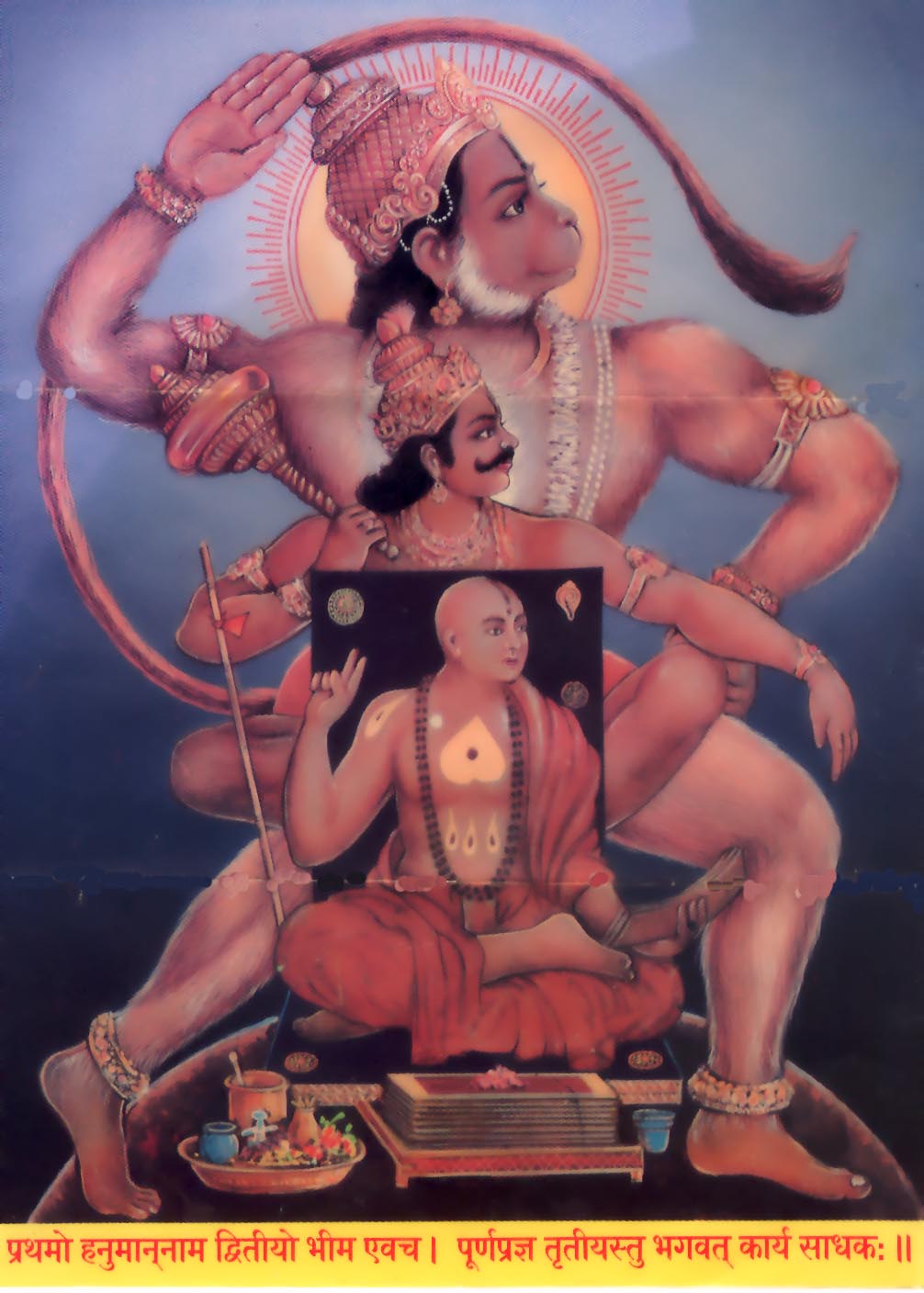
This Mukhyapraana-tattva manifests as Hanuman in Tretaa Yuga, Bhimasena in Dvaapara Yuga, and Acharya Madhva in Kali Yuga — all perfectly serving the Supreme Lord Hari in different roles. This is not just Maadhva sampradaaya but is also based on accepted pramaaNa-s, in this case Ballittha Sookta from Rig Veda (CLICK for details):
- Hanuman — Tretaa Yuga: “ऋतस्य धेना अनयन्त सस्रुतः” — The first avataara, Hanuman, described as the embodiment of knowledge, carrying the message of Shri Rama (the Eternal, Unchanging Truth) to Sita.
- Bhimasena — Dvaapara Yuga: “पृक्षॊ वपुः पितुमान्नित्य आशयॆ द्वितीयमासप्तशिवासु मातृषु” — The second avataara, Bhimasena, described as known for his immense strength, as the destroyer of evil forces, and knower of all shaastra-s.
- Acharya Madhva — Kali Yuga: “तृतीयमस्य वृषभस्य दोहसे दशप्रमतिं”; “यदीमनु प्रदिवो मध्व आधवे गुहा सन्तं मातरिश्वा मथायति”— The third avataara is explicitly called out as Madhva (author of Shaastra-s) and also Anandateertha (abode of blissful knowledge) and Poorna-Pragnya (दश – प्रमतिं) – the establisher of Tattvavaada which proclaims the supremacy of Shri Hari.
Note that Shruti-s only state principles in a condensed manner. Their proper meaning emerges only through a consistent interpretive tradition supported by Smriti, Itihaasa, Puraana, and Bhaashya.
Specifically, Acharya Madhva’s Bhaashya-s excel in this regard and establish two main points: First and foremost, that Vishnu or Hari is the One Supreme Lord (सर्वोत्तम). And secondly, that while in many contexts the word “Praana” may refer variously to breath, life-force, vital energy, or the presiding deity of life itself, the Maadhva interpretation distinguishes these carefully and identifies Mukhyapraana or Vaayu (जीवोत्तम) as the conscious presiding principle governing all praana-functions under the Supreme Lord Hari.
In this regard, one of Acharya’s unique contributions is सर्व-शब्द-वाच्यत्व — the fundamental principle that all words primarily and ultimately refer to the Supreme Lord, and only secondarily to other entities depending on context. Based on this interpretive framework, his Brahmasutra Anubhaashya – Sarvashastrartha Sangraha is a masterful condensation of the entire Vedaanta philosophy.
1c) Bhaarati Devi and the Propagation of Knowledge
In the Maadhva sampradaaya, Bhaarati Devi functions as the divine consort of Vaayu and participates in the propagation of knowledge under the Lord’s order. This is an integral part of the doctrine of तत्त्वाभिमानि देवता — deities presiding over various cosmic principles, functions, organs, and forms of knowledge.
Just as Agni presides over speech, Surya over vision, and Vaayu over life-force, higher divine beings preside over subtle functions connected to knowledge and spiritual upliftment.
Specifically, Bhaarati Devi presides over speech, wisdom, understanding, and transmission of knowledge.
Relevant references include:
Rig Veda 2.3.8
“सरस्वती साधयन्ती धियं न इळा देवी भारती विश्वतूर्तिः…” : Sarasvati, Ilaa, and Bhaarati are invoked together as divine powers associated with intellect, expression, and wisdom.
Rig Veda 1.142.9
“आ नो देवी भारती…” : Bhaarati is independently invoked as a deity worthy of worship.
Rig Veda 10.125 (AmbhRNee Sukta)
“अहं राष्ट्री संगमनी वसूनाम् चिकितुषी प्रथमा यज्ञियानाम् ॥ … मया सो अन्नमत्ति यो विपश्यति यः प्राणिति य ईं शृणोत्युक्तम् ॥” : The ऋषि here is वाक् अम्भृणी which is to be interpreted as Bhaarati Devi speaking in first person as the अभिमानी of speech. Lakshmi through Bhaarati (consort of Praana) is the ‘sovereign force’ enabling knowledge, wisdom, inspiration, and activities such as eating food, seeing, breathing and hearing.
As with earlier references establishing Mukhyapraana as the chief delegate of Supreme Lord Vishnu, the above passages establish his consort Bhaarati as the chief delegate of Lakshmi Devi, the seat of wisdom and knowledge, amongst other functions delegated to her.
2. Why does Mukhyapraana not find similar prominence in other philosophies?
Praana is not absent in other darshana-s, However, only Madhva clarifies him as Mukhya-Praana since he is:
- the foremost amongst jeevas – including other Praana/Vaayu forms hence the prefix “Mukhya”;
- eternally distinct from and completely dependent on the Lord; and
- empowered as the cosmic regulator under the Lord’s authority.
This is not an arbitrary theological insertion, but derived through a consistent interpretive methodology applied across Shruti, Smriti, Itihaasa, and Puraana.
Here is a summary view across darshana-s:
Advaita
Advaita focuses ultimately on nirvishesha Brahman — Brahman without attributes. Accordingly, Praana is generally treated as:
• a function of the subtle body (सूक्ष्म-शरीर),
• or part of the empirical world sublated upon realization of nirvishesha Brahman
Since individuality itself is ultimately considered mithyaa (illusory) at the highest level, there is no scope for an eternally distinct and ontologically real Mukhyapraana.
Vishishtadvaita
Vishishtadvaita accepts a qualified Brahman with attributes and real distinctions. However, it does not develop the same eternal and intrinsic gradation among souls emphasized in Dvaita. So Praana is generally interpreted more as a divine function or cosmic principle rather than as the uniquely exalted foremost jeeva emphasized in Dvaita.
Other Darshana-s
Systems such as Saankhya, Yoga, and Nyaaya typically discuss Praana more in physiological, cosmological, or yogic terms, rather than as a central theological entity.
Dvaita/Tattvavaada
Acharya Madhva’s unique contribution lies in interpreting all of Shruti consistently and realistically — as conveying यथार्थ-ज्ञान (knowledge of reality as it truly is).
For example, if Praana is called ज्येष्ठ and श्रेष्ठ (see Chaandogya reference above), then naturally the question arises: “Greatest among whom?”. Comparative terminology necessarily implies plurality and hierarchy. From there follow distinctions among souls, gradation among souls, and functional hierarchy.
Thus, while many schools interpret Praana symbolically or functionally, Dvaita accepts Praana as a real and eternally distinct conscious entity whose greatness is repeatedly affirmed in scripture.
The Dvaita approach is therefore not an artificial insertion into Shaastra-s, nor an arbitrary assertion. It accepts all scriptural statements “as is” without prioritizing or de-emphasizing any of these pramaaNa-s, and then applies proper inference to develop a coherent interpretation.
For readers interested in the philosophical foundations of Dvaita/Tattvavaada, here is an earlier article with more details: Tattvavaada Prameya
Conclusion
Ultimately, the question is not whether the word “Praana” appears in scripture — it clearly does, and in fact extensively. The real question is how those references are to be interpreted coherently across Shruti, Smriti, and Sampradaaya (tradition).
Acharya Madhva’s contribution was not merely “introducing” Mukhyapraana, but to systematically reveal the theological significance already embedded within the Vedic corpus through a consistent framework of realism, intrinsic hierarchy (तारतम्य), and supremacy of the One Independent Supreme Lord (विष्णु-सर्वोत्तमत्व).
In conclusion, worship of the Lord through Bhaaratiramana Mukhyapraana is not Maadhva sectarian innovation but faithful alignment with the Vedic corpus expanded using proper interpretation in Tattvavaada.
/Raghunath Rao/ “Do your Best … and leave the Rest … “
(All mistakes mine – all credit to Gurus and Acharyas )
|| sarvaṁ śrī kṛṣṇārpanamastu ||