हरि सर्वोत्तम । वायु जीवोत्तम | श्री गुरुभ्यो नमः
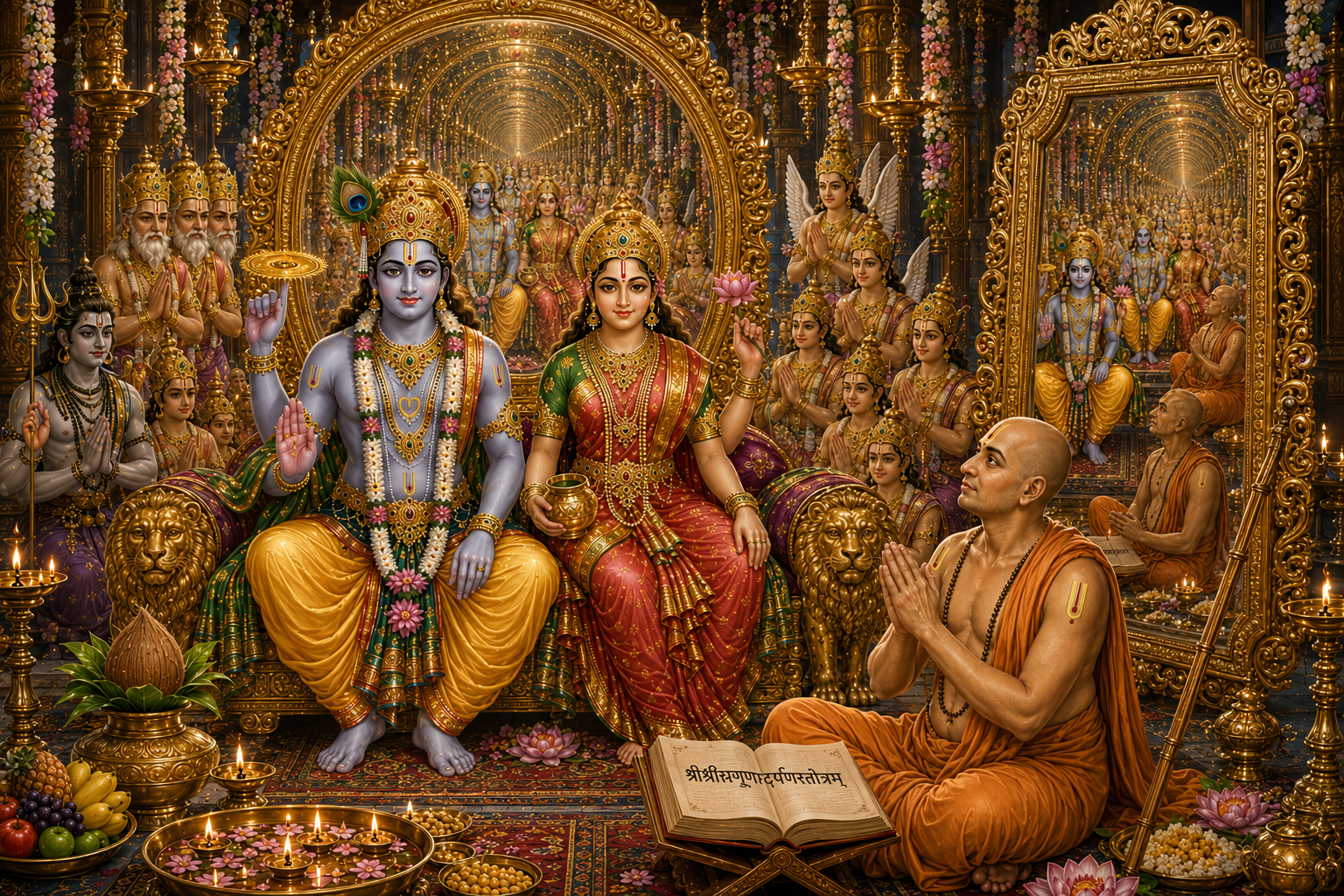
श्रीश्रीशगुणदर्पणस्तोत्रम् (Meaning)
Introduction:
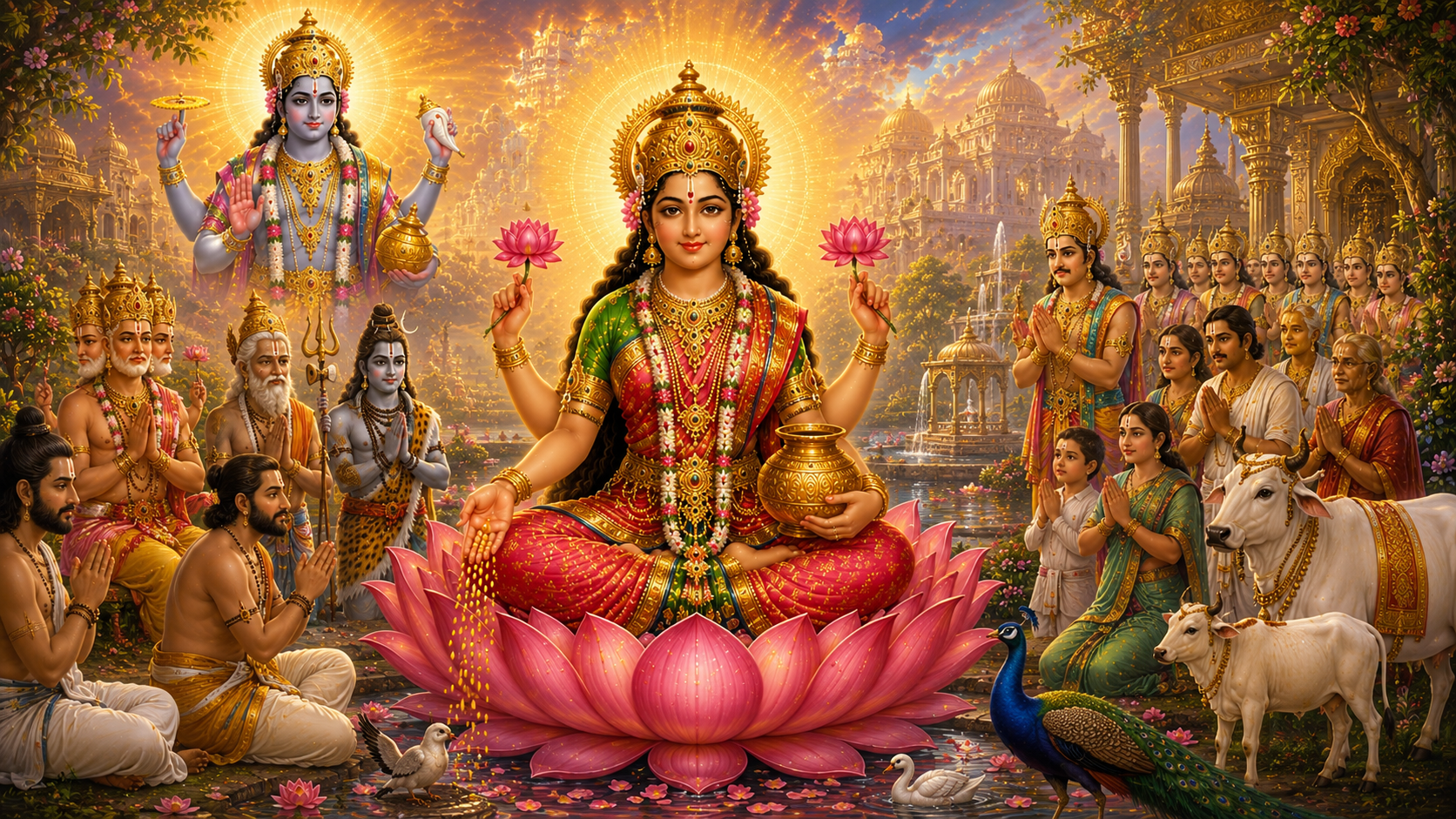
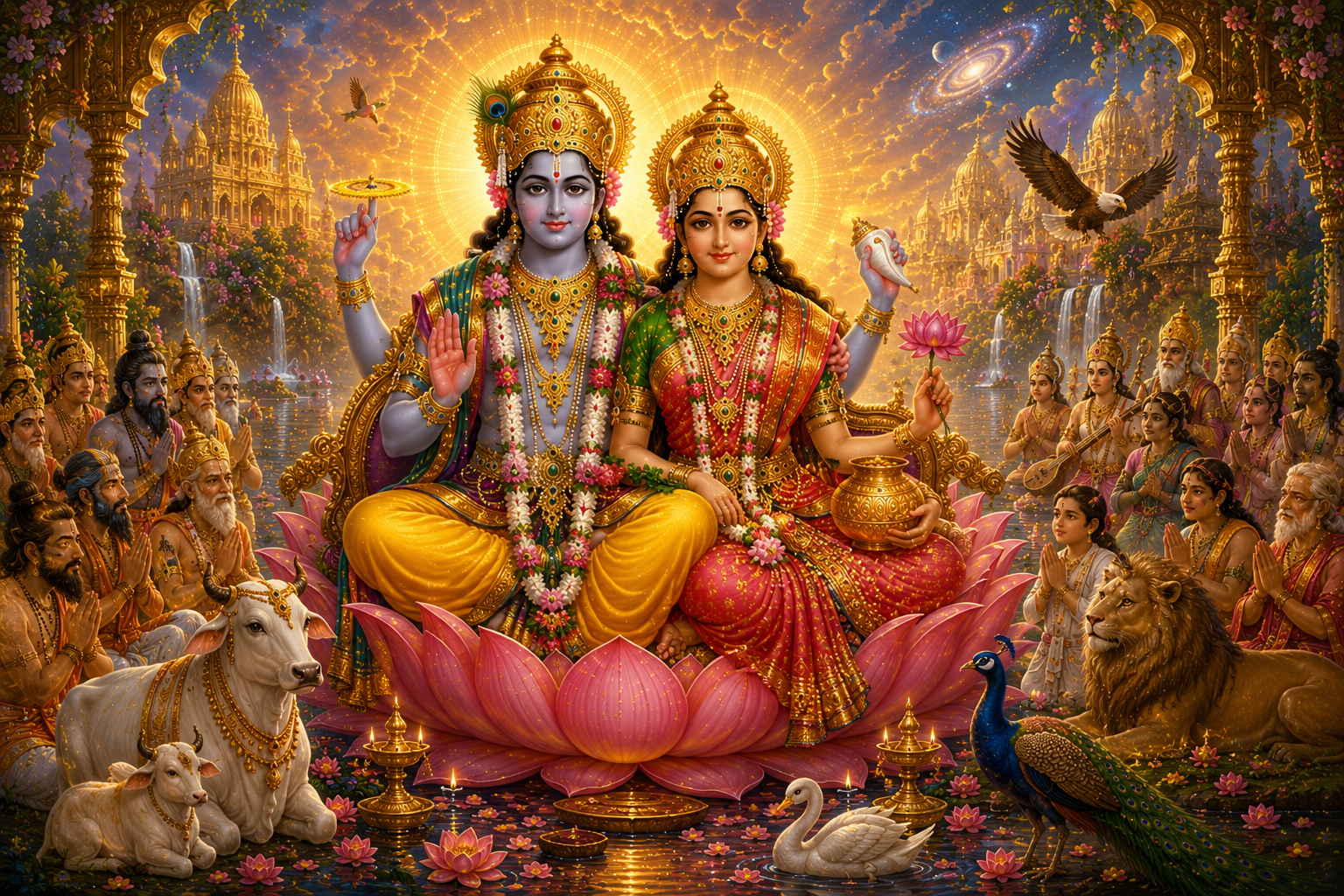
- Note that the title is Shri-Shrisha Guna Darpana – a mirror reflection by Shri Vaadiraaja Teertha of the supreme qualities of *both* Lakshmi and Narayana. This is because worship of Lakshmi alone or Narayana alone is not sufficient to attain either spiritual wealth (knowledge and devotion) or material prosperity in fullness.
- History records that Shri Vaadiraaja Teertha composed this work to alleviate King Achyuta Raaya of poverty during a famine and subsequently chanted and taught it to uplift many Brahmins from poverty.
- Tradition is to chant this preceding and following Narayana Varma for maximum effect – counts of 1000, 100, 54, 28, 12, 8 or 5.
- This work also mirrors the Shri Sukta from Rig Veda thus making it effectively available for those who do not have Brahmopadesha and thus lack eligibility to directly study Veda-s.
या सुगन्ध-अस्य-नासा-आदि-नव-द्वारा अखिलेन या ।
दुराधर्षा सर्व-सस्य-उदय-अर्थं वा करीषिणी ॥ १ ॥
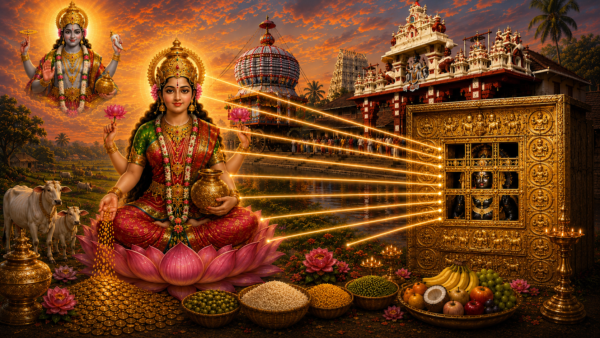
She (या) with divine fragrance (सुगन्ध) from all nine doors (नव-द्वारा) such as nose (नासा-आदि) of Her transcendental body (अस्य), who pervades all existence completely (अखिलेन), who is invincible (दुराधर्षा), and who as Bhudevi causes (करीषिणी) the arising and growth (उदय-अर्थं) of all vegetation and crops (सर्व-सस्य).
• “नव-द्वार” reference shows that unlike ordinary beings, Lakshmi’s body is apraakRta, i.e. transcendental and beyond material defects.
• “दुराधर्षा” indicates that Lakshmi is beyond the control of all dependent beings and is subordinate only to Shri Hari.
• “करीषिणी” is interpreted in the Shri Sukta tradition as Bhudevi — the nourishing aspect of Lakshmi responsible for fertility, agriculture, and prosperity.
या नित्य-पुष्टा सर्व-अङ्गैः सौन्दर्य-आदि-गुणैः अपि ।
ईश्वरीं सर्व-भूतानां ताम् इह उपह्वये श्रियम् ॥ २ ॥
I invoke here (इह उपह्वये) that Goddess Lakshmi (ताम् श्रियम्), who is eternally full and flourishing (नित्य-पुष्टा), who is endowed in all Her limbs (सर्व-अङ्गैः) with beauty and other divine qualities (सौन्दर्य-आदि-गुणैः), and who is the ruler (ईश्वरीं) of all beings (सर्व-भूतानाम्).
• This verse echoes Shri Sukta, showing that this stotra mirrors Vedic teachings
• “नित्य-पुष्टा” does not merely mean materially nourished, but eternally perfect, youthful, and complete.
• “ईश्वरी” does not imply independence equal to Narayana. Rather, Lakshmi rules all beings under His supreme will while remaining eternally inseparable from Him.
मातर्-लक्ष्मि नमः तुभ्यं माधव-प्रिय-भामिनि ।
युवां विश्वस्य पितरौ इतरेतर-योगिनौ ॥ ३ ॥
O Mother Lakshmi (मातर्-लक्ष्मि), salutations unto You (नमः तुभ्यं), O beautiful beloved (प्रिय-भामिनि) of Madhava (माधव). You both (युवां) are the parents (पितरौ) of the universe (विश्वस्य), eternally united and inseparable from one another (इतर-इतर-योगिनौ)
• “माधव” means “the Lord of Lakshmi (मा)” and also “the Lord of knowledge (मा).”
• “इतर-इतर-योगिनौ” establishes the eternal inseparability of Lakshmi and Narayana.
• Note that Lord is aatmaa-rama, completely blissful within Himself. So while He grants pleasure to Lakshmi He Himself has no need for anything external.
समना किल मातः त्वम् अमुना तत्-अयोगिनी ।
मम नाथेन नैव स्यात् विमनाः च न स त्वयि ॥ ४ ॥
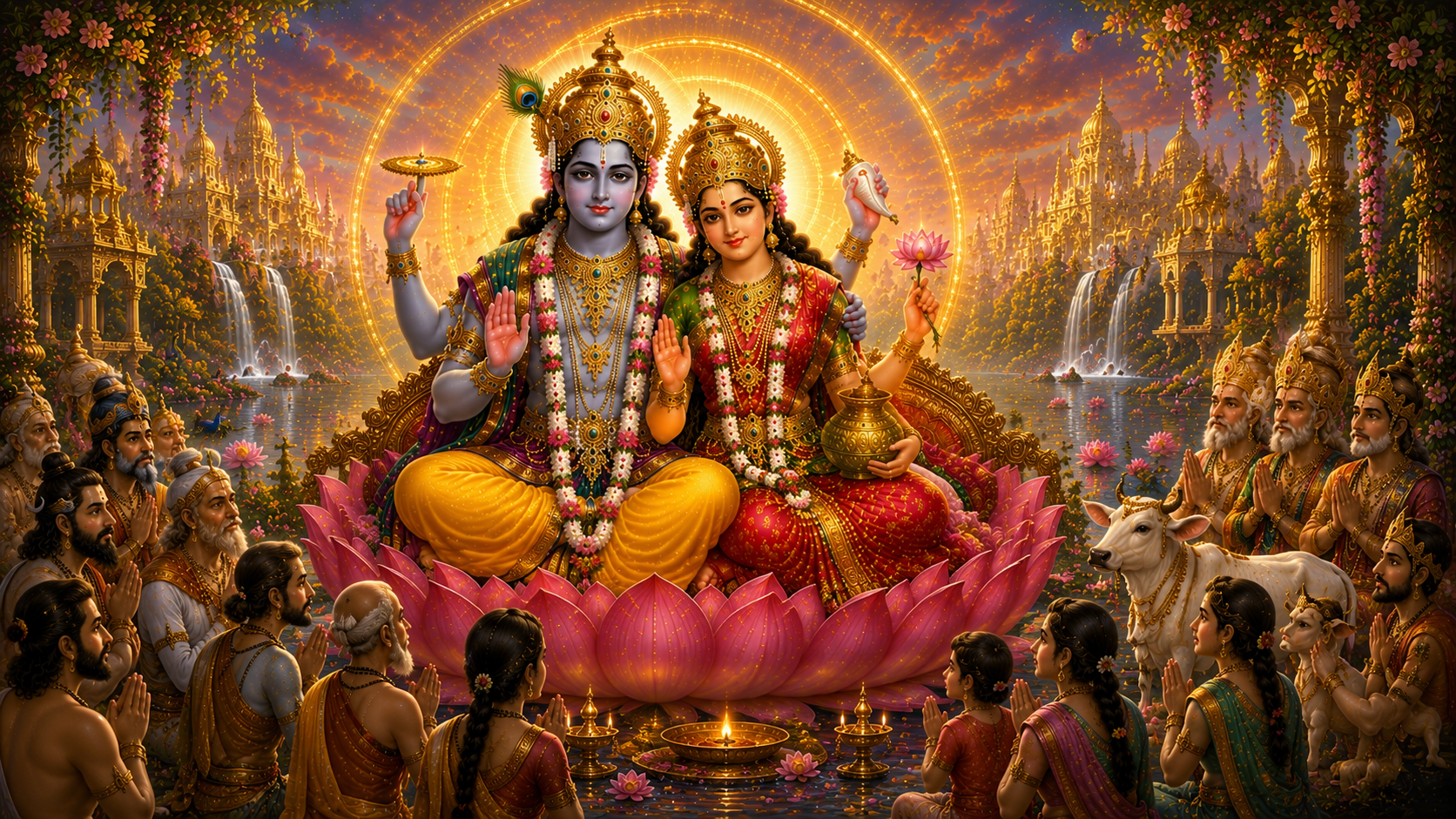
O Mother (मातः), You (त्वम्) are indeed always together equally (समना किल) with Him (अमुना), never separated from Him (तत्-अयोगिनी). Therefore my Lord (मम नाथेन) is never displeased (न विमनाः स्यात्) with You, nor is He ever apart from You (न स त्वयि).
• “समना” here indicates Lakshmi is equal to Shri Hari in time and space dimensions (deshataH kaalataH) but infinitely less in qualities, i.e. guNataH.
• Lakshmi is superior to all beings, yet eternally subordinate to Hari.
• Therefore there can never be disagreement or discord between Them.
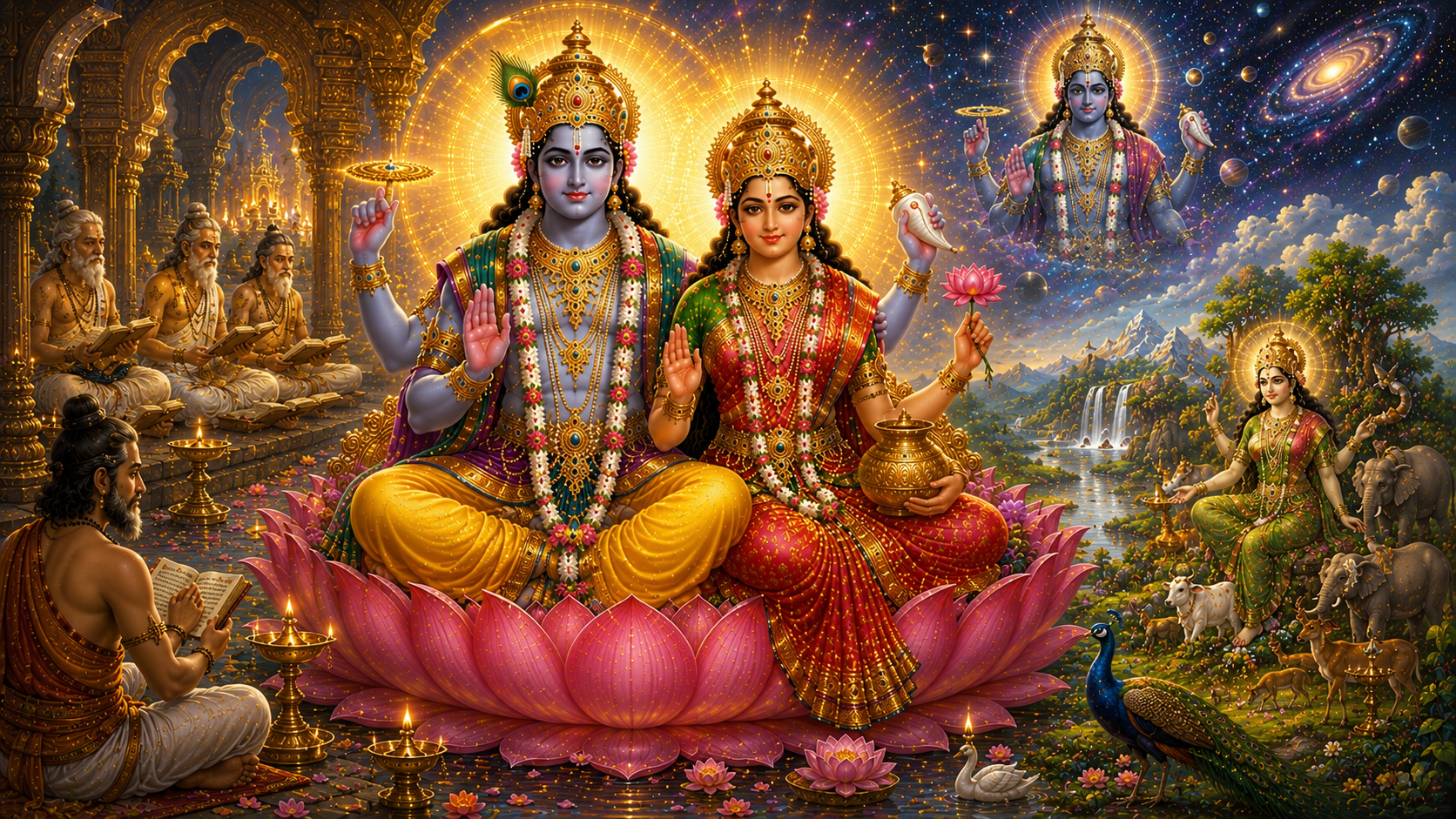
त्वं वेद-मानिनी वेद-वेद्यः किल स ते प्रियः ।
त्वं मूल-प्रकृतिः देवी स दिव्य-पुरुषः किल ॥ ५ ॥
You (त्वं) are the revered presiding Goddess of the Vedas (वेद-मानिनी), and He (सः), Your beloved (ते प्रियः), is indeed the One known through the Vedas (वेद-वेद्यः). You are the primordial source of material nature (मूल-प्रकृतिः), O Devi (देवि), while He is the Supreme Divine Person (दिव्य-पुरुषः).
• “मूल-प्रकृति” refers to Lakshmi’s association with primordial material causation — yet unlike Prakriti itself, She is fully conscious, divine, and untouched by materiality.
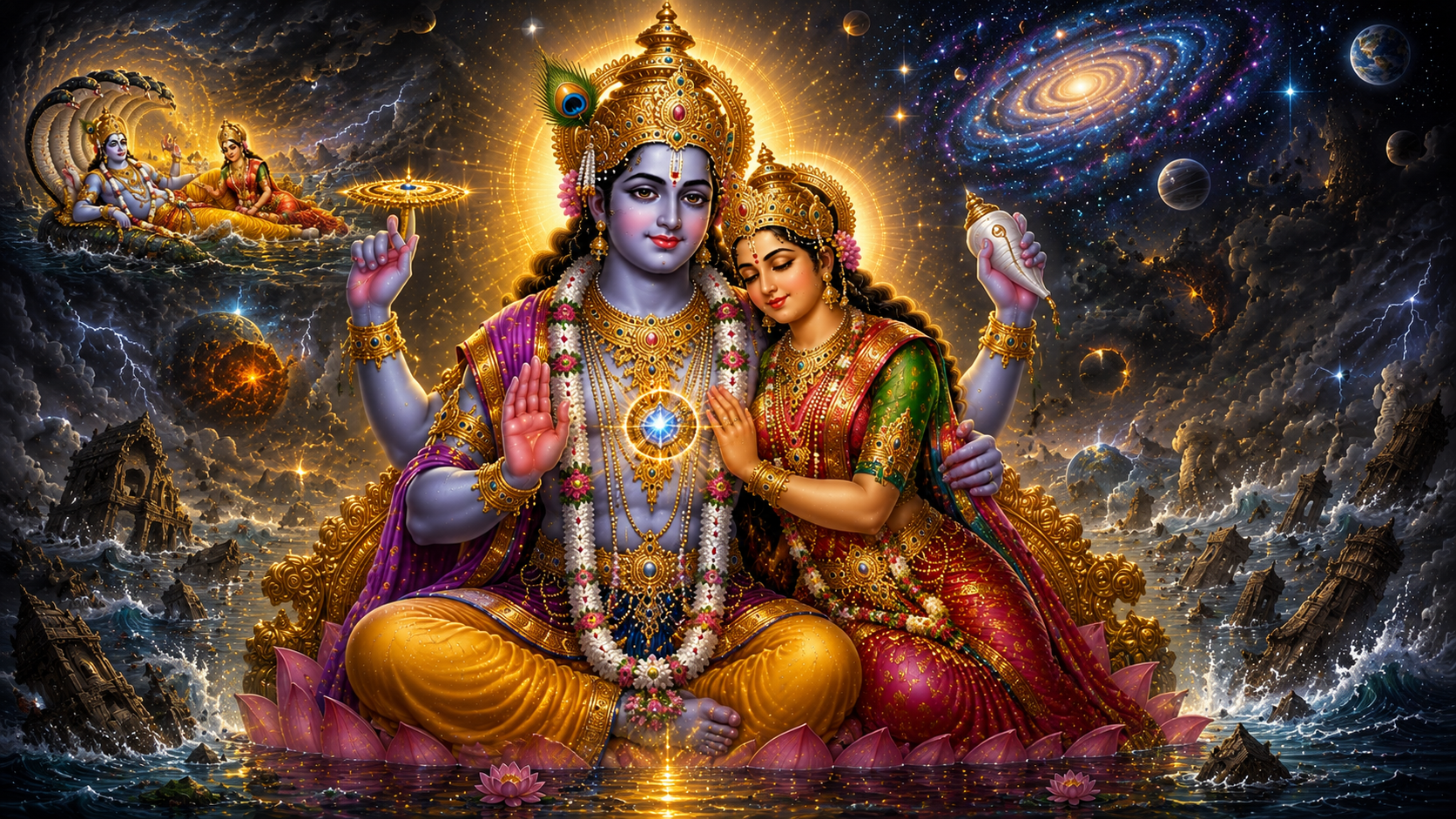
यः त्वाम् उरसि धत्ते अम्ब कौस्तुभ-द्युति-भासिते ।
स त्वां नैव अच्युतः सर्वस्य अत्यये सत्यपि त्यजेत् ॥ ६ ॥
O Mother (अम्ब), He (यः) who bears You (त्वाम् धत्ते) upon His chest (उरसि), radiant with the brilliance (भासिते) of the Kaustubha gem (कौस्तुभ-द्युति), that infallible Lord Acyuta (अच्युतः) never (नैव) abandons You (त्वां त्यजेत्), even at the dissolution (अत्यये) of the entire universe (सर्वस्य), indeed (सति अपि).
• The Lord’s chest is traditionally called “श्रीवत्सस्थल” because Lakshmi eternally resides there.
• Kaustubha gem symbolizes the Lord’s supreme splendour and sovereignty.
• Even during Mahaa-Pralaya, when all worlds dissolve, Lakshmi and Narayana remain eternally united.
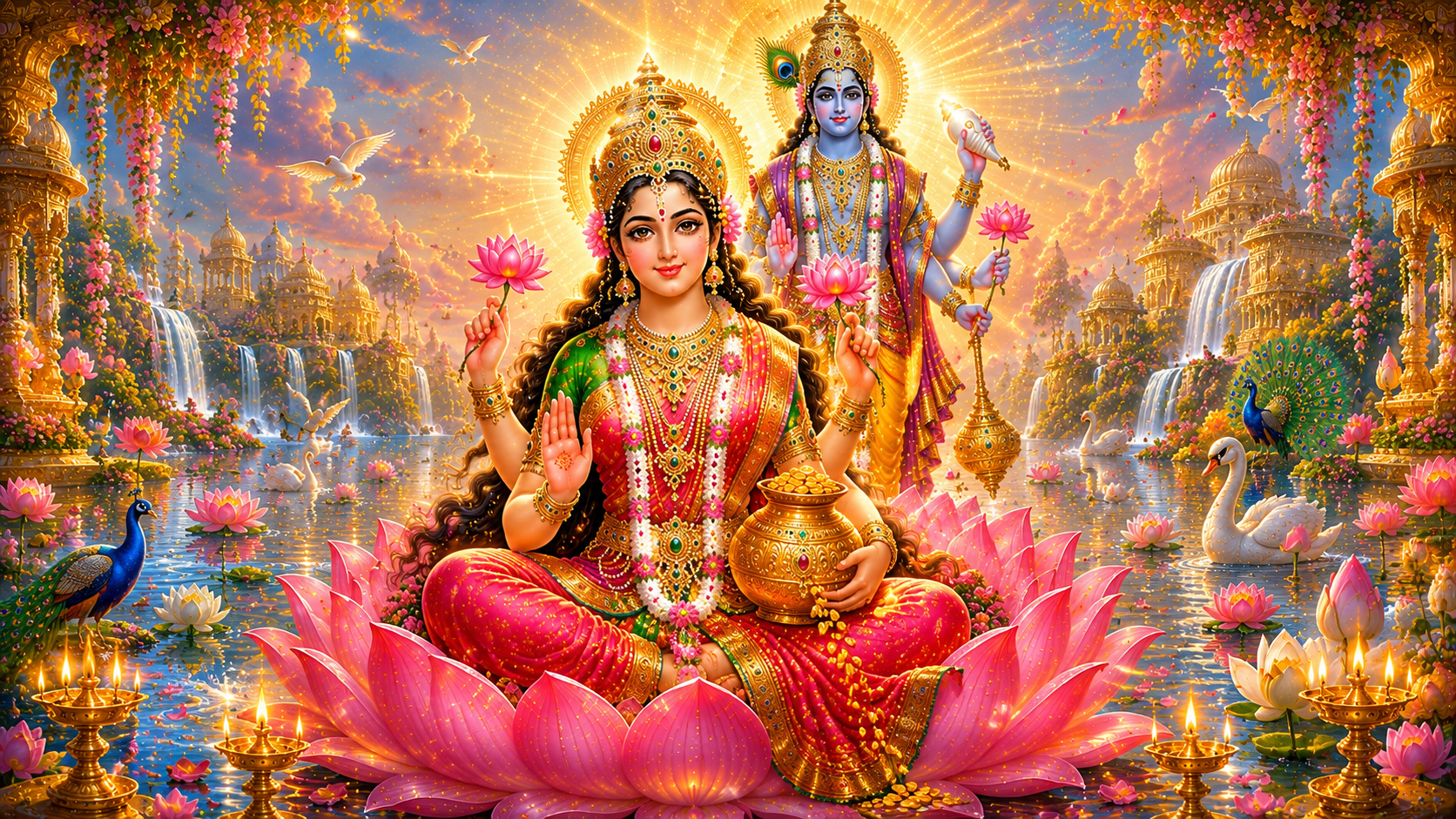
देवि त्वं ललना-रत्नं देवः असौ पुरुष-उत्तमः ।
युवां युवानौ सततं युवयोः न वयः-अधिकः ॥ ७ ॥
O Goddess (देवि), You (त्वं) are the jewel among women (ललना-रत्नं), and that Lord (असौ देवः) is the Supreme Person (पुरुष-उत्तमः). Both of You (युवां) are eternally (सततं) youthful (युवानौ), and between You two (युवयोः) there is no difference of age (न वयः-अधिकः).
• “पुरुषोत्तम” indicates Narayana’s supremacy over all beings including Lakshmi, Brahma, Vayu, and others.
• “युवानौ” signifies eternal freshness, beauty, and freedom from decay.
• “न वयः-अधिकः” indicates both are beginningless and eternal, not that They are equal in supremacy.
• Lakshmi alone among all beings shares eternal freedom from old age, sorrow, ignorance, and decay.
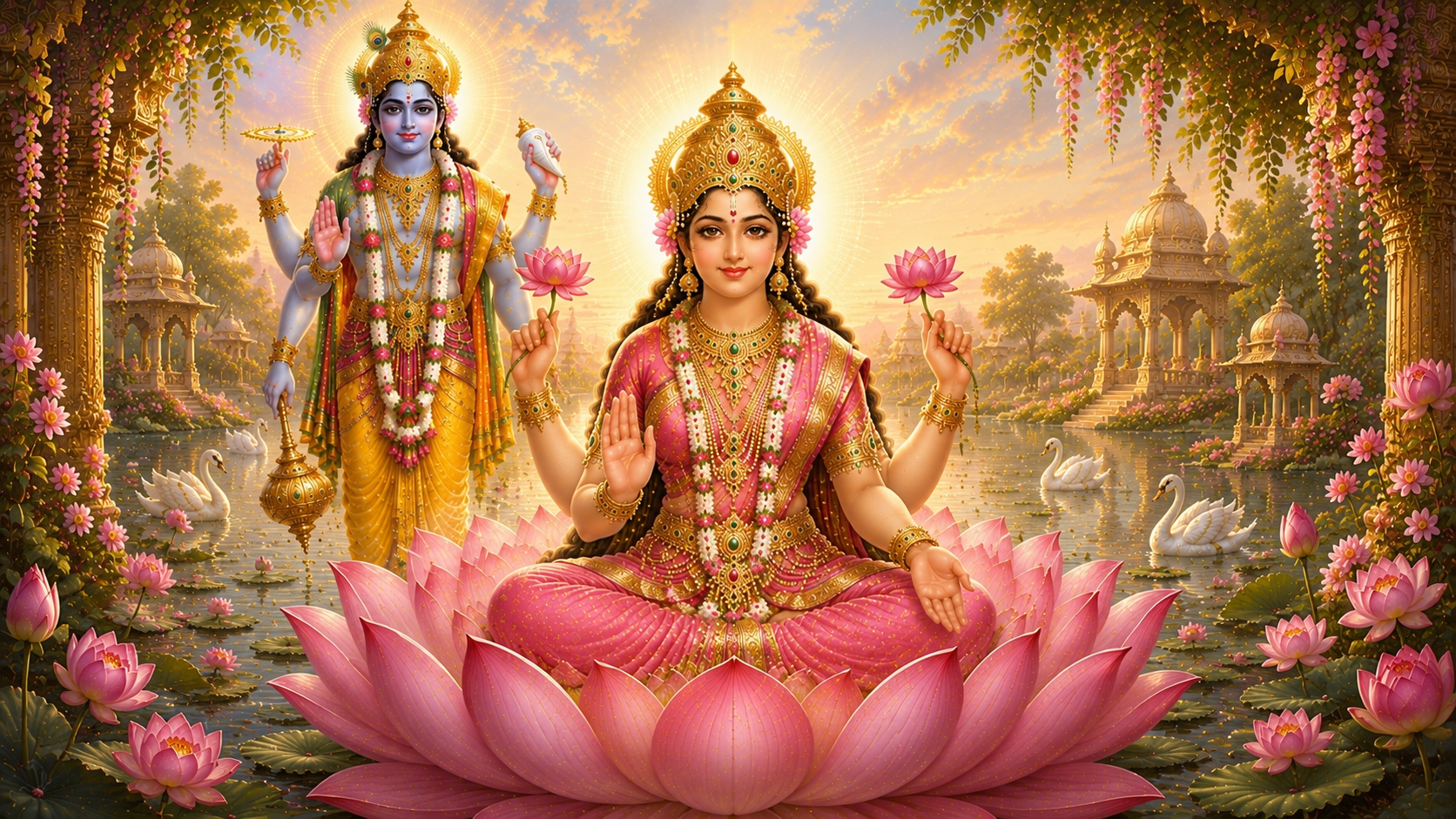
त्वं पद्मिनी पद्म-वक्त्रा पद्माक्षी पद्म-विष्टरा ।
पद्म-द्वय-करा पद्म-कोश-अभ-नस्तन-शोभना ॥ ८ ॥
You (त्वं) are lotus-dwelling (पद्मिनी), lotus-faced (पद्म-वक्त्रा), lotus-eyed (पद्माक्षी), and seated upon a lotus (पद्म-विष्टरा). You hold lotuses in both hands (पद्म-द्वय-करा), and Your bosom shines beautifully (स्तन-शोभना) like lotus buds (पद्म-कोश-अभ).
• The repeated use of “पद्म” symbolizes purity, beauty, auspiciousness, softness, and transcendence untouched by material and worldly impurity.
• “पद्माक्षी” indicates eyes overflowing with compassion toward devotees.
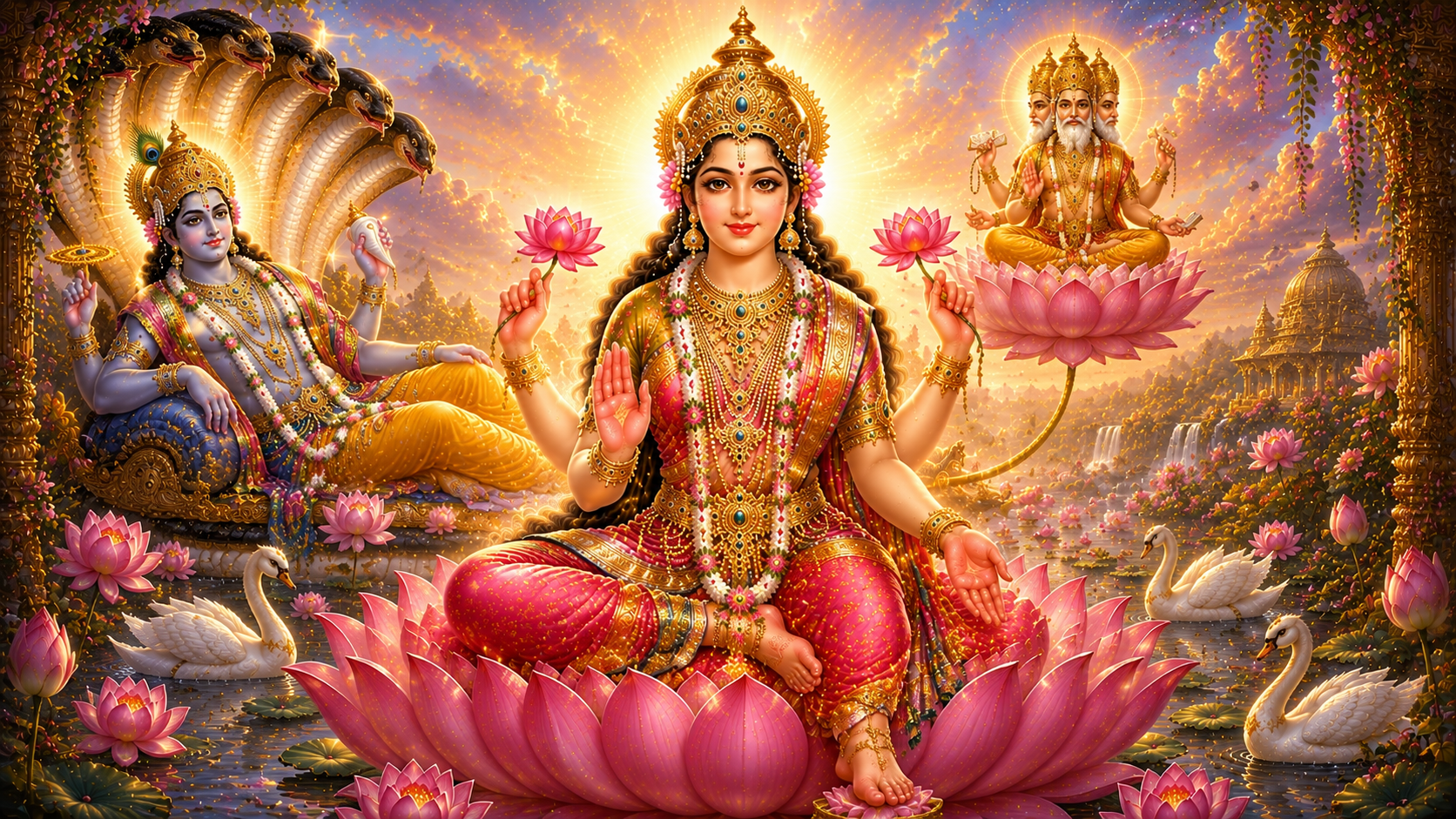
पद्म-हस्ता पद्म-पादा पद्म-नाभ-मनः-प्रिया ।
पद्म-उद्भवस्य जननी पद्मा च वर-वर्णिनी ॥ ९ ॥
Your hands are lotus-like (पद्म-हस्ता), Your feet are lotus-like (पद्म-पादा), and You are beloved to the mind (मनः-प्रिया) of Lord Padmanabha (पद्म-नाभ). You are the mother (जननी) of lotus-born Brahma (पद्म-उद्भवस्य), and You Yourself are Padma (पद्मा), possessing supreme divine beauty and auspicious form (वर-वर्णिनी).
• “Padmanabha” refers to Narayana from whose navel-lotus Brahma manifests.
• Lakshmi is called the mother of Brahma because all creation proceeds through Her divine mediation under Hari’s will.
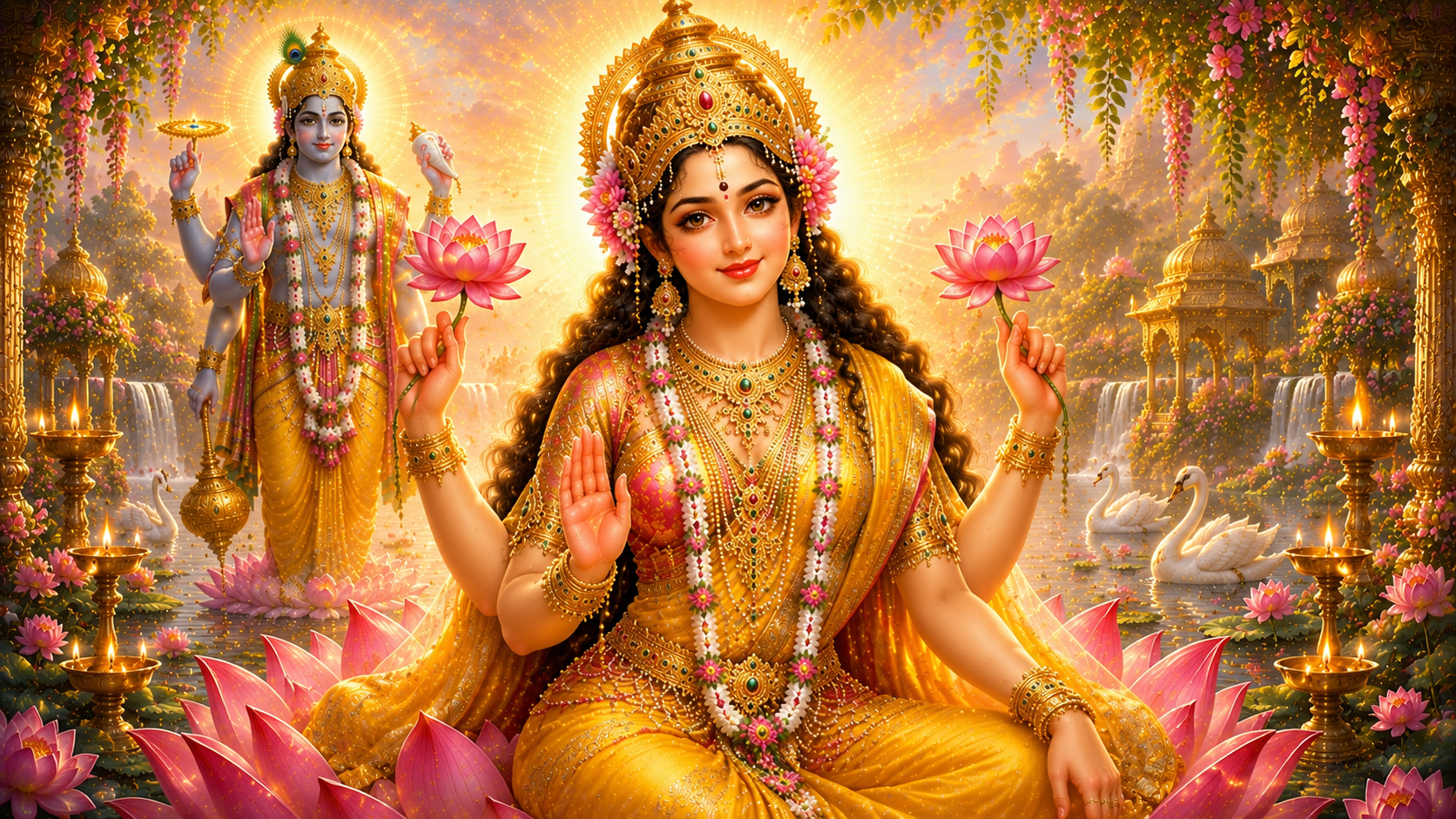
अम्बां पीताम्बर-श्रोणीं लम्ब-अलक-लसन्मुखीम् ।
बिम्ब-अधर-ओष्ठीं कस्तूरी-जम्बाल-तिलकां भजे ॥ १० ॥
I worship (भजे) Mother Lakshmi (अम्बां), whose hips/waist (श्रोणीं) are adorned with yellow garments (पीताम्बर), whose face shines beautifully (लसन्-मुखीम्) framed by long flowing locks of hair (लम्ब-अलक), whose lips (ओष्ठीं) are red like the bimba fruit (बिम्ब-अधर), and who wears an auspicious tilaka mixed with musk (कस्तूरी-जम्बाल-तिलकां).
• “पीताम्बर” signifies auspiciousness, prosperity, purity, and divine splendour.
• Kasturi tilaka symbolizes auspiciousness, beauty, and divine fragrance.
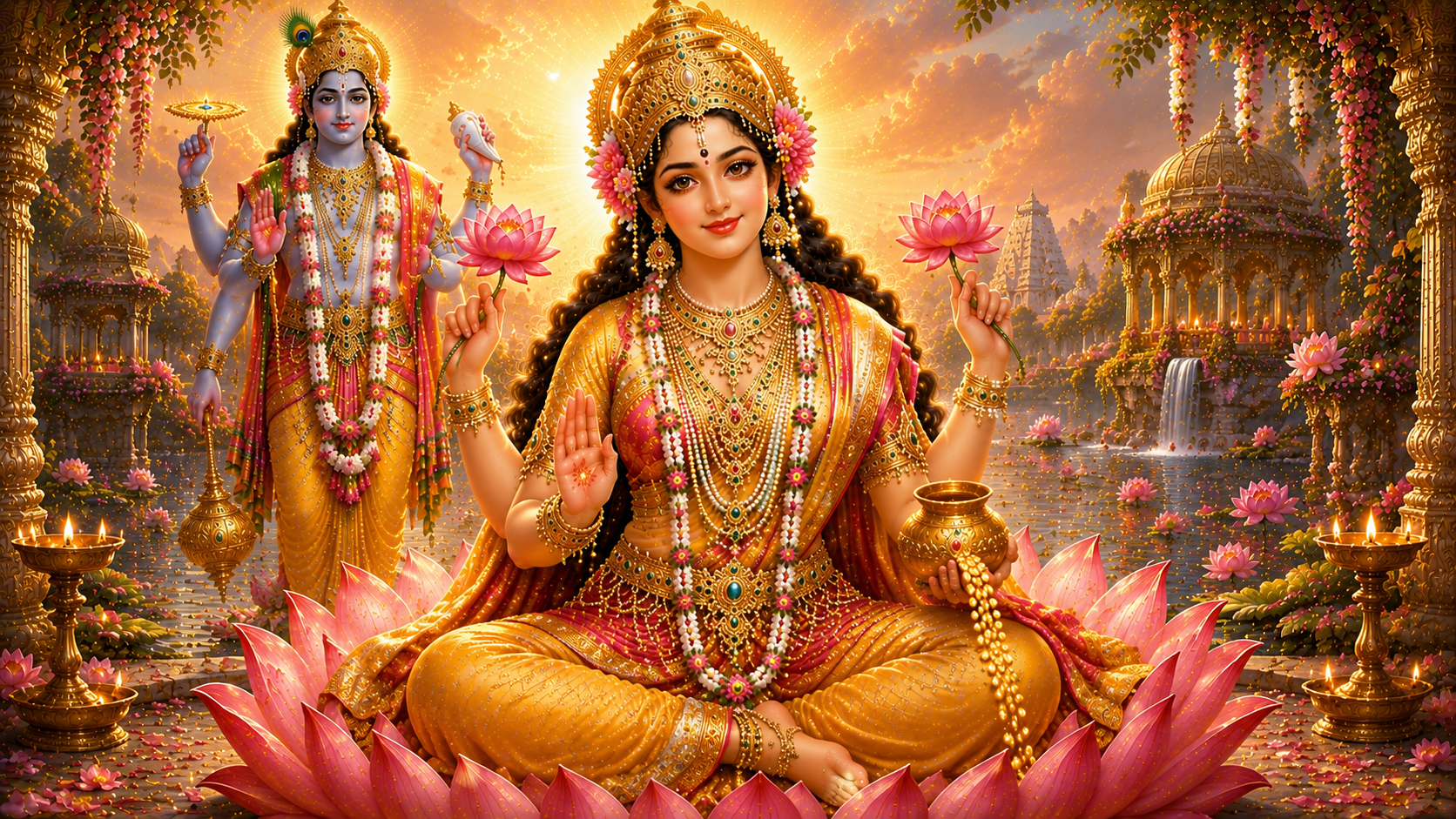
रत्न-उद्दीप्त-सु-माङ्गल्य-सूत्र-वृत्त-शिरोधराम् ।
कुण्डल-प्रभया उद्दण्ड-गण्ड-मण्डल-मण्डिताम् ॥ ११ ॥
I worship Her (ताम्), whose auspicious marriage-thread (सु-माङ्गल्य-सूत्र) shines brilliantly with gems (रत्न-उद्दीप्त), adorning Her neck (शिरोधराम्), and whose beautiful cheeks (गण्ड-मण्डल) are fully (उद्दण्ड) lit and decorated (मण्डिताम्) by the radiance (प्रभया) of Her earrings (कुण्डल).
• “माङ्गल्य-सूत्र” signifies the eternal divine union of Lakshmi and Narayana, which can never be broken.
• The ornaments of Lakshmi are not material objects but transcendental manifestations of auspiciousness and divine splendour.
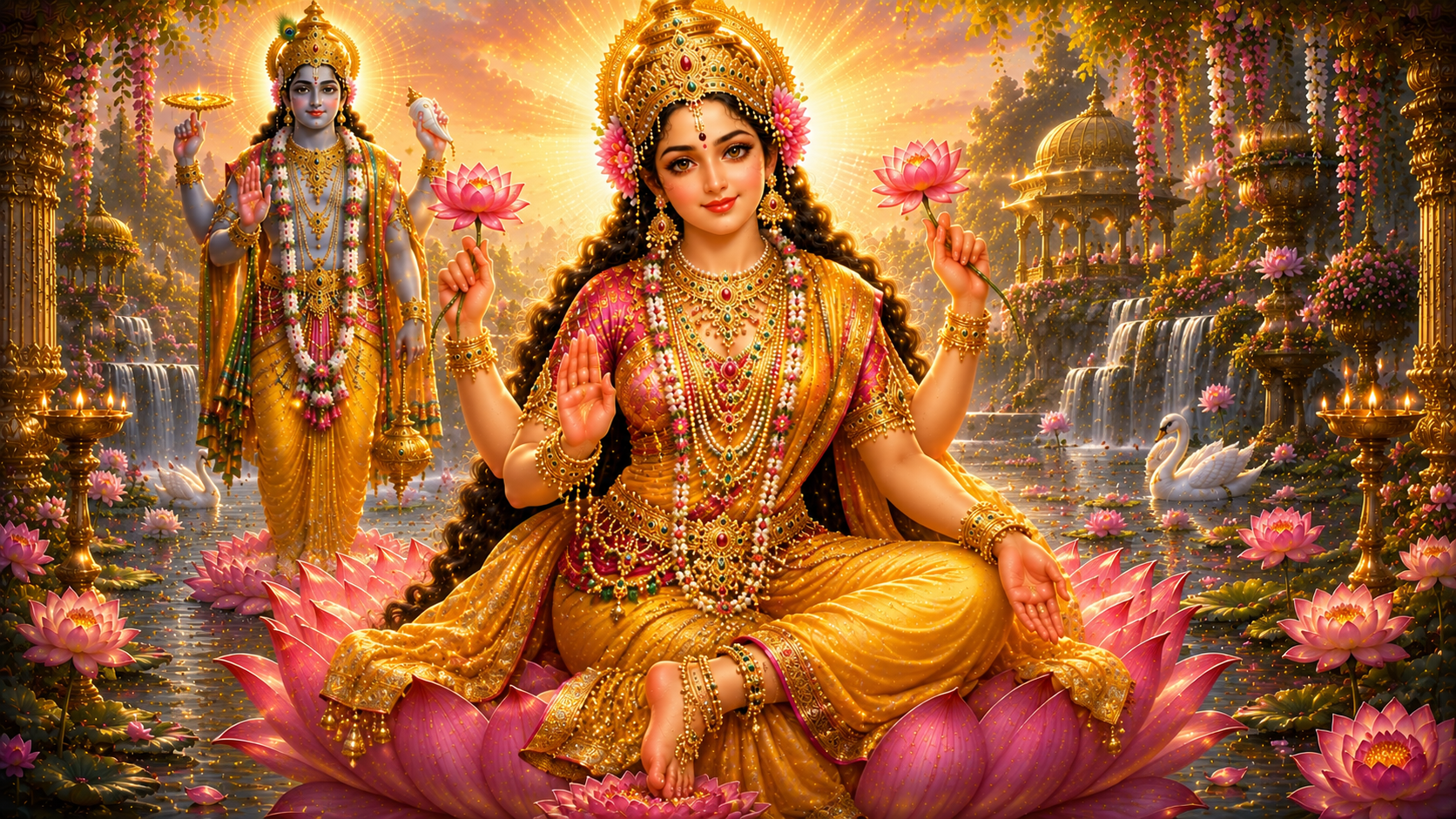
कुच-कञ्चुक-सञ्चारि-हार-नीक-मनोहराम् ।
काञ्ची-किङ्किणि-मञ्जीर-कङ्कण-आद्यैः अलङ्कृताम् ॥ १२ ॥
I worship Her (ताम्), who is enchanting (मनोहराम्), with rows of necklaces (हार-नीक) moving gracefully (सञ्चारि) upon Her blouse covering the bosom (कुच-कञ्चुक), and who is adorned (अलङ्कृताम्) with a golden waist-belt (काञ्ची), tinkling ornaments and anklets (किङ्किणि-मञ्जीर), bangles (कङ्कण), and other ornaments (आद्यैः).
• The sound of Lakshmi’s anklets and ornaments is described as spiritually uplifting and auspicious.
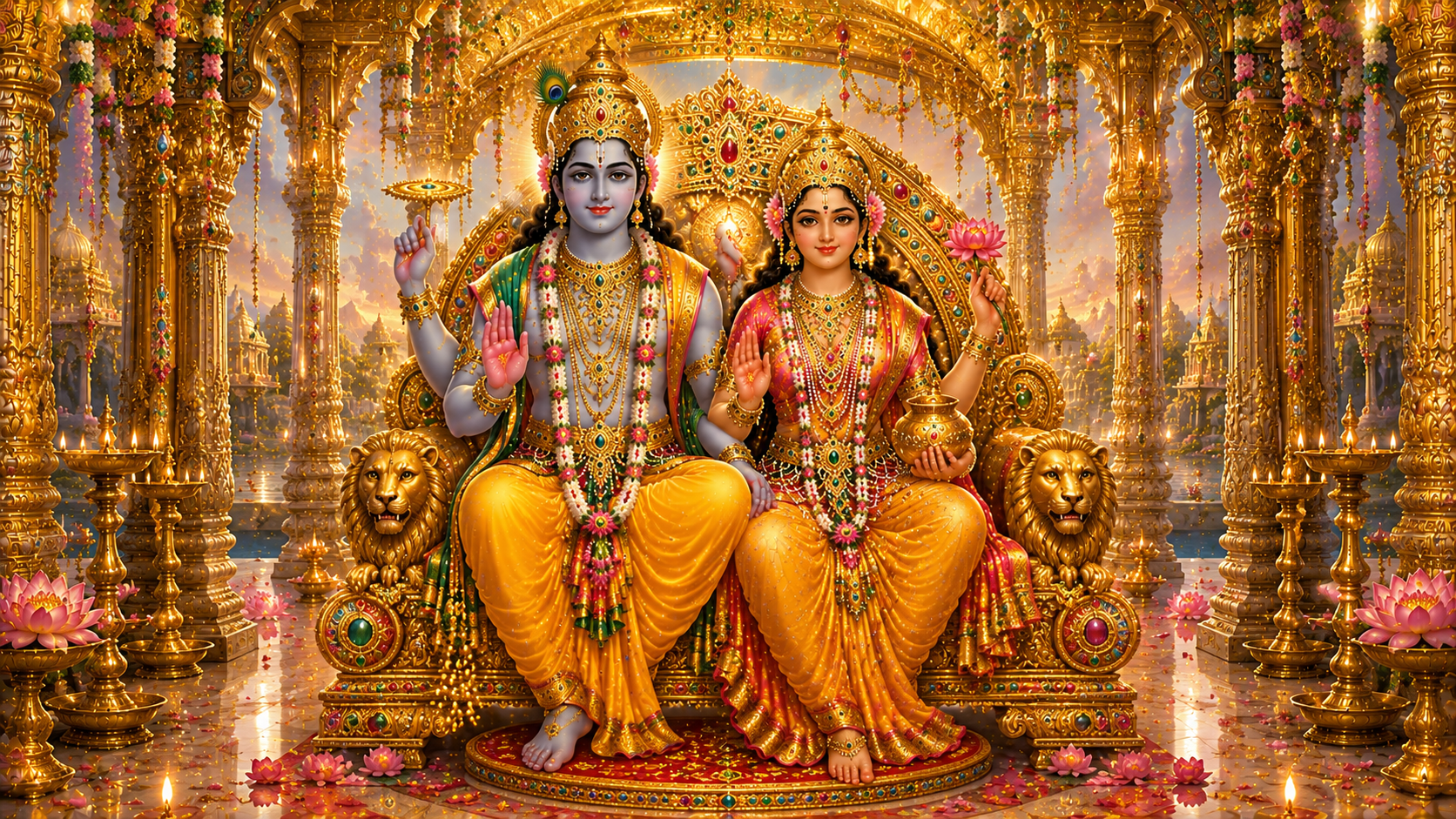
सुवर्ण-मण्डपे रत्न-चित्र-सिंहासन-उत्तमे ।
नमामि हरिणा साकम् इन्दिरां कृत-मन्दिराम् ॥ १३ ॥
I bow (नमामि) to Indira (इन्दिराम्), who is seated together (साकम्) with Lord Hari (हरिणा) upon the supreme throne adorned by lions (सिंहासन-उत्तमे), wondrously decorated with gems (रत्न-चित्र) within a golden pavilion (सुवर्ण-मण्डपे), and who has made that divine abode Her residence (कृत-मन्दिराम्).
• “इन्दिरा” is one of Lakshmi’s celebrated names, indicating supreme beauty and prosperity.
• Lakshmi is never worshipped independently of Hari; this verse specifically emphasizes Their inseparable presence seated together on a throne, ruling over all worlds and beings.
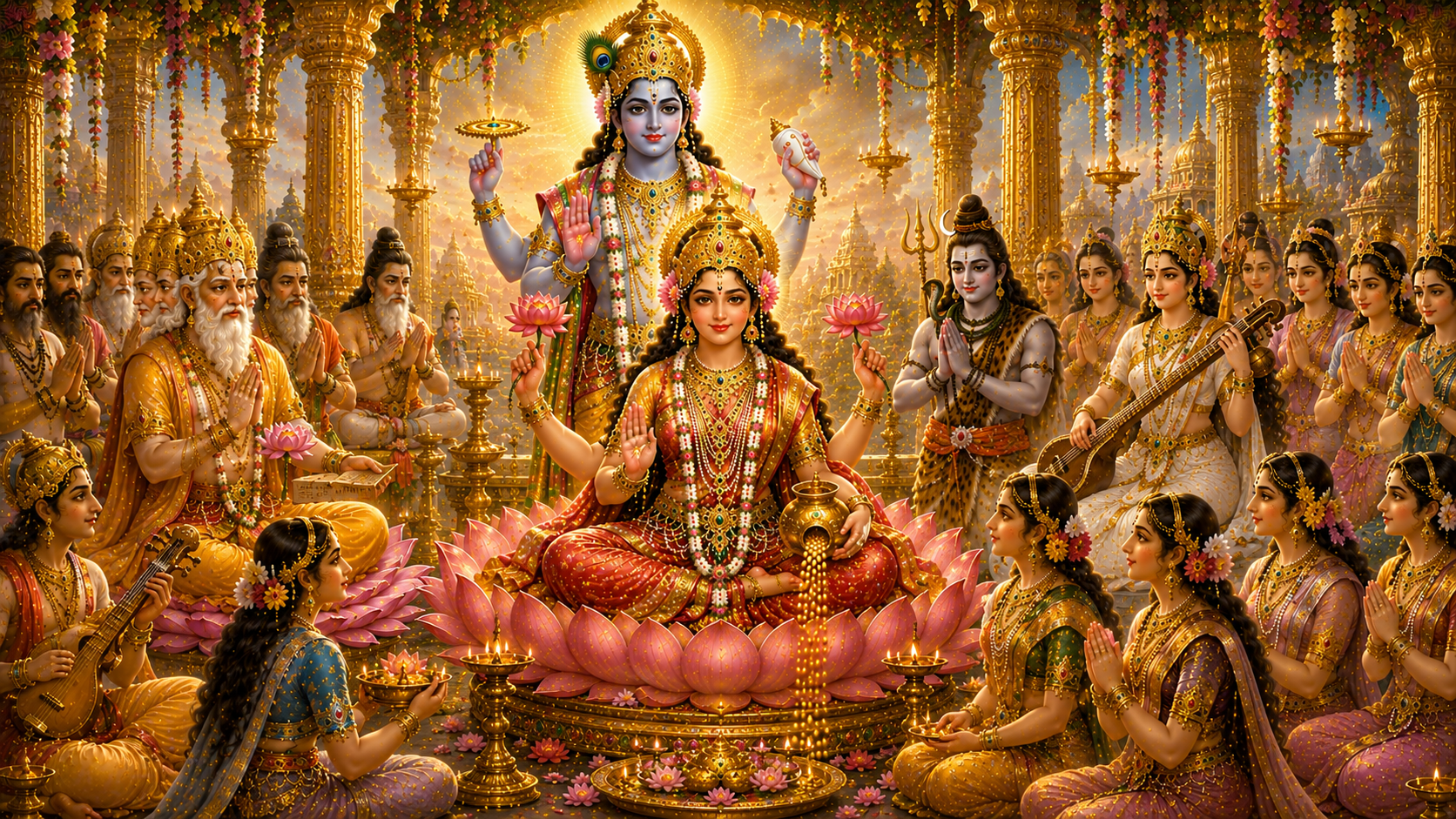
ब्रह्म-आद्याः विबुध-श्रेष्ठाः ब्रह्माणी-आद्याः सुर-अङ्गनाः ।
यां पूजयन्ते सेवन्ते सा मां पातु रमा सदा ॥ १४ ॥
May that Goddess Ramaa (सा रमा) always (सदा) protect me (मां पातु), whom (याम्) the foremost among the wise gods (विबुध-श्रेष्ठाः) beginning with Brahma (ब्रह्म-आद्याः), and the celestial women (सुर-अङ्गनाः) beginning with Saraswati (ब्रह्माणी-आद्याः), worship (पूजयन्ते ) and serve (सेवन्ते).
• “रमा” signifies the One who delights Hari and gives joy to devotees.
• This verse establishes Lakshmi’s supremacy over all other deities and divine consorts. She is second only to Narayana and superior to Brahma, Vayu, Saraswati, Bharati, Shiva, and all others.
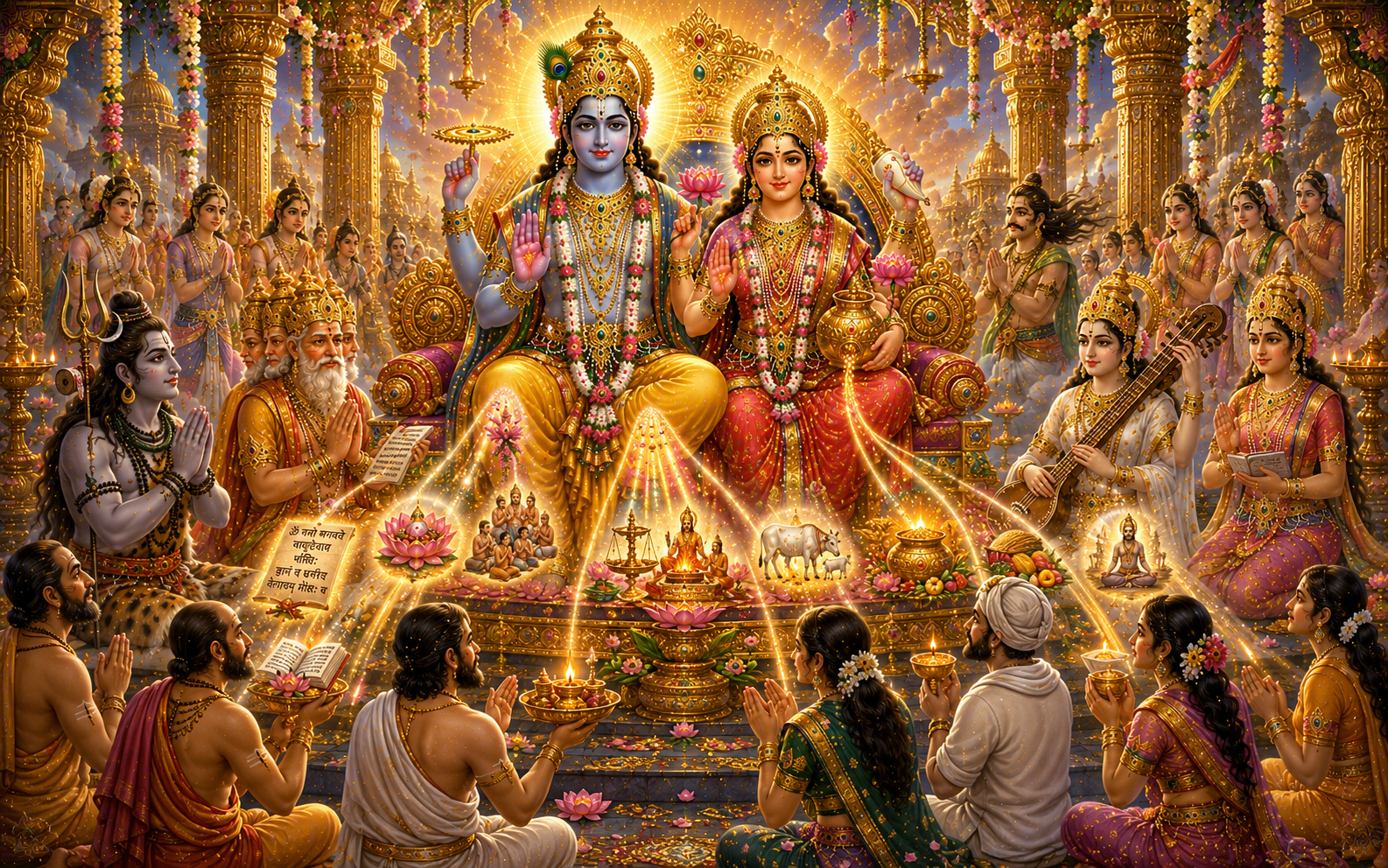
सर्व-अलङ्कार-भरितौ सर्व-सद्गुण-मण्डितौ ।
शर्व-आदि-सर्व-भक्त-ओघ-सर्व-सम्पद्-विधायकौ ॥ १५ ॥
I praise Lakshmi and Narayana (तौ), who are adorned (भरितौ) with all ornaments (सर्व-अलङ्कार), embellished (मण्डितौ) with all auspicious qualities (सर्व-सद्गुण), and who bestow (विधायकौ) every kind of prosperity and fulfilment (सर्व-सम्पद्) upon the multitude of all devotees (सर्व-भक्त-ओघ), beginning with Lord Shiva (शर्व-आदि).
• The verse establishes that, according to Tattvavaada, even Shiva and other deities receive blessings and fulfilment from Lakshmi-Narayana.
• “सम्पद्” includes not merely material wealth, but devotion, wisdom, dharma, vairagya, and liberation-oriented grace.
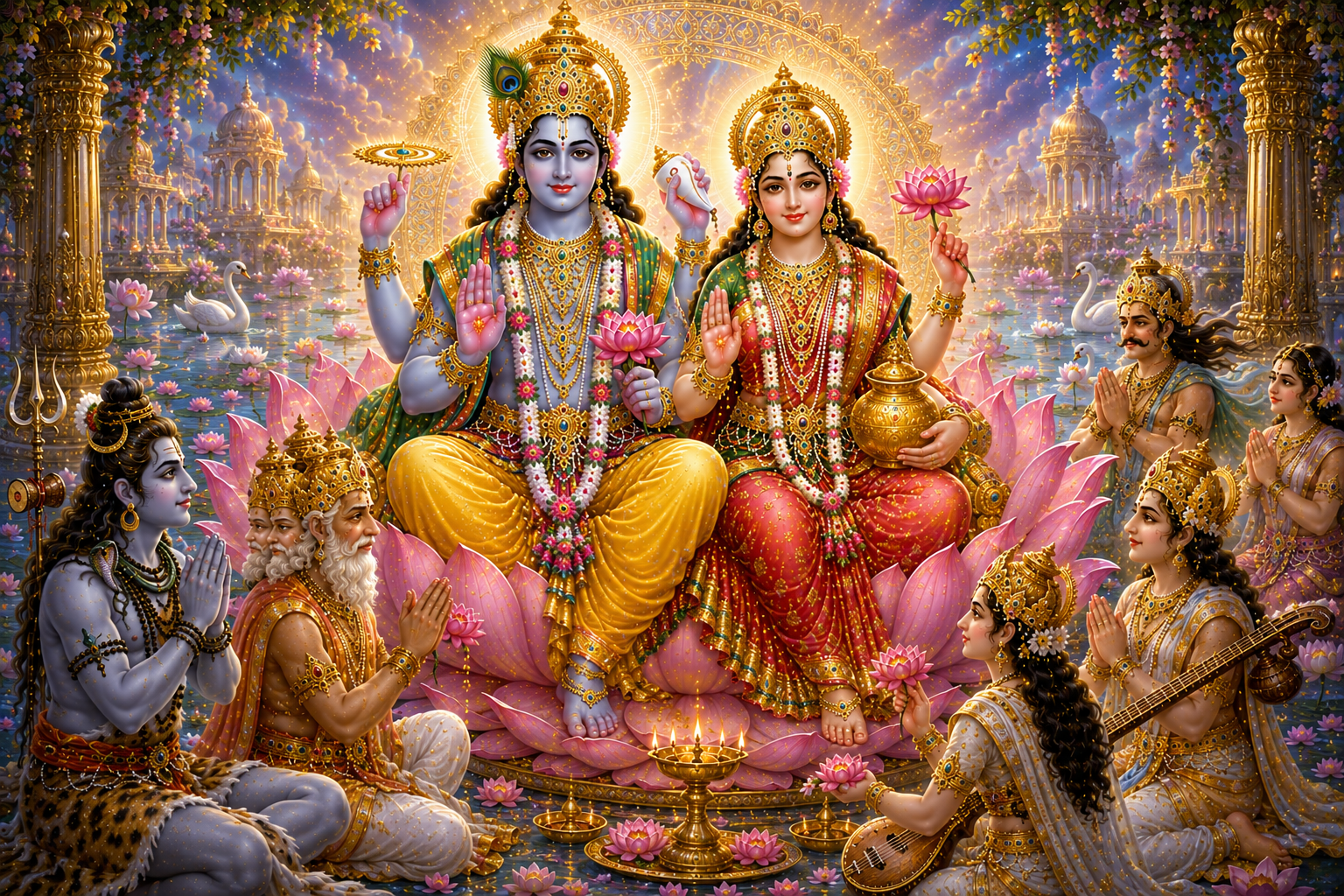
सु-मुखौ सुन्दर-तरौ सु-नासौ सुख-चित्-तनू ।
सुर-आराधित-पाद-अब्जौ रमा-नारायणौ स्तुमः ॥ १६ ॥
We praise (स्तुमः) Lakshmi and Narayana (रमा-नारायणौ), whose divine faces (सु-मुखौ) are exceedingly beautiful together (सुन्दर-तरौ), with graceful and auspicious noses (सु-नासौ), divine bodies of bliss and consciousness (सुख-चित्-तनू), and lotus-feet (पाद-अब्जौ) that are worshipped (आराधित) by the devas (सुर).
• Unlike embodied beings in samsaara, the divine forms of Lakshmi and Narayana are eternal, flawless, self-luminous, and transcendental.
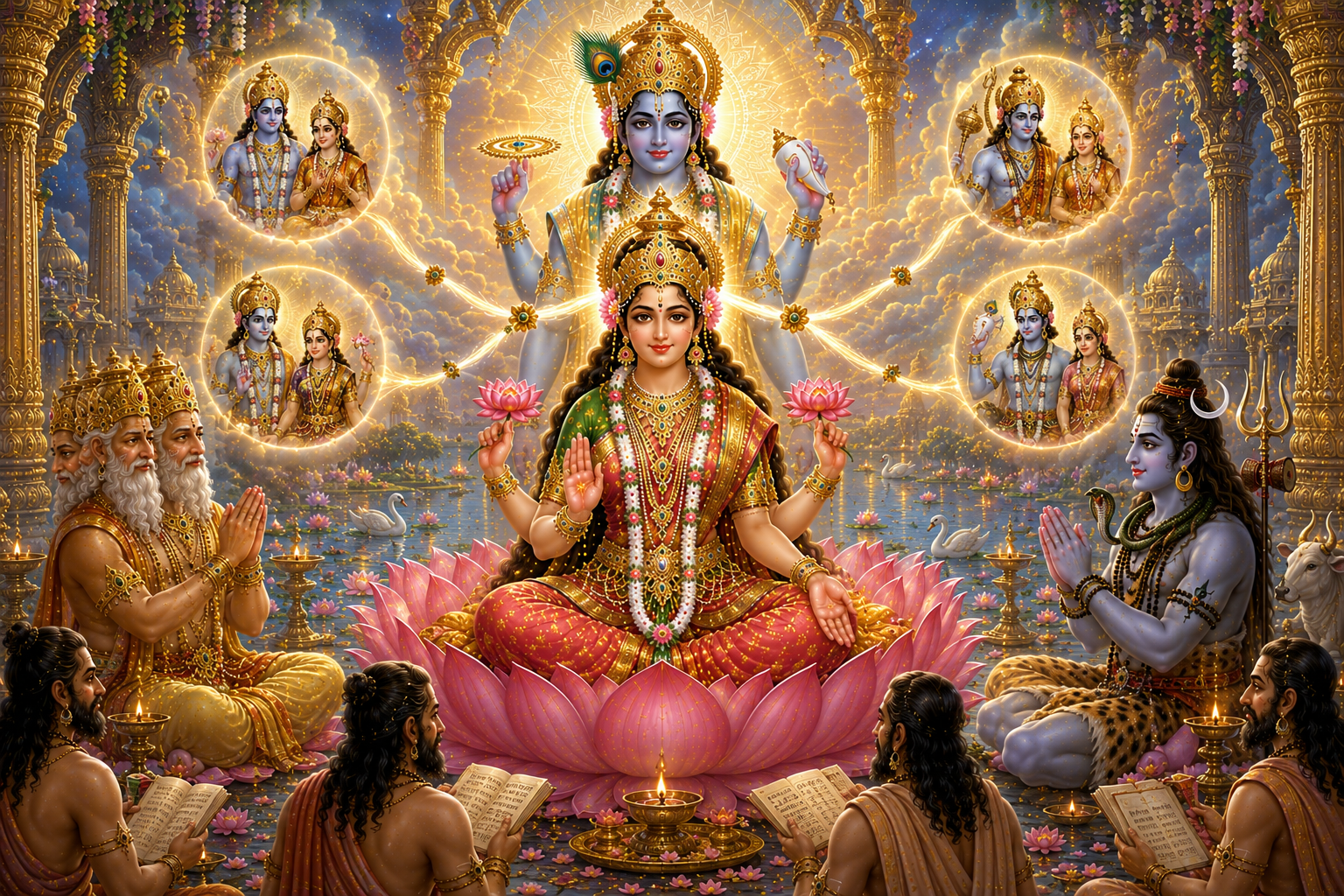
चतुः-कपर्दा या देवी चतुर-आस्य-आदिभिः स्तुता ।
चतुर्वेद-उदित-गुणा चतुर्मूर्तेः हरेः प्रिया ॥ १७ ॥
I worship that Goddess (या देवी), who has four braided tresses (चतुः-कपर्दा), who is praised (स्तुता) by the four-faced Brahma and others (चतुर-आस्य-आदिभिः), whose qualities are proclaimed (उदित-गुणा) by the four Vedas (चतुर्वेद), and who is beloved (प्रिया) of Lord Hari (हरेः) in His four-fold forms (चतुर्मूर्तेः).
Notes
• “चतुः-कपर्दा” the four arranged braids refer to the 4 streams of Vedas, which praise Her and Lord Narayana.
• “चतुर्मूर्ति” refers to the four primordial Vyuuha forms of the Lord distinct from Narayana, i.e. Vaasudeva, Sankarshana, Pradyumna, and Aniruddha, paired with Lakshmi’s corresponding forms of Maaya, Jayaa, Rati and Shanti.
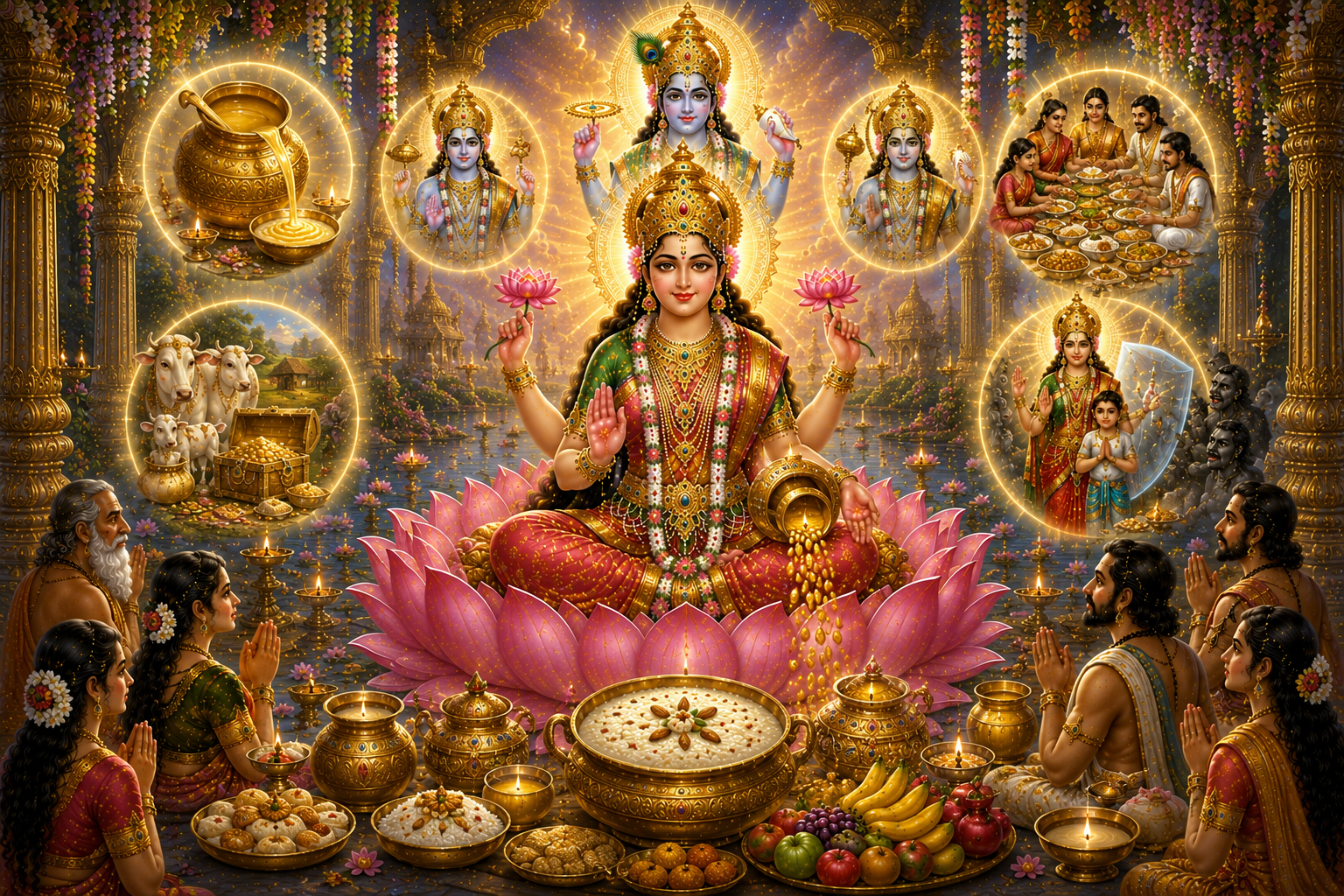
घृत-प्रतीकां तां नित्यं घृत-पूर्ण-अन्न-दायिनीम् ।
यथा-इष्ट-वित्त-दात्रीं च नतः अस्मि अभय-दां श्रियम् ॥ १८ ॥
I bow (नतः अस्मि) to that Goddess Lakshmi (श्रियम्), whose special presence in clarified butter makes it auspicious (घृत-प्रतीकां), who is the constant bestower of (नित्यं दायिनीम्) sumptuous food rich with ghee (घृत-पूर्ण-अन्न), the giver (दात्रीं) of desired wealth (यथा-इष्ट-वित्त), and fearlessness and protection (अभय-दाम्) [to her devotees].
• In Vedic symbolism, “घृत” (ghee) represents nourishment, brilliance, sacredness, prosperity, and clarity of intellect.
• Wealth here includes both material prosperity and spiritual wealth such as devotion and knowledge.
• “अभय-दा” signifies not merely worldly protection, but freedom from fear arising from samsaara, poverty, and spiritual downfall.
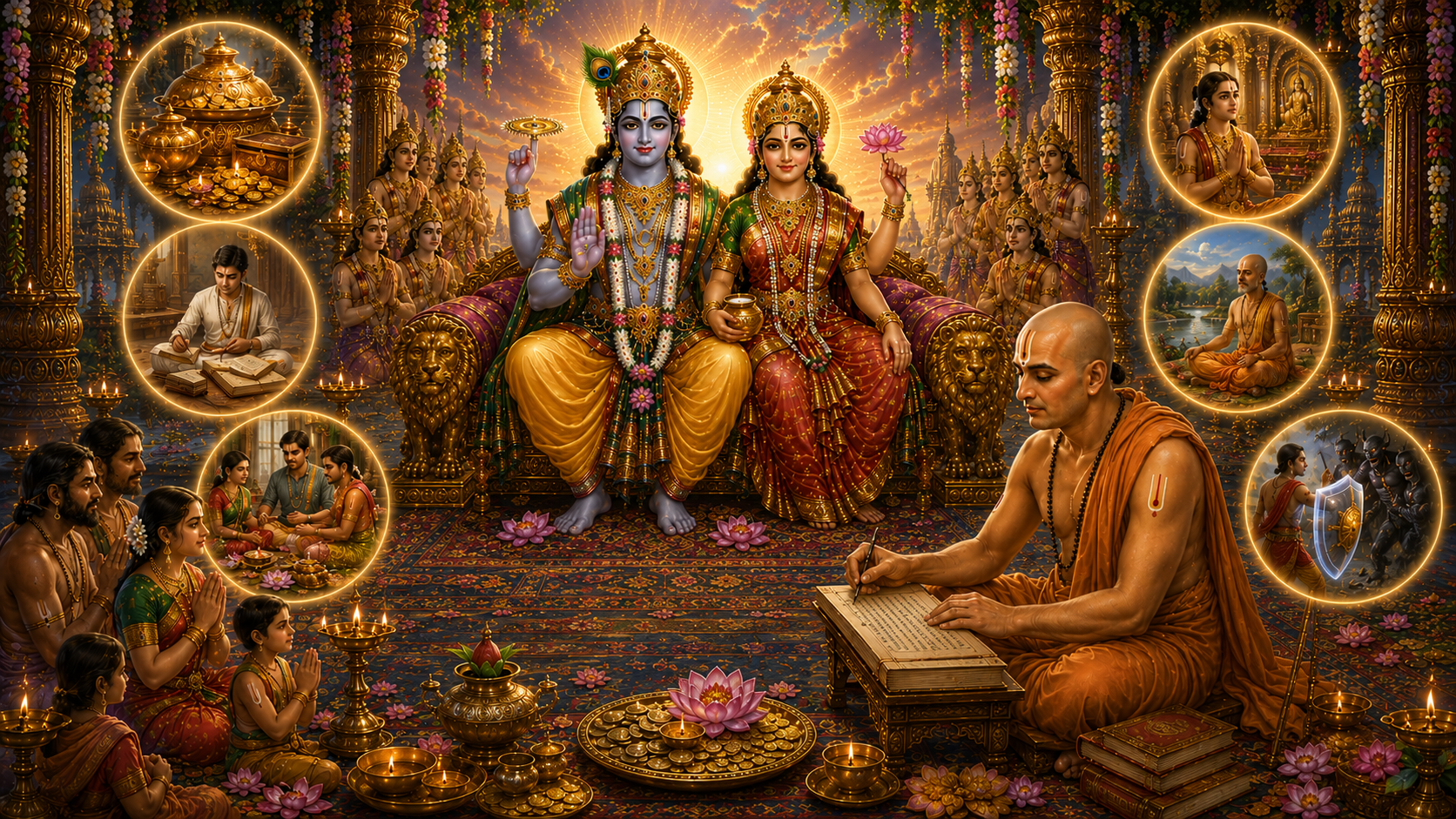
वादिराजेन रचितं श्री-श्रीश-गुण-दर्पणम् ।
इमं स्तवं पठन् मर्त्यः श्रीमान् स्यात् न अत्र संशयः ॥ १९ ॥
Any mortal (मर्त्यः), who recites (पठन्) this hymn of praise (इमं स्तवं), called the “Reflection of the Auspicious Qualities Lakshmi and Her Lord” (श्री-श्रीश-गुण-दर्पणम्) composed (रचितं) by Shri Vaadiraaja (वादिराजेन), shall become endowed with prosperity and auspicious wealth (श्रीमान् स्यात्); of this there is no doubt (न अत्र संशयः).
• “श्रीमान्” includes not only material prosperity, but also spiritual wealth, dignity, devotion, knowledge, and divine grace.
इति श्री-वादिराज-तीर्थ-श्री-चरण-विरचितं श्री-श्रीश-गुण-दर्पणम् ।
Thus ends the Shri-Shrisha-Guna-Darpana, composed by the revered Shri Vaadiraaja Teertha.
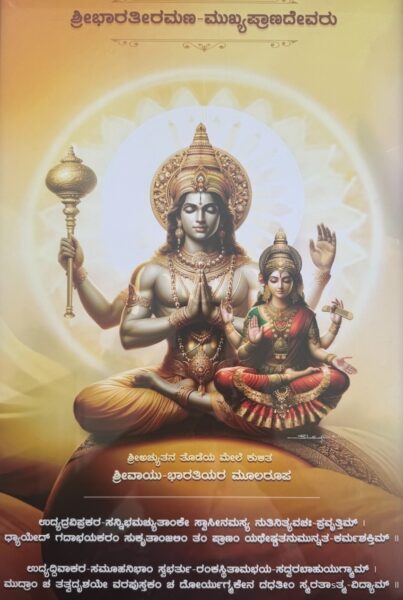
भारती-रमण-मुख्य-प्राण-अंतर्गत श्री-कृष्ण-अर्पणम् अस्तु ।
May this be an offering unto Shri Krishna, who resides within Mukhya Praana, the beloved of Bhaarati Devi.
श्रीश्रीशगुणदर्पणस्तॊत्रम् (For chanting)
या सुगन्धास्य-नासादि-नव-द्वाराऽखिलेन या ।
दुराधर्षा सर्व-सस्योदयार्थं वा करीषिणी ॥१॥
या नित्य-पुष्टा सर्वाङ्गैः सौन्दर्यादि-गुणैरपि ।
ईश्वरीं सर्व-भूतानां तामिहोपह्वये श्रियम् ॥२॥
मातर्लक्ष्मि नमस्-तुभ्यं माधव-प्रिय-भामिनि ।
युवां विश्वस्य पितराव्-इतरेतर-योगिनौ ॥३॥
समना किल मातस्-त्वम्-अमुना तद्-अयोगिनी ।
मम नाथेन नैव स्या विमनाश्-च न स त्वयि ॥४॥
त्वं वेद-मानिनी वेद-वेद्यः किल स ते प्रियः ।
त्वं मूल-प्रकृतिर्-देवी स दिव्य-पुरुषः किल ॥५॥
यस्-त्वाम्-उरसि धत्तेऽम्ब कौस्तुभ-द्युति-भासिते ।
स त्वां नैवाच्युतः सर्वस्यात्यये सत्यपि त्यजेत् ॥६॥
देवि त्वं ललना-रत्नं देवोऽसौ पुरुषोत्तमः ।
युवां युवानौ सततं युवयोर्-न वयोऽधिकः ॥७॥
त्वं पद्मिनी पद्म-वक्त्रा पद्माक्षी पद्म-विष्टरा ।
पद्म-द्वय-करा पद्म-कोशाभ-नस्तन-शोभना ॥८॥
पद्म-हस्ता पद्म-पादा पद्मनाभ-मनः-प्रिया ।
पद्मोद्भवस्य जननी पद्मा च वर-वर्णिनी ॥९॥
अम्बां पीताम्बर-श्रोणीं लम्बालक-लसन्-मुखीम् ।
बिम्बाधरोष्ठीं कस्तूरि-जम्बाल-तिलकां भजे ॥१०॥
रत्नोद्दीप्त-सुमाङ्गल्य-सूत्र-वृत्त-शिरोधराम् ।
कुण्डल-प्रभयोद्दण्ड-गण्ड-मण्डल-मण्डिताम् ॥११॥
कुच-कञ्चुक-सञ्चारि-हार-नीक-मनोहराम् ।
काञ्ची-किङ्किणि-मञ्जीर-कङ्कणाद्यैरलङ्कृताम् ॥१२॥
सुवर्ण-मण्डपे रत्न-चित्र-सिंहासनोत्तमे ।
नमामि हरिणा साकम्-इन्दिरां कृत-मन्दिराम् ॥१३॥
ब्रह्माद्या विबुध-श्रेष्ठा ब्रह्माण्याद्याः सुराङ्गनाः ।
यां पूजयन्ति सेवन्ते सा मां पातु रमा सदा ॥१४॥
सर्वालङ्कार-भरितौ सर्व-सद्गुण-मण्डितौ ।
शर्वादि-सर्व-भक्तौघ-सर्व-सम्पद्-विधायकौ ॥१५॥
सुमुखौ सुन्दरतरौ सुनासौ सुख-चित्तनू ।
सुराराधित-पादाब्जौ रमा-नारायणौ स्तुमः ॥१६॥
चतुष्कपर्दा या देवी चतुरास्यादिभिः स्तुता ।
चतुर्वेदोदित-गुणा चतुर्मूर्तेर्-हरेः प्रिया ॥१७॥
घृत-प्रतीकां तां नित्यं घृत-पूर्णान्न-दायिनीम् ।
यथेष्ट-वित्त-दात्रीं च नतोऽस्म्यभयदां श्रियम् ॥१८॥
वादिराजेन रचितं श्री-श्रीश-गुण-दर्पणम् ।
इमं स्तवं पठन्-मर्त्यः श्रीमान् स्यान्-नात्र संशयः ॥१९॥
इति श्री-वादिराज-तीर्थ-श्री-चरण-विरचितं
श्री-श्रीश-गुण-दर्पणम् ॥
भारती-रमण-मुख्य-प्राणान्तर्गत श्री-कृष्णार्पणमस्तु ॥

/Raghunath Rao/ “Do your Best … and leave the Rest … “
(All mistakes mine – all credit to references, pravachanas and online material)
|| sarvaṁ śrī kṛṣṇārpanamastu ||