About Kaaliya Mardana
The Story of Kaaliya Mardana
Kaaliya Mardana is in the Bhagavata (SMB 10.16) & Harivamsha (Vishnuparva 11.12).
Kaaliya was a ferocious multi-headed naaga (serpent) in the Ramanaka Dwipa of river Yamuna. He was one of the snakes born to Kashyapa and Kadru along with Shesha, Vasuki, Airavata, Thakshaka, Karkodaka, Maninaga, and Purananaga.
SMB Dashama Skanda says Kaaliya had 1000 heads (note: Shesha did not want to be associated with these naagas). Vinata, another wife of Kashyapa and was mother of Garuda. Vinata became a slave to Kadru loosing a bet to her. She was freed by Garuda using nectar (Amruta) brought from Devaloka. Garuda developed an enmity towards snakes and he began to kill them. The snakes appeased him by offering fruits of yagnas on special days. But Kaaliya did not, and instead fought with Garuda. He could not overcome Garuda rattled by his wings and out of fear escaped to Kalindi river where he was safe from Garuda. (Previously, Sage Saubhari was meditating on the banks of Kaalindi. Garuda, while catching fish, splashed water on the sage, who cursed him, saying that Garuda’s head would explode if he ever set foot there.) So while Kaaliya took refuge in the sweet waters of the Yamuna outside Vrindavan, his venom would boil the water and kill any living beings that came into the river.
One day, while Krishna was playing with his friends, the cows were struck dead by Kaaliya’s venom. Krishna then climbed a tree and jumped into the lake. Kaaliya coiled around him and attacked him, but Krishna escaped effortlessly. He then jumped onto Kaaliya’s head and began to perform his cosmic dance. The serpent started vomiting blood and was on the verge of being crushed to death. However, Kaaliya’s wives begged for forgiveness, and Krishna spared his life, instructing him to return to Ramanaka. Krishna also blessed Kaaliya, assuring him that Garuda, upon seeing Krishna’s footprints, would not harm him. This illustrates how Lord Krishna helps triumph over evil and protects his devotees. It also demonstrates the power of compassion and forgiveness, showcasing the divine qualities of Krishna.
About Kaaliya Mardana Patta Devaru
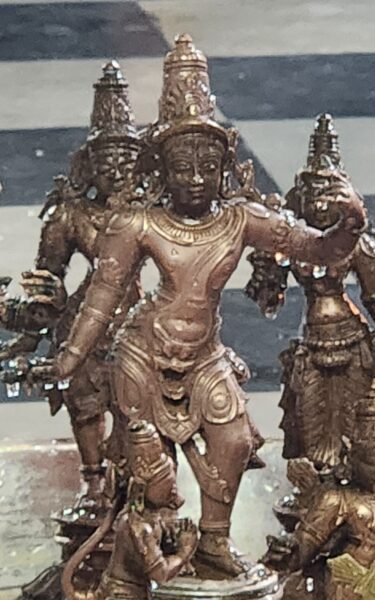
Kaaliyamardana is Lord Krishna who subdued the dreaded multi-headed serpent Kaaliya in the river Yamuna by dancing on his head. Shri Madhvacharya (1238 C.E.) was the proponent of the (dualistic) Dvaita or Tattvavaada philosophy that says Aatman/Jeeva are different from Paratma. He worshipped this Kaaliya Mardana idol and handed it over to his disciple Shri Narahari Teertharu.
This idol is the main deity of the Adamaru Matha and has been passed down through the lineage. This Rukmini Satyabhama sahita Chathurbhuja Kaaliyamardhana devaru depicts Lord Krishna dancing on Kaaliya’s head with his wives Rukmini and Satyabhama on either side.
The Kaaliya Mardhana Sloka
Shri Vadiraja Teertharu (1480 C.E.) is credited with giving impetus to the Haridasa movement with his own compositions. He was the chief pontiff of Sode matha and established the current two-year Paryaaya system in Udupi Krishna Matha. He composed the Kaaliya Mardhana sloka:
अनीनदत्पद्म-भवो मृदङ्गं जगौ हनूमान्जगताम्-धीशं।
अदर्शयत्ताल-गतीः कपर्दी ननर्त गोपालक-बाल-मौलिः ॥
anīnadat padma-bhavo mṛdaṅgaṁ jagau hanūmān jagatām-adhīśaṁ .
adarśayat tāla-gatīḥ kapardī nanarta gopālaka-bāla-mauliḥ ..
ಅನೀನದತ್ ಪದ್ಮ-ಭವೋಮೃದಂಗಂ ಜಗೌ ಹನೂಮಾನ್ ಜಗತಾಂ-ಅಧೀಶಂ ।
ಅದರ್ಶಯತ್ ತಾಲ-ಗತೀಃ ಕಪರ್ದೀ ನನರ್ತ ಗೋಪಾಲಕ-ಬಾಲ-ಮೌಲಿಃ ॥
Meaning of the Sloka: Brahma, the Lotus-born (पद्मभव), played (अनीनदत्) on the tonal drum (म्रिदन्गम्), and Hanuman sang (जगौ) about the Supreme Lord of the Universe (जगताम् अधीशं). Shiva, with matted hair (कपर्दि), revealed the cadence of rhythm (तालगतीः), to which Lord Gopalakrishna, the foremost gem (मौलि) among the cowherd boys (गोपालक बाल), danced (ननर्त) on Kaliya.
Taatparya (Interpretation) HH Eeshapriya Teertharu (Jr. Pontiff of Adamaru Matha)
Swamiji offers the interpretation of this sloka. He starts by quoting Shraddha Suktam.
Shraddha Suktam (Rigveda Samhita 10.151)
Shraddha Suktam emphasizes the significance of faith and devotion during rituals. It conveys that offerings made with Shraddha (faith) to the deities leads to blessings and prosperity.
श्र॒द्धया॒ग्निः समि॑ध्यते श्र॒द्धया॑ हूयते ह॒विः । श्र॒द्धां भग॑स्य मू॒र्धनि॒ वच॒सा वे॑दयामसि ॥ १०.१५१.०१
प्रि॒यं श्र॑द्धे॒ दद॑तः प्रि॒यं श्र॑द्धे॒ दिदा॑सतः । प्रि॒यं भो॒जेषु॒ यज्व॑स्वि॒दं म॑ उदि॒तं कृ॑धि ॥ १०.१५१.०२
यथा॑ दे॒वा असु॑रेषु श्र॒द्धामु॒ग्रेषु॑ चक्रि॒रे । ए॒वं भो॒जेषु॒ यज्व॑स्व॒स्माक॑मुदि॒तं कृ॑धि ॥ १०.१५१.०३
Quoted by Swamiji:
श्र॒द्धां दे॒वा यज॑माना वा॒युगो॑पा॒ उपा॑सते । श्र॒द्धां हृ॑द॒य्य१॒॑याकू॑त्या श्र॒द्धया॑ विन्दते॒ वसु॑ ॥ १०.१५१.०४
shraddhaM devaa yajamaana vayugoopa upaasathe । shraddhaM hrudaayaya kuutya shraddhayaa vindhate vasu ॥
The devatas and the performers of rituals, protected by the God Vayu, are worshiping Goddess Shraddha. All worship Goddess ShraddhaM with (devotional) intent in their heart. One gains true wealth through Shraddha.